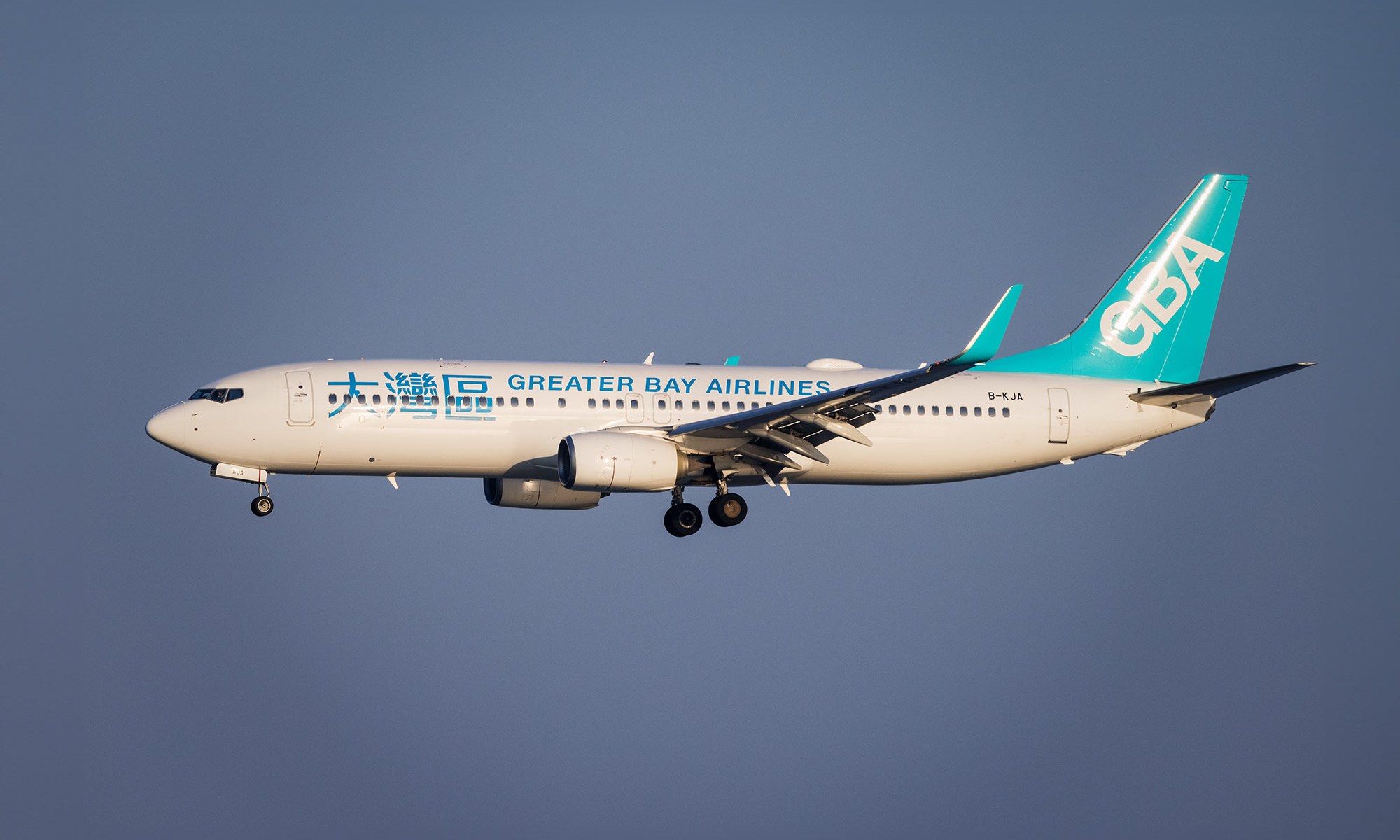

One of the newest carriers at Singapore Changi Airport has made the decision to cease its flights between the Lion City and Hong Kong, with the news that Greater Bay Airlines (GBA) will be pulling out of this key route on 31st May 2024, just 36 days after it launched these services
This will certainly go down as one of Changi’s shortest-lived airlines, with the low-cost carrier apparently quickly concluding it cannot break the stranglehold of Cathay Pacific, Scoot and Singapore Airlines on this route. That trio of carriers boasts 123 weekly flights in each direction, based on June 2024 schedules.
As we highlighted when this route was first announced, GBA was always set to struggle in the market against far better-known incumbent competitors like Cathay Pacific and SIA, given that it was charging at least S$360 for a round-trip ticket, while they were charging less on many dates.
Remaining schedule
GBA has been operating daily flights on its Singapore – Hong Kong route since launching the service 12 days ago, on 26th April 2024.
Here’s how the schedule was supposed to look, until the flights end on 31st May 2024, just over three weeks from now.
Greater Bay Airlines
Singapore Hong Kong
26th April 2024 – 31st May 2024
| Days | |||||||||
| M | T | W | T | F | S | S | |||
 |
HB258 737-800 |
||||||||
| SIN 14:45 |
HKG 18:45 |
||||||||
|
HB257 737-800 |
||||||||
| HKG 09:45 |
SIN 13:45 |
||||||||
However, the airline is already starting to trim its services, with up to two flight per week already cancelled between now and the end of the month, on the following dates:
- Thu 9th May
- Sat 11th May
- Tue 14th May
- Tue 21st May
- Thu 23rd May
- Tue 28th May
Update 9th May 2024: GBA has now provided the following statement in response to our request.
“Greater Bay Airlines (GBA) will suspend its scheduled service between Hong Kong and Singapore starting 1 June 2024 until further notice due to commercial reasons after considering the latest market situations. We deeply apologise for the inconvenience caused to our passengers.
Greater Bay Airlines
“To minimise the possible impact to passengers, we will directly contact our passengers to make flight protection, rebooking or refund arrangements, and all the associated fees will be waived.
“We would like to express our heartfelt thanks to all our passengers and stakeholders for their continued support to GBA. We will learn from the experience and strive to explore new potential destinations, enhance the service of existing routes and collaborate with travel agencies on charter business.”
Stiff competition
GBA faced stiff competition on the Singapore – Hong Kong route, with the following flights in the schedule from early June 2024:
- Cathay Pacific (63/wk)
- Scoot (18/wk)
- Singapore Airlines (42/wk)
This includes a recent reinstatement for Cathay Pacific’s daily Singapore – Bangkok – Hong Kong flights in late March.
Even with all these services, 123 weekly flights between Singapore and Hong Kong still only reaches 88% of the 139 on offer pre-COVID, based on June 2020 schedules, though this is a market that does seem to be struggling to recover to full pre-pandemic levels.

Qantas Group low-cost carrier Jetstar Asia has not made a return to the route, and Cathay-owned HK Express operation in the post-COVID period was also short-lived (though not as short as GBA’s!), operating between February 2022 and June 2023.
Fares
For the rest of May 2024 while this route is still operating, GBA is offering the following baseline pricing on nearly all its Singapore – Hong Kong flights:
- SIN-HKG: HKD580 + tax
- HKG-SIN: HKD320 + tax
Once mandatory taxes and fees are included, this brings the cheapest round-trip ticket, which is widely available across most dates, to HKD 2,334 (~S$405).
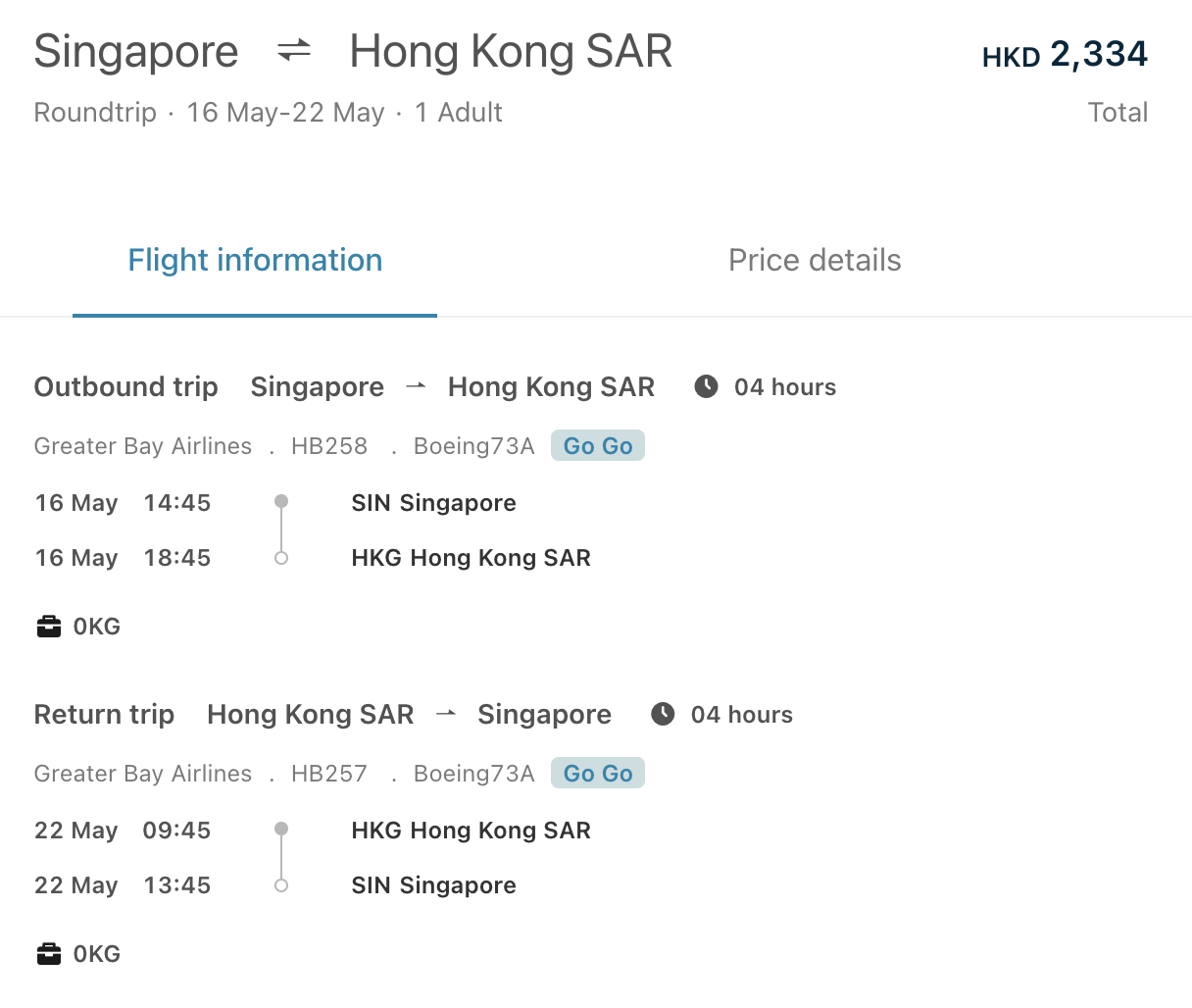
Note that GBA’s “Go Go” fares have no checked baggage allowance and are non-refundable and non-changeable, while seat selection is “paid or pot-luck”.
The airline also offers more expensive “Value Go” and “Flex Go” fare types, with greater inclusions for a higher price, or you can start with “Go Go” then pick and choose your bespoke preferred add-ons.
The problem here is that you can take Cathay Pacific in Economy Class on a “Light” fare including 23kg of checked baggage, complimentary meals and drinks for only S$322 round-trip this month, or a similar fare type on Singapore Airlines for S$318.
With both airlines offering full service and wide-body comfort on this route, who would pay more and choose GBA?
For those happy with a no-frills experience, Scoot’s round-trip fares on Hong Kong flights start at S$275 this month, a third less than GBA is charging.
GBA was offering limited-time promotional round-trip fares from HKD880 (S$153) including 20kg of checked baggage for Hong Kong-originating passengers when this route first launched, but that deal has since been discontinued.
About GBA
GBA launched mid-pandemic, a challenging time to start an airline in Hong Kong amid the SAR’s strict (and seemingly ever-changing) travel and movement restrictions.
The airline was founded by Bill Wong Cho-bau, owner of Shenzhen-based Donghai Airlines.
Using a leased former Norwegian Air Boeing 737-800, the carrier started charter services initially in November 2021, but then commenced scheduled flights with a regular passenger service between Hong Kong and Bangkok in July 2022.
Currently GBA operates flights between Hong Kong and Bangkok, Taipei, Seoul, Tokyo, Osaka, Singapore and Manila, using a fleet of eight Boeing 737-800 aircraft.
GBA already withdrew from the Vietnam market, with four times weekly flights between Hong Kong and Ho Chi Minh City axed in February this year, having operated since July 2023, and now Singapore joins that list, cutting the airline’s destination count to six cities from June 2024.
Big ambitions
Despite swiftly withdrawing from the Singapore market, GBA remains an airline with significant growth aspirations for the future.
In March 2023, the airline confirmed orders for 15 brand new Boeing 737 MAX 9 aircraft, which the carrier says will form the backbone of its fleet, allowing “more flights between Hong Kong and major cities in Asia and Mainland China”.

This will also see the airline shift from a single-class service, with the introduction of Business Class, while the aircraft will also boast Wi-Fi entertainment and satellite internet access. The exact cabin layout and seat products have not yet been revealed.
These MAX 9 aircraft are due to be delivered between mid-2024 and 2027.
Part of the order deal with Boeing also included “commitments” for five Boeing 787 Dreamliner aircraft, though the variant is not specified and any potential firm order and introduction timeline will be based on the carrier’s future planning for long-haul services, which GBA calls a “mid- to long-term plan”.


Summary
It’s sad to see a new travel option between Singapore and Hong Kong removed from the list later this month, with a surprisingly short stint on this route by newcomer Greater Bay Airlines, a low-cost carrier with big ambitions for the future including Business Class cabins and wide-body aircraft.
Unfortunately the fares on this competitive city pair never seemed to be set aggressively enough to woo customers over from the better-known incumbents, including Cathay Pacific and Singapore Airlines, both of whom offer a full service model in Economy Class.
(Cover Photo: Kevin Chung)
Strange to see them trying to compete with full-service carriers on these routes: after the void of KA there are so many unfulfilled destinations in mainland CN, SEA, and JP/KR that they could serve but they always choose to face big players heads on. They will not be dearly missed though.
Not surprised. There is way too much supply on SINHKG route even though it’s not close to pre Covid. Cathay is cancelling flights e.g. some dates in May only 4 operating not the full 9. This was never going to work for Greater Bay.
Travelers have choices and will be wise to fly with full service airlines and avoid all the uncertainties using budget airlines. With all the add-ons being charged, and minimal, if non existence service in budget airlines, probably not worth the savings.
What savings? They can be just as expensive, if not more so, if one needs certain sets of services.