

Singapore Airlines first started operating its own aircraft to and from Busan in South Korea back in late October 2019, taking over from SilkAir ahead of the latter’s full merger into the mainline operation, a transition that also saw the four-times-weekly service upgraded from a 162-seat Boeing 737-800 to a 285-seat Airbus A330-300.
The route, like many others, was suspended in March 2020 due to the COVID-19 pandemic, but it resumed in August 2023 – this time operated by Singapore Airlines’ smaller 154-seat Boeing 737-8 MAX aircraft.
Now there’s news that the four times weekly service is set for a hike, increasing to six times weekly from 26th October 2025, before upgrading to daily flights from 1st February 2026.
That represents a 75% frequency and capacity increase for the airline to South Korea’s second largest city, an important financial, R&D and MICE event location, but perhaps top of the list for many of our readers – home to some of South Korea’s best beaches.
The schedule
Here’s how SIA’s Singapore – Busan flight schedule looks between now and the end of the northern summer season in late October 2025.
Singapore Airlines
Singapore ⇄ Busan Schedule
Now – 25th October 2025
| Days | |||||||||
| M | T | W | T | F | S | S | |||
 |
SQ616 737-8 MAX |
||||||||
| SIN 23:05 |
PUS 06:20* |
||||||||
| Duration: 06:15 | |||||||||
|
SQ615 737-8 MAX |
||||||||
| PUS 07:40 |
SIN 13:10 |
||||||||
| Duration: 06:30 | |||||||||
* Next day
Minor timing differences until 30th March 2025
Service then hikes to six times weekly from the start of the northern winter season on 26th October 2025, with only Sundays not seeing a Singapore – Busan flight and consequently Mondays lacking a service in the return direction.
Singapore Airlines
Singapore ⇄ Busan Schedule
26th October 2025 – 31st January 2026
| Days | |||||||||
| M | T | W | T | F | S | S | |||
|
SQ616 737-8 MAX |
||||||||
| SIN 23:30 |
PUS 06:35* |
||||||||
| Duration: 06:05 | |||||||||
|
SQ615 737-8 MAX |
||||||||
| PUS 07:45 |
SIN 13:35 |
||||||||
| Duration: 06:50 | |||||||||
* Next day
Finally from 1st February next year, operation on this route increases to daily, a 75% capacity and frequency increase compared to the current schedule.
Singapore Airlines
Singapore ⇄ Busan Schedule
From 1st February 2026
| Days | |||||||||
| M | T | W | T | F | S | S | |||
|
SQ616 737-8 MAX |
||||||||
| SIN 23:30 |
PUS 06:35* |
||||||||
| Duration: 06:05 | |||||||||
|
SQ615 737-8 MAX |
||||||||
| PUS 07:45 |
SIN 13:35 |
||||||||
| Duration: 06:50 | |||||||||
* Next day
This also brings capacity almost back to pre-COVID levels on the route, with 1,078 seats in each direction per week, compared to 1,140 seats per week when the A330s were operating on the current four times weekly schedule.
SIA competes with Jeju Air on the Singapore – Busan route, with the latter carrier offering daily Boeing 737-800 flights on the route.

(Photo: Shutterstock)
SIA’s 737 MAX cabin products
Singapore Airlines’ Boeing 737-8 MAX jets feature the carrier’s latest 2021 narrow-body cabin products, including a flat-bed seat in Business Class, two “throne” seat options, and an upgraded experience in Economy Class, including seat-back in-flight entertainment.
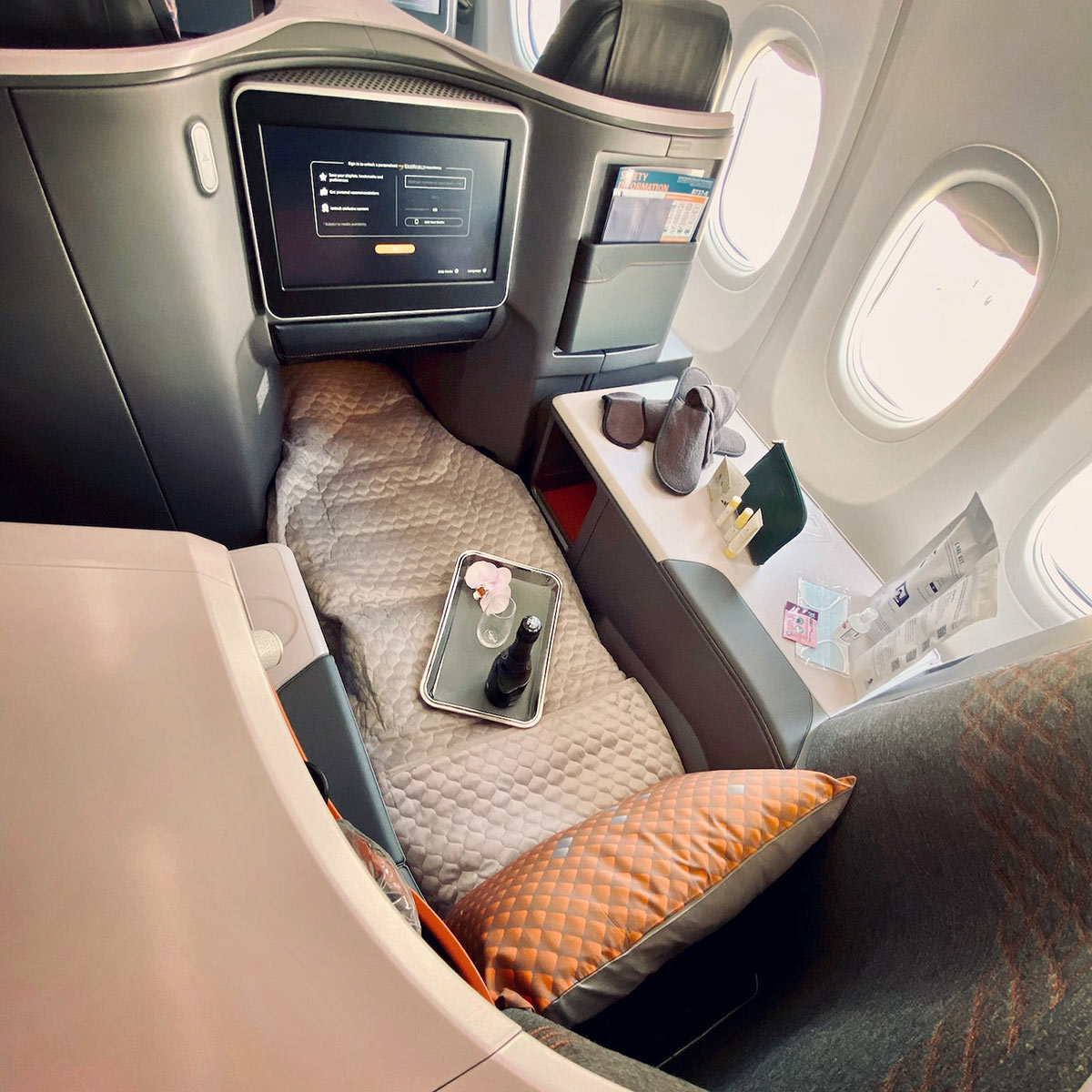
(Photo: MainlyMiles)
Wi-Fi is also available in both cabins, with an unlimited free allowance now offered for Business Class passengers and KrisFlyer members travelling in Economy Class.
These aircraft also benefit from SIA’s Live TV service, allowing you to catch up on the latest news or watch a live sporting event while you’re flying.

(Image: aeroLOPA)
Here are our dedicated articles covering the new cabins, to help you know what to expect on board the airline’s Busan flights.
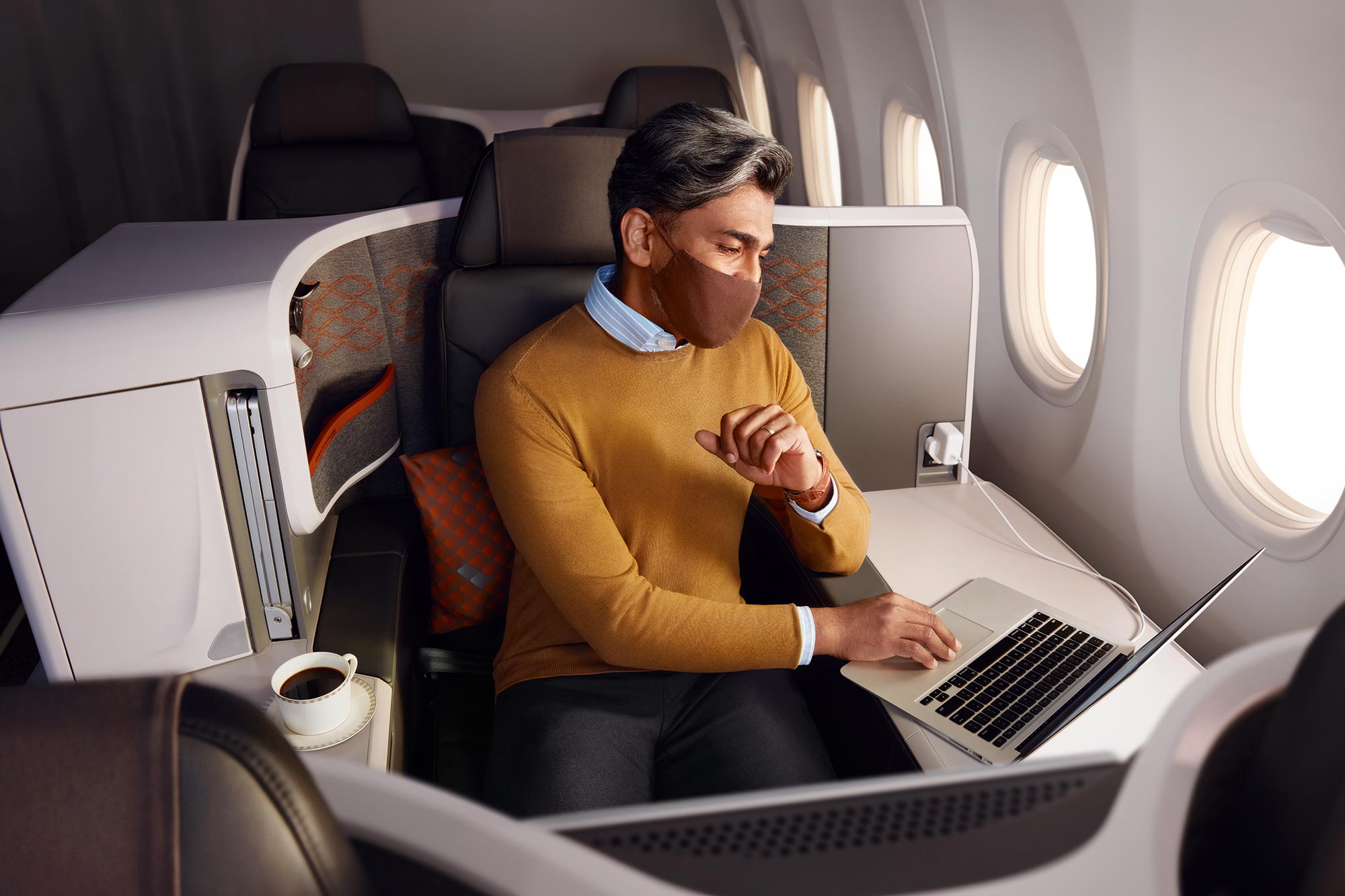
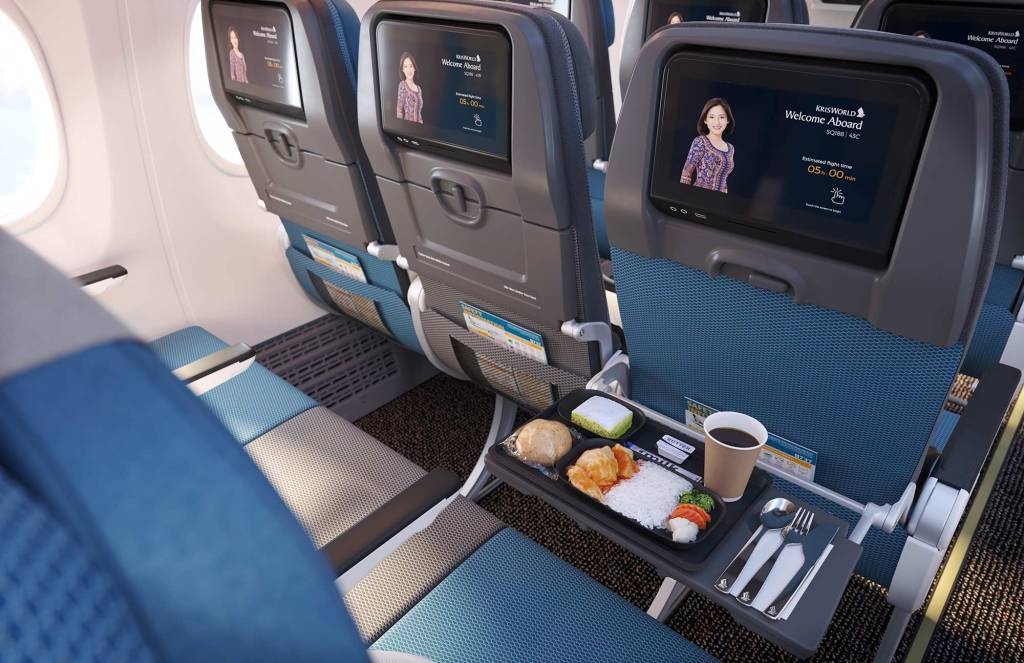
Do bear in mind that you’ll get a better experience in both cabins on SIA’s larger aircraft compared to the 737 MAX, like on the Airbus A350 Medium Haul and Boeing 787-10 aircraft being used to and from nearby Seoul.
The differences here include direct aisle access in Business Class with a wider seat, while in Economy Class there’s more legroom and recline, plus AC charging sockets, on the wide-body jets.
This may not make a huge difference on shorter routes, but with these Busan flights clocking in at over 6 hours, the differences are certainly worth noting when you have the alternative choice of heading to Seoul instead.
KrisFlyer redemptions
Here are the KrisFlyer award rates for the Singapore – Busan route, which match those for nearby Seoul services.

| KrisFlyer Award Pricing Singapore ⇄ Busan |
||
| Saver | Advantage | |
| Economy | 27,000 | 45,000 |
| Business | 52,000 | 70,000 |
If you already hold or intend to book a firm ticket in an eligible Economy booking class, here’s how many miles it will then cost you to upgrade to Business Class, assuming Saver upgrade award availability.
| Upgrade using KrisFlyer miles Singapore ⇄ Busan |
|
| Upgrading to → | 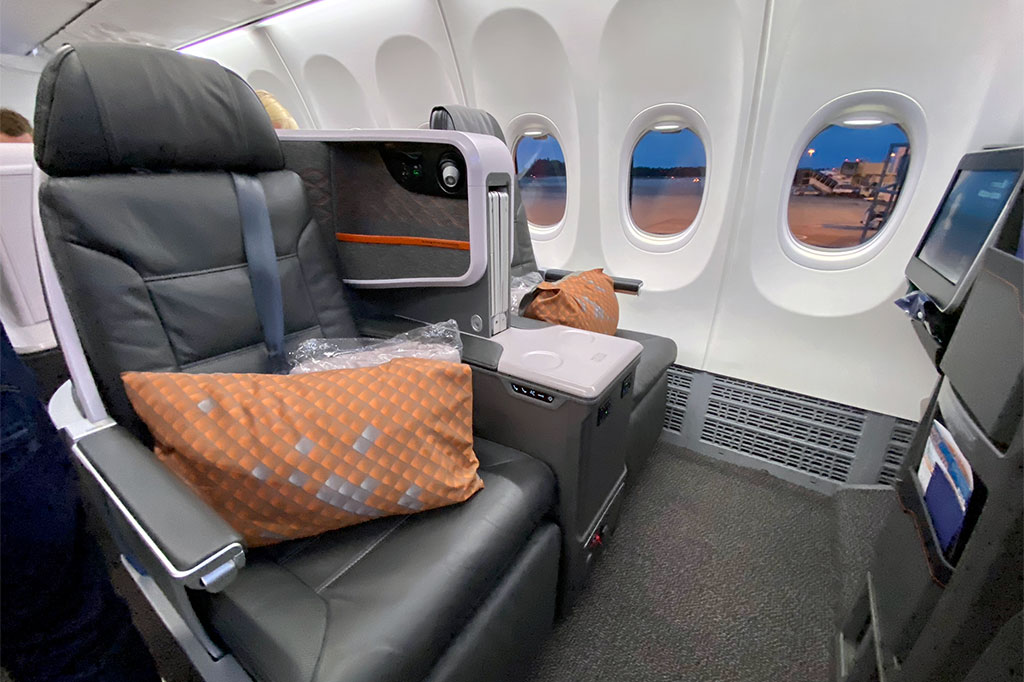 Business |
| Existing booking ↓ | |
| Economy Standard (Class: M, H, W) |
42,500 |
| Economy Flexi (Class: Y, B, E) |
32,000 |
As usual, upgrading with miles is not a great deal, unless your company is paying for an Economy Flexi fare.
Award space is quite generous for travel this winter, with up to two Business Class Saver redemptions available on many dates.
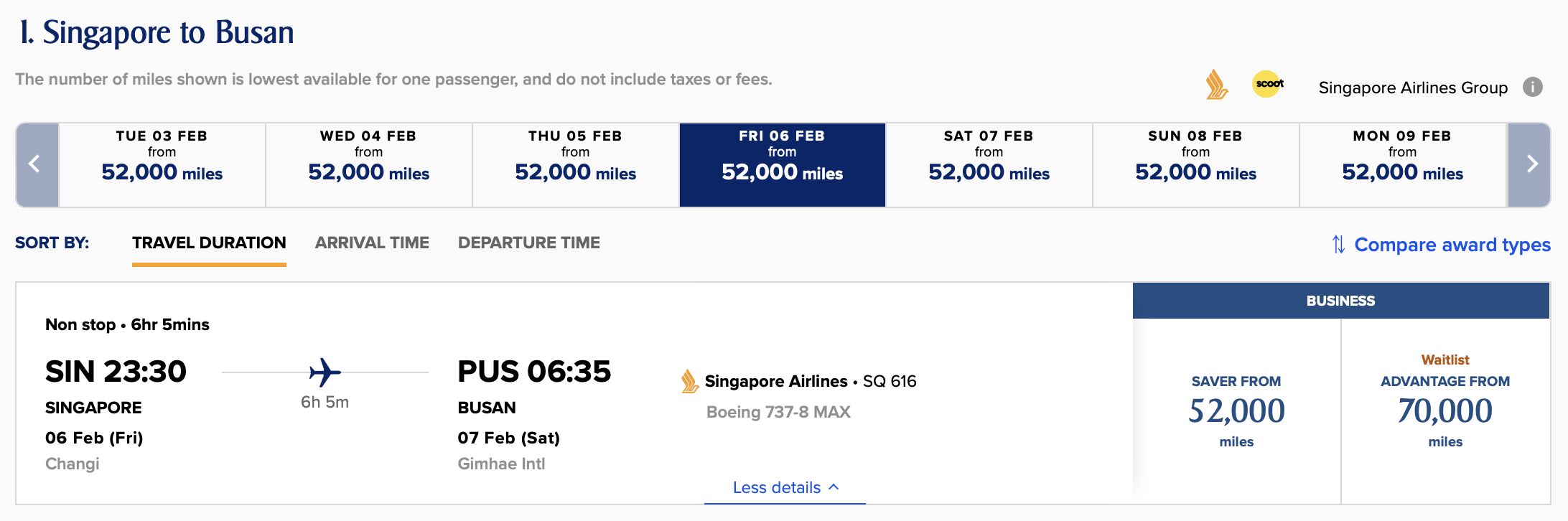
Award space is dynamic and additional seats can be added closer to the departure date, so keep checking if you’re looking to redeem KrisFlyer miles to or from Busan, especially in the coming months.
Singaporeans don’t need an ETA to visit South Korea
South Korea recently extended its K-ETA waiver for Singaporean visitors, along with those holding 21 other nationalities including those with passports issued in Australia, Germany, the USA, and the UK.
That means for arrivals from now until 31st December 2025, you can avoid both the application process and the 10,000 KRW (~S$10) application fee per person, for tourist trips to the country.

(Photo: Shutterstock)
Only a paper arrival card or an e-Arrival card need to be submitted in this case.


Summary
Singapore Airlines will increase its Busan service from four to six times weekly in October 2025, then further to daily flights from February 2026, ultimately representing a 75% capacity increase to South Korea’s second largest city.
The route will continue to be operated by Boeing 737-8 MAX aircraft, offering flat-bed Business Class, free Wi-Fi and Live TV service.
This expansion brings total seat capacity closer to pre-pandemic levels, when larger Airbus A330s were used on the route, and increases competition with Jeju Air, who already operate daily flights between the two cities.
(Cover Photo: CJ Nattanai / Shutterstock)
Thanks always for the great insights, Andrew!
I checked the Korean airport statistics and found that the load factor on the Busan–Singapore route consistently exceeds 95% on average.
It seems like strong demand from both directions has led to the route being upgraded to daily service.
Do you think there’s a chance Singapore Airlines might upgauge the aircraft to a 787-10 by 2026, instead of operating the 737 MAX 8?
Cities similar in size to Busan, like Fukuoka and Nagoya, are already served by the 787-10.