


If you’re planning a trip to Indonesia, particularly to Bali, Jakarta, or Surabaya, there’s a new mandatory requirement you’ll need to complete before arrival. Indonesia has launched its unified “All Indonesia” Digital Arrival Card, streamlining multiple entry procedures into a single digital form.
The system launched on 1st September 2025 at three major airports and will become mandatory at all international airports across Indonesia from 1st October 2025, with sea and land border crossings following suit.
Here’s everything you need to know about Indonesia’s new digital entry requirements.
What is the “All Indonesia” arrival card?
Indonesia’s new digital portal consolidates what were previously separate processes – immigration, customs, and health declarations – into a single streamlined form. This replaces multiple standalone systems including SATUSEHAT (health declaration) and e-CD (customs declaration) forms.

The system mirrors similar digital initiatives introduced by other Southeast Asian countries, following Thailand’s recent launch of its Digital Arrival Card (TDAC) in May 2025, and existing systems in Singapore (SGAC) and Malaysia (MDAC).
Key points to note about the “All Indonesia” system include:
- Free of charge: No fees are involved in completing the digital form
- Quick completion: Takes approximately three minutes
- Advance submission: Can be completed on the day of arrival, or up to two days before
- QR code generation: Provides a digital QR code for scanning at checkpoints
- Mandatory at eligible airports: Currently required at Jakarta (CGK), Bali (DPS), and Surabaya (SUB), expanding to all international airports from 1st October 2025
How to complete the All Indonesia arrival card
You should complete the All Indonesia card before arriving in Indonesia via the official portal:
There is also a mobile app for Apple and Google devices.
You’ll need to select whether you are an Indonesian Citizen or a Foreign Visitor in order to start the process.
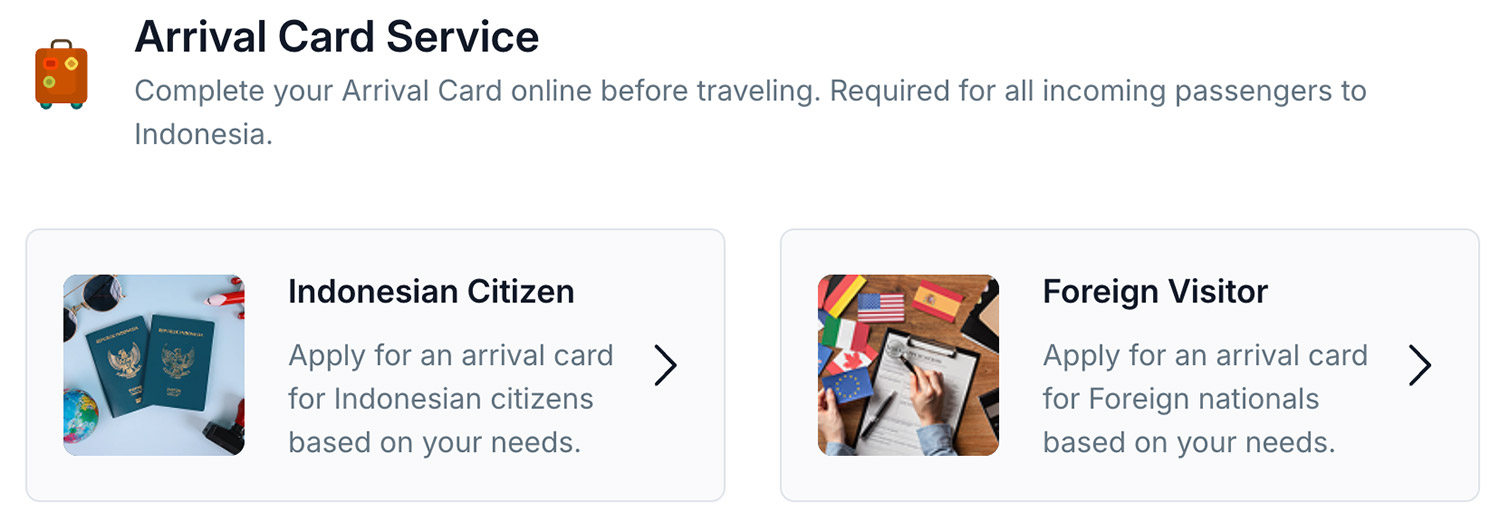
While it remains unclear whether airlines are verifying the All Indonesia completion at check-in, you are strongly advised to submit your Arrival Card before departure, to avoid potential issues at the origin airport or on arrival in Indonesia.
Step 1: Visit the official portal at allindonesia.imigrasi.go.id
Step 2: Select “English” and “Foreign Visitor”
Step 3: Complete the required information across several sections:
- Personal details (or scan your passport’s Machine-Readable Zone (MRZ), to save time)
- Travel information including your accommodation address in Indonesia
- Health & Customs declarations
Step 4: Submit the completed form
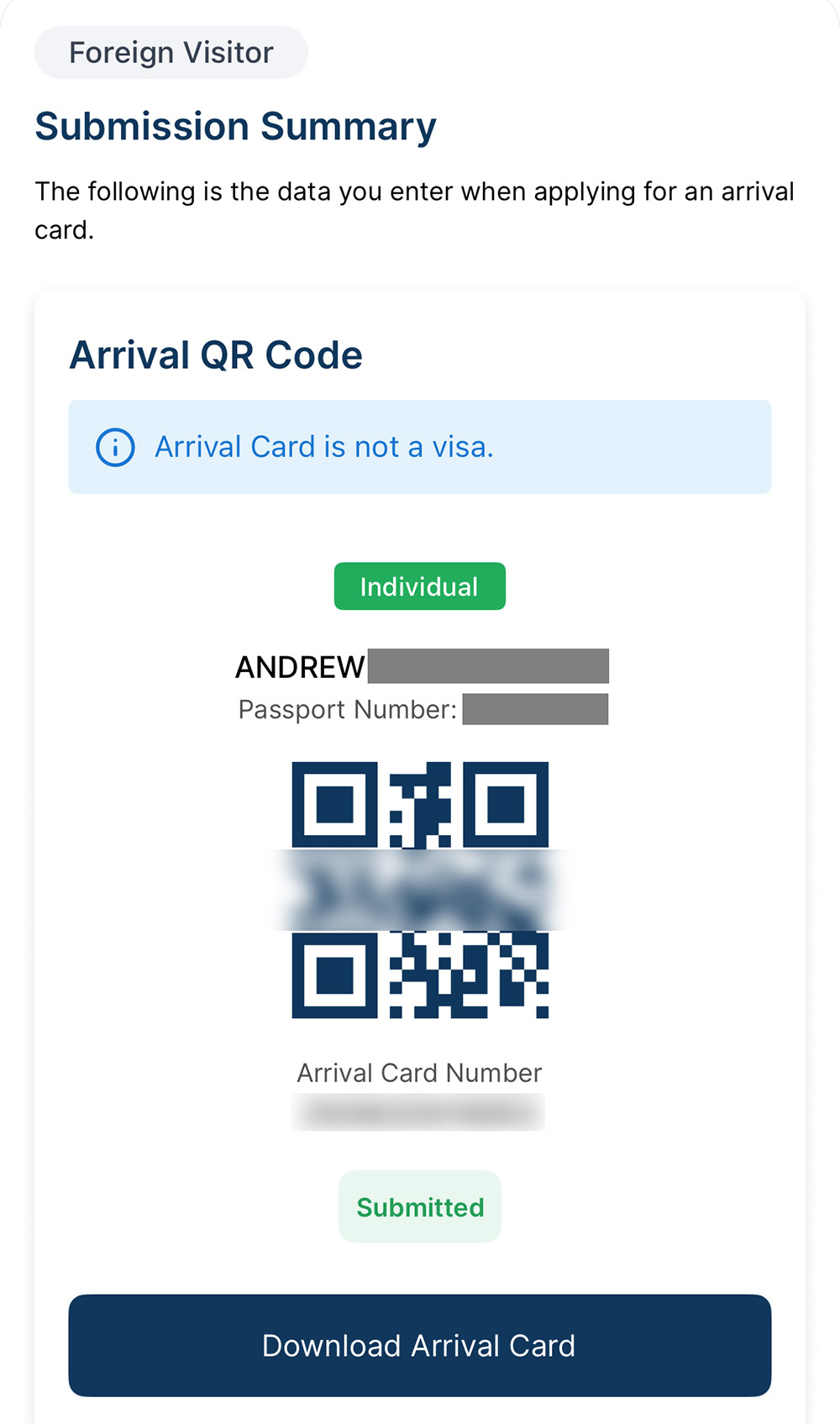
Step 5: Receive your QR code via email
Step 6: Present the QR code (printed, or on your device) along with your passport upon arrival
We recommend saving the QR code to your smartphone, but you can also consider printing a backup copy to take along with you – handy if your phone battery dies in the arrivals queue!
I completed the All Indonesia form yesterday via the Apple app for an upcoming trip, and the process was simple with the QR code then available in-app, with option to save to your device’s camera roll, plus also sent by email.
Who needs to complete the form?
The All Indonesia Arrival Card is now mandatory for:
- All foreign visitors arriving at selected airports (currently Jakarta, Bali, and Surabaya) and sea ports (currently Batam), regardless of visa status
- All Indonesian citizens returning home (unlike some other countries’ systems)
Implementation timeline
The rollout for the All Indonesia arrival card will follow a phased approach:
- From 1st September 2025: System launched at Jakarta (CGK), Bali (DPS), and Surabaya (SUB)
- From 1st October 2025: Mandatory at all international airports including Komodo, Lombok, Makassar, Manado, Medan, and Yogyakarta
- From 1st October 2025: Extension to sea and land border posts, including Benoa (Bali) and Bintan
Important: All Indonesia is not a visa
It’s important to understand that the All Indonesia Arrival Card does not replace visa requirements. This is purely a digital entry declaration combining immigration, customs, and health procedures.
While Singapore Citizens and those holding other ASEAN nationalities can enter Indonesia visa-free for tourist visits of up to 30 days, others may require a full visa, Visa on Arrival, or e-VoA.

(Photo: Amarterra Villa)
The All Indonesia Arrival Card is a separate mandatory requirement, even if you’re visa-exempt or already hold a valid visa.
Those with 87 nationalities can opt for a Visa on Arrival (VoA) at a cost of IDR 500,000 (~S$45). This can be obtained at the airport, but we recommend doing so in advance via the e-VoA system.


A VoA allows a 30-day stay, extendable to 60 days. Singaporeans and ASEAN citizens can also opt for a VoA if they want the flexibility of a longer visit, since the 30-day visa-free entry mentioned above cannot be extended.
Bali tourism tax
Do note that since 14th February 2024, all international visitors to Bali, including children, are also subject to the Bali Tourism Levy, a mandatory fee of IDR 150,000 (approximately $12 SGD) per person. You can pay this tax ahead of your trip via this website, or at the airport on arrival.
Summary
Indonesia’s “All Indonesia” Digital Arrival Card represents a partial streamlining of the country’s entry procedures.
While it remains another step in your pre-travel preparation, the system is designed to save time at the airport and replaces at least two electronic forms that previously needed to be completed anyway, either in advance or on arrival.
Key points to remember:
- Complete the form up to two days before travel via allindonesia.imigrasi.go.id, or the mobile app
- This is mandatory at participating airports and ports, but does not replace visa requirements
- Takes under three minutes to complete, and is free
- Save your QR code electronically and consider printing a backup
- Mandatory at all entry ports from 1st October 2025
One notable oversight in the system is that it doesn’t allow simultaneous application for electronic visa-on-arrival, requiring travellers who need a VoA to complete that process separately.
The digitisation of arrival procedures is becoming the norm across Southeast Asia, and Indonesia’s latest approach – with one form combining immigration, customs, and health declarations – is the latest example, though it does mean one more thing to remember before you travel.
(Cover Photo: Shutterstock)
And yet Australia still requires paper landing cards. What a backwards country.