


Singapore Airlines has confirmed it will adopt Low Earth Orbit (LEO) satellite connectivity to enhance the in-flight Wi-Fi experience for passengers, joining a growing roster of premium carriers making this significant upgrade to the equivalent of home broadband speeds, gate-to-gate.
“We will adopt Low Earth Orbit (LEO) satellite connectivity to further enhance in-flight Wi-Fi experience,” the airline stated in its half-year trading update this week.
It’s an announcement many would say is overdue, with a raft of major airlines already either installing this new technology, or committing to it in recent years.
SIA joins the likes of Qatar Airways and United Airlines as it moves forward with this technology, which offers speeds over 10 times faster than the airline’s current Ku-band and Ka-band installations, with a fraction of the latency (delay).
Likely Starlink installation
While SIA hasn’t officially named its provider, the smart money is on Starlink, given the system’s dominance among recent carrier adoptions. Qatar Airways, Air France, SAS and United Airlines are among those who have chosen Elon Musk’s satellite constellation for their fleets.

Most recently, British Airways and Iberia have also signed up for Starlink, with a fleet-wide installation planned.

(Photo: Robin Guess)
It’s great to see Singapore Airlines keeping pace with its premium competitors here, with this latest confirmation, and while there are some other LEO alternatives to Starlink including OneWeb by Panasonic and Amazon Project Kuiper (now Amazon Leo), our prediction is Starlink as the likely provider in common with other major airlines.
A genuine game-changer
LEO satellite technology represents a quantum leap over traditional in-flight connectivity.
Once installed on SIA’s fleet, passengers can expect:
- Home or office broadband speeds – finally, fully usable internet at 40,000 feet
- Gate-to-gate connectivity – no more waiting until cruise altitude to get online
- HD video streaming – YouTube, Netflix, and other services work seamlessly
- Live video calls – Teams, Zoom, and FaceTime are all viable
Qatar Airways’ experience with Starlink demonstrates the technology’s capability. The airline has already equipped its entire Boeing 777 fleet and is progressively rolling out installations across its Airbus A350s, targeting completion by 2026.

(Photo: Head for Points)
Real-world speed tests from Qatar’s system show genuinely impressive performance.
SIA’s expected rollout
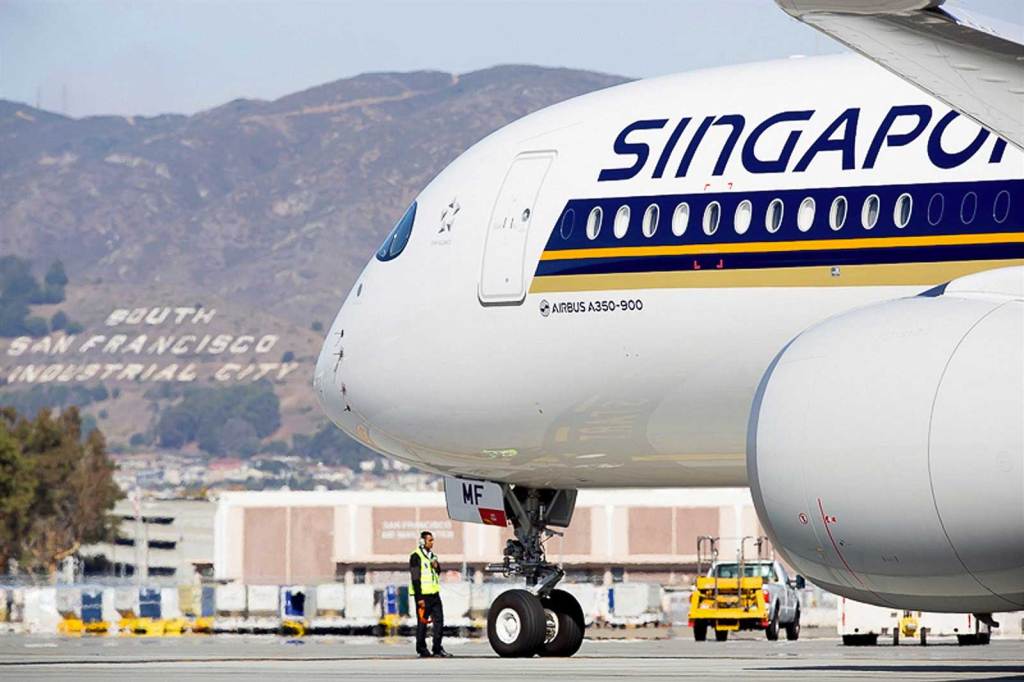
Singapore Airlines hasn’t formally announced which aircraft will be installed with fast LEO Wi-Fi systems at the time of writing, but logically we anticipate the following implementation:
- Airbus A350-900 Long Haul and A350-900 ULR aircraft: With cabin retrofits rolling out from Q2 2026
- Boeing 777-9 aircraft: Factory-fresh installations from 2027 onwards (pending Boeing’s delivery schedule)
(Photo: Singapore Airlines)
Singapore Airlines was the first airline in the world to adopt GX Aviation Ka-band Wi-Fi on its Airbus A380s, currently its fastest system also installed on some other aircraft types in the fleet, but its capabilities are hugely eclipsed by the speeds LEO Wi-Fi systems like Starlink now offer.
What makes LEO Wi-Fi like Starlink faster?
LEO connectivity provided by the likes of Starlink uses a network of Low Earth Orbit satellites, which sit at around 550km altitude, compared to more typical geostationary satellites, like Inmarsat’s, that sit almost 36,000km above the earth.

This allows for faster speeds and much lower latency (delay), compared to the satellite Wi-Fi connections we are currently used to on board Singapore Airlines’ current fleet.
Most satellite internet services come from single geostationary satellites that orbit the planet at 35,786 km.
Starlink
As a result, the round trip data time between the user and satellite—also known as latency—is high, making it nearly impossible to support streaming, online gaming, video calls or other high data rate activities.
Starlink is a constellation of thousands of satellites that orbit the planet much closer to Earth, at about 550km, and cover the entire globe. Because Starlink satellites are in a low orbit, latency is significantly lower—around 25 ms vs 600+ ms.
The latency is the ‘ping’ time you see when doing an internet connection speed test, and it sure does come in at around 600ms when we’ve done so on most of our flights using more traditional satellite connections (even 900ms is not uncommon).
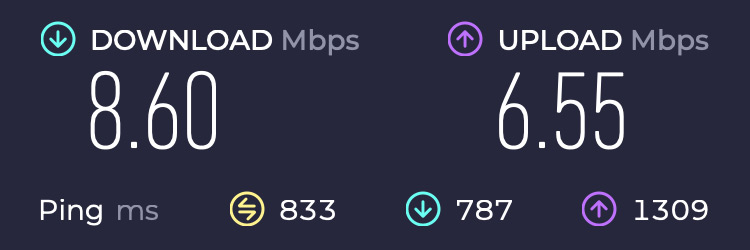
Starlink is now installed on all 42 of Hawaiian Airlines’ Airbus A321 and Airbus A330 aircraft, and this recent detailed review gave the free service high praise, with ping times of 36ms to 124ms, a fraction of the current norm on most carriers.
Rapid installation is possible
One encouraging detail from Qatar’s experience: Starlink installation can take as little as two days to fully install and test the system, according to details obtained by Head for Points.
This efficiency could allow Singapore Airlines to retrofit existing aircraft relatively quickly during scheduled maintenance windows, potentially accelerating the rollout beyond our initial expectations over the coming years.
SIA’s current Wi-Fi offering
Singapore Airlines already offers free unlimited in-flight Wi-Fi across its entire fleet, thanks to the recent retirement of the Boeing 737-800s, for First and Business Class passengers plus travellers in Premium Economy and Economy Class who are KrisFlyer members.
However, this is still currently the slower Ku-band or Ka-band Wi-Fi, typically capable of 4-9 Mbps depending on the system type, number of concurrent users and geographical location.
‘Ping’ times or latency (delay) is also significant with these older installations, which is what makes browsing sometimes feel like ‘slow motion’ to the end user. Check out our full guide to the airline’s existing offering.


Summary
Singapore Airlines’ confirmation that it will adopt LEO satellite connectivity marks one of the most significant upgrades to the in-flight connectivity experience in recent years, promising a step-change from today’s Ku- and Ka-band systems.
While the carrier has yet to formally name its provider, Starlink remains by far the most likely candidate, given its rapidly expanding footprint across major global airlines and the real-world performance it has demonstrated.
The shift to LEO will finally unlock genuinely home-broadband-class speeds on SIA flights, with low latency enabling everything from seamless HD streaming to reliable video calls, capabilities that are currently out of reach on the airline’s existing systems.
Rollout timelines are still to be confirmed, but installation pace observed at other airlines suggests that once the programme begins, retrofits could progress quickly across the fleet.
Long-haul Airbus A350s are the logical starting point, as they roll into the hangar for refits from early 2026, while the upcoming Boeing 777-9s will almost inevitably arrive factory-fitted.
(Cover Photo: Ross Parmly)
Finally. So many times, wifi can’t work at all. It has been the worst experience ever, especially for a company like SQ. Hopefully they will share which aircraft will have it.
Long overdue. Definitely a welcomed change for a premium airline such as SIA.
The ability to do video calls will be a game changer, adding to more pluses for SIA! No real need to turn to other airlines.
Could be a way for SQ to monetize by providing free the current service standard, at least in Y. And charging for better.
SIA need to buck up as more Asian airlines have already announced to join Starlink Internet. Latest being Korean Air and Hanjin Group airlines Asiana Airlines, Jin Air, Air Busan and Air Seoul will introduce Starlink high-speed in-flight Wi-Fi to their entire fleets.