

For four decades, Singapore Airlines’ attempts to establish a foothold in Canada have been marked by political brinkmanship, broken promises, PR wars, veiled threats, last-minute deals signed in the small hours of the morning, and not one but two complete withdrawals from the market.
Along the way there have been full-page newspaper advertisements accusing Canada of cowardice, allegations of stolen passengers, a multi-million dollar flight simulator contract caught in the crossfire, and an air services agreement so one-sided that industry insiders dubbed it “a pig in a poke”.
Here’s the full story of Singapore Airlines’ turbulent relationship with the Great White North, a saga spanning 40 years, three bilateral agreements, and countless rounds of negotiations.
It’s a long read, but then again, it’s been a long journey. Buckle up.
It all dates back to 1983
To fully appreciate the story of SIA’s Canada flights, you have to go back to 1983, long before the carrier actually flew there.
Singapore had been trying to get Canada to negotiate an air services agreement for years before Ottawa finally came to the table in late 1983. The first round of talks was held in Ottawa in September that year, followed by a second round in Singapore from 24th to 27th January 1984.
The outcome of that four-day meeting seemed promising.
On paper, the bilateral agreement initialled by the two countries in January 1984 offered something for everyone: Singapore Airlines, Air Canada, and Canadian Pacific would all be permitted to operate direct services between Singapore and Canada, with unlimited traffic rights, including fifth freedom approvals for the necessary stopovers.
Air Canada could fly to Singapore via a transatlantic route, Canadian Pacific via the Pacific, and Singapore Airlines could go in either direction.
But the devil was in the details – and those details would prove devilish indeed.
“A pig in a poke” – not the best agreement for Singapore
Canada at the time operated under a “divided world” aviation policy dating back more than a decade, which carved up international routes between its two major carriers. Air Canada got most of the Atlantic routes; Canadian Pacific, as its name suggests, got the Pacific side.
Singapore, strategically located at one of the few places where Air Canada and Canadian Pacific’s territories effectively overlapped, agreed to match SIA’s traffic rights to the services offered by the two Canadian airlines, in the apparent belief that Canada’s divided world policy would soon be scrapped, or at least redrafted.
This would prove to be a costly mistake.
The 1984 agreement meant Singapore Airlines was placed under a web of restrictions. On the North Atlantic, SIA could fly to Toronto, but only if it operated via Montreal’s Mirabel Airport, a condition the airline considered economically unviable.
The airline was also barred from operating in the Atlantic direction via Greece, Italy or the Netherlands – those were Canadian Pacific territory, not Air Canada routes – while the British Government refused SIA “fifth freedom” traffic rights between London and Toronto.
On the Pacific, SIA could in theory serve Vancouver via Tokyo or Hong Kong, seen as the most lucrative intermediate stopover points, but was barred from doing so until Canadian Pacific began its own Singapore service – and Canadian Pacific showed little urgency to do so.
Meanwhile, the idea that the restrictive policy would be relaxed any time soon failed to materialise.
As industry sources would later put it, Singapore had bought “a pig in a poke”.

2 May 1986
Air Canada takes off – alone
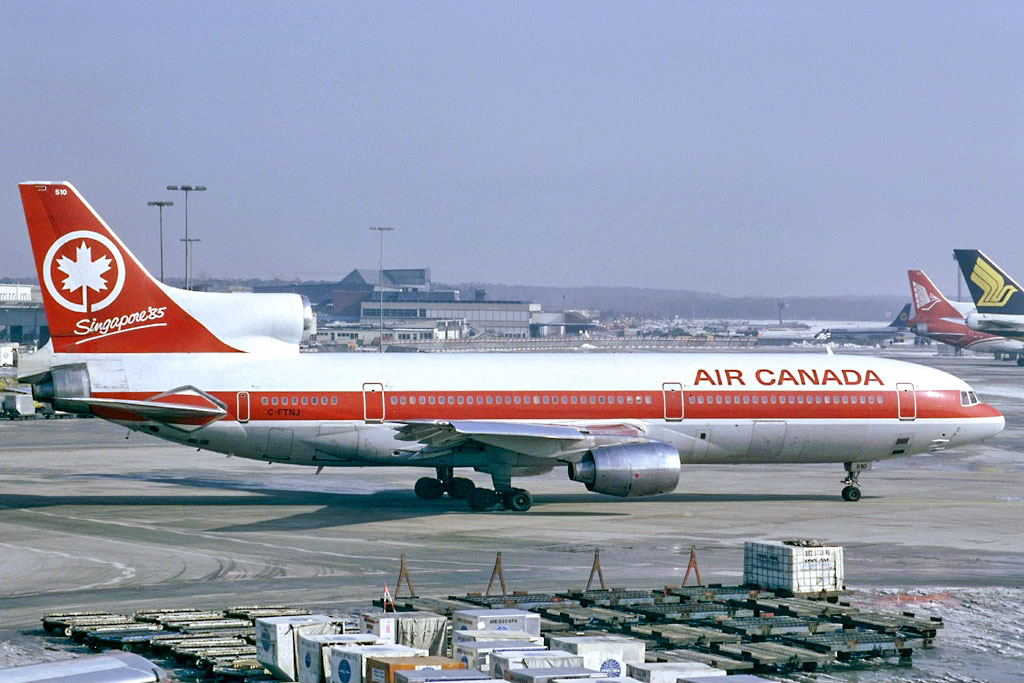
While Singapore Airlines’ Canadian ambitions remained grounded by restrictions, Air Canada wasted no time. On 15th January 1985, the Canadian flag carrier launched its Toronto – London – Bombay – Singapore service using Lockheed TriStars, operating three times weekly.
(Photo: Felix Goetting)
The aircraft featured 214 seats, including 12 “sleeper” seats in First Class.
By April 1986, Air Canada had increased the service to four flights per week, having recently reported being “very pleased” with 74% load factors and practically sold-out Business Class cabins on most flights.
The route was working – for Air Canada, at least. But Singapore Airlines could only watch from the sidelines, and its executives were publicly irked.
“Have we been too generous?… Air Canada is laughing all the way to the bank.”
Lim Chin Beng, Deputy Chairman, Singapore Airlines
Source: The Ottawa Citizen, 2 May 1986
Patience runs out
By 1986, Singapore’s patience was wearing thin.
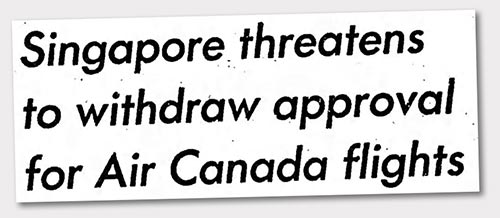
In March, government negotiators met in Ottawa but failed to reach agreement over Singapore’s demands for relaxed restrictions on both Pacific and transatlantic routes. SIA’s managing director, Cheong Choong Kong, warned that if nothing changed by June, Singapore might cancel Air Canada’s landing rights altogether.
5 Mar 1986
“If we don’t get satisfaction from the meeting we will formally ask the [Singapore] Government to suspend Air Canada’s rights…
Cheong Choong Kong, Managing Director, Singapore Airlines, March 1986
“We hope it won’t get to that stage but we are ready to go to the extreme if necessary.”
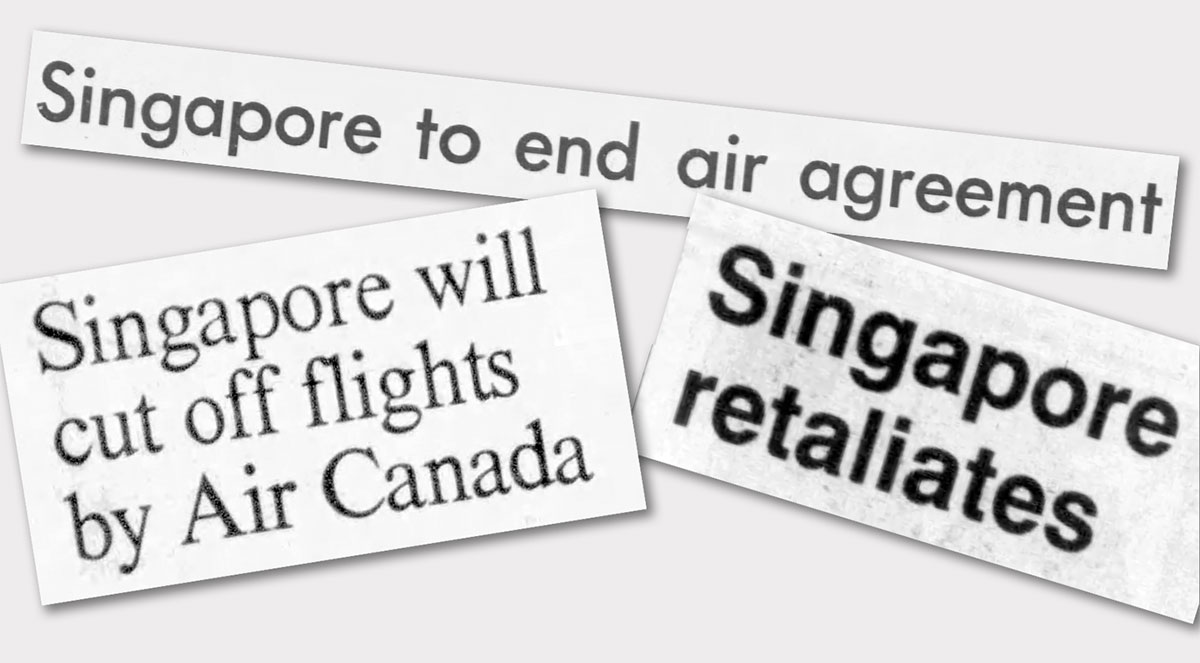
The talks went nowhere. In July 1986, the Civil Aviation Authority of Singapore made good on Cheong Choong Kong’s threat: it formally gave 12 months’ notice to terminate the bilateral air agreement with Canada.
14-15 Jul 1986
The statement was blunt. The 1984 agreement, Singapore said, “places numerous restrictions on Singapore Airlines and has effectively reduced its ability to commence services to Canada”.
Air Canada, which had been happily operating its four-times-weekly Singapore service via London and Bombay for over 18 months, now faced the prospect of losing its traffic rights by mid-1987.
“Air talks are primarily about the rights of airlines. And when these turn out to be too unequal, to the extent that one airline could operate flights while the other could not because of the terms in the agreement, the situation had to be corrected.”
The Business Times, Singapore, 2nd June 1987
Air Canada’s Vancouver spokesman described Singapore’s decision as “a tactical move”, adding: “everyone is playing hardball on bilaterals and a lot of it is posturing. We believe an agreement can be reached”.
So confident was the airline, it continued to sell tickets for seats on flights due to operate even after the air services agreement was set to end, promising rebooking or refunds in the “extremely unlikely” situation it would actually have to stop flying to Changi.
Whether that confidence was well-placed remained to be seen. For now, the air link between the two countries hung by a thread – and Singapore Airlines had yet to operate a single flight to Canada.
A last-minute agreement
As the July 1987 deadline approached, both sides knew what was at stake. Air Canada, projecting confidence, extended its Singapore office lease for four years and hired two new sales managers.
Behind the scenes, the mood was less assured.
Canadian Transport Minister John Crosbie flew to Singapore in January 1987 to meet his counterpart, Yeo Ning Hong, in a bid to break the deadlock. The meeting left officials “confident that each side wants to make it work”, according to Canadian High Commissioner Sean Brady. But wanting and achieving were two different things.
The third round of negotiations began in Singapore on Monday 25th May 1987. Four days of talks dragged on until 11pm each night. By Thursday night, it seemed Air Canada would have to cease its Singapore flights by mid-July.
According to one report, the Canadian High Commission and Air Canada were preparing to hold a press conference the following day, to announce their withdrawal from Singapore.
“On Thursday night, the talks broke down and it seemed as if Air Canada might have to say goodbye to Singapore in July. According to a Canadian delegate, the Canadian High Commission and Air Canada prepared to hold a press conference to announce this.”
The Straits Times, Singapore, 31st May 1987
Was it a tactical move? Well, unexpectedly, negotiators returned to the table on Friday – Hari Raya Puasa, a public holiday in Singapore – for an unplanned last attempt. They talked through the night.
At 2.46am on Saturday 30th May 1987, a new bilateral air services agreement was signed.
“The deadlock between Singapore and Canada over their air services agreement has been broken”, announced Lim Hock San, Director-General of the Civil Aviation Authority of Singapore, breaking the news to The Straits Times. “Canada has removed a number of restrictions on Singapore Airlines’ proposed operations to the country”.
What did Singapore win?
The new agreement gave Singapore Airlines meaningful concessions. Crucially, SIA was allowed to route via Amsterdam on flights to Canada. The restriction requiring SIA to serve both Montreal and Toronto on the Atlantic route was also lifted; the airline could now serve Toronto alone.
On the Pacific side, SIA won the right to operate to Vancouver up to three times weekly – Canadian Airlines (formerly Canadian Pacific) would no longer be allowed to fly to Singapore at all, having failed to exercise its right to do so for years, blocking SIA’s flights in the process.
In a surprise addition, the agreement also included “fifth freedom” traffic rights for Singapore Airlines between Canada and the United States, potentially allowing the airline to operate future services connecting Canadian cities with American hubs.
Routes like Toronto – Los Angeles or Vancouver – New York were now on the cards for SIA, competing against incumbent carriers for passengers travelling solely between these cities as part of wider services linking Canada and Singapore.
Canada, for its part, secured Air Canada’s continued access to Singapore. The carrier could now increase its Toronto – London – Bombay – Singapore service to six times weekly, with an upgrade to Boeing 747s replacing the smaller Lockheed TriStars, since seat caps were also removed.
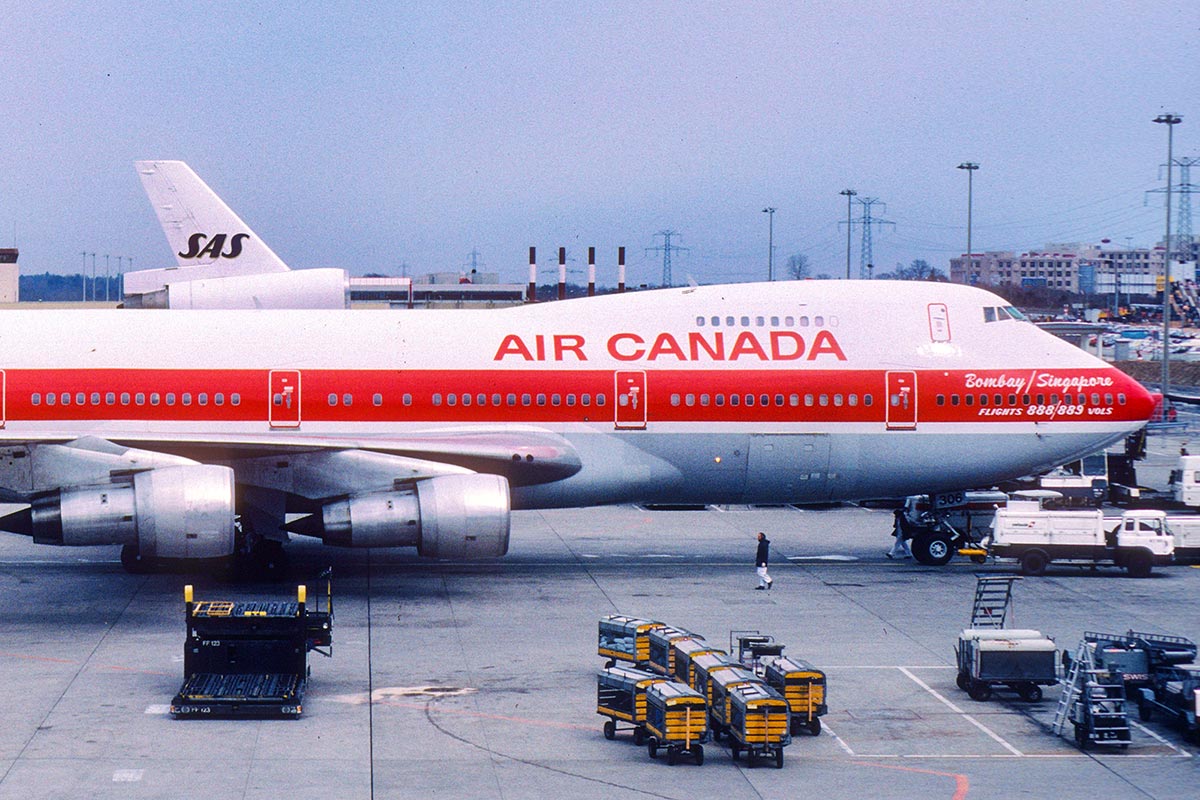
(Photo: Aero Icarus)
“Both sides heaved a sigh of relief that it had been reached”, reported The Straits Times. The Canadian High Commissioner was more effusive: “To have removed air links would have been a major blow to the interests of the two countries, after the efforts we have been making to boost trade and investment”.
For Singapore Airlines, Canada still represented “a vast untapped potential, a market that nearly slipped away from within arm’s reach”, said The Straits Times.
The path was now cleared. But would SIA now finally launch a flight to Canada?
SIA launches Vancouver
The new bilateral air services agreement between Singapore and Canada was formally inked on 5th February 1988, and less than a month later on 2nd March 1988 Singapore Airlines announced it would start flying to Vancouver via Seoul.
The service would operate twice per week from 1st July 1988, using Boeing 747-300 ‘BIG TOP’ Combi aircraft on Mondays, able to carry 304 passengers and 40 tonnes of freight, and Boeing 747-200 ‘Super B’ jets on Fridays, able to carry 400 passengers and 12 tonnes of freight.
Singapore Airlines had earlier secured “fifth freedom” traffic rights between South Korea and Canada, allowing it to take on and drop off passengers at this intermediate stop.
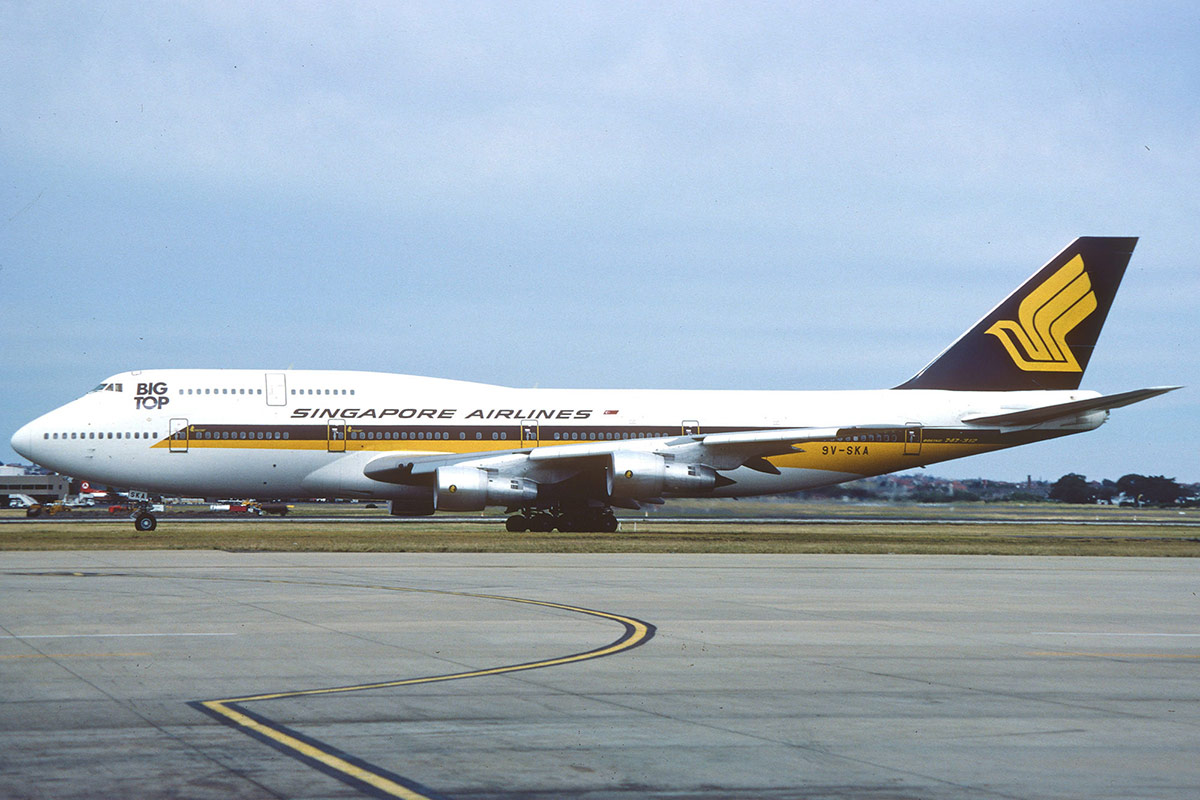
(Photo: Aero Icarus)
Canada became the airline’s 38th country and Vancouver its 57th network destination.
Relations between SIA and Air Canada had thawed, with the two carriers serving both Vancouver and Toronto respectively from Changi, and by 1989 the pair had even formed a joint marketing and cooperation agreement to promote traffic growth.
Toronto at last
Seven years after the original bilateral agreement was signed, Singapore Airlines was finally ready to cross the Atlantic.
In September 1988, Singapore successfully concluded talks with the Netherlands, securing “fifth freedom” rights that would allow SIA to carry passengers and cargo solely between Amsterdam and Toronto.
Just like Seoul on the Pacific side, it was a crucial piece of the puzzle for the route’s viability, and allowed the launch of services as early as April 1990, but the route didn’t actually get started until over a year later.

(Photo: Marcin Skalij)
In April 1991, another vital agreement fell into place: Singapore and Austria renegotiated their air services agreement, granting SIA fifth freedom rights between Vienna and Toronto. This meant the carrier could now pick up and drop off passengers at every stage of the journey.
Air Canada pulls out of Singapore
While Singapore Airlines was preparing the ground for the launch of its Toronto flights, Air Canada was also planning to boost its Lion City services.
In August 1990, the Canadian carrier announced it would join SIA on the Singapore – Seoul – Vancouver route, using brand new Boeing 747-400s that would take a truly ’round-the world’ Singapore – Seoul – Vancouver – Toronto – London – Bombay – Singapore routing.
Twice weekly flights would supplement the carrier’s existing four times weekly Singapore – Bombay – London services from mid-1991.
Then, just six weeks later, a shock.
The Gulf War had caused jet fuel prices to almost double in the space of two months, plunging airlines like Air Canada deep into the red.
On 11th October 1990, just six weeks after announcing brand new flights from Changi, Air Canada said it would suspend all its Singapore services from 27th January 1991, choosing to instead deploy its Boeing 747 aircraft used for the service on more profitable routes.
“Of course we are sad that the Singapore / Bombay flight is the one that is being suspended.”
Rick St Maurice, Regional Director Pacific, Air Canada, October 1991
It meant that from late January 1991, Singapore Airlines would become the sole operator of flights between the Lion City and Canada.
SIA launches Toronto
On 1st June 1991, Singapore Airlines flight SQ24 departed Changi Airport bound for Toronto Pearson via Vienna and Amsterdam, operated by a Boeing 747-400 “MEGATOP”. It was a historic moment: SIA had become the first Southeast Asian carrier to operate a transatlantic service.

(Photo: Christian Junker)
SQ24 flights operated three times per week, departing Singapore at 1am on Tuesdays, Thursdays and Saturdays, eventually returning to Changi some 54 hours later as SQ23 at 7am on Mondays, Thursdays and Saturdays.
The launch didn’t get off to the smoothest start. In early May, SIA had run full-page newspaper advertisements in Toronto announcing that the service would begin on 2nd May 1991, a full month before the actual launch date. The following day, the airline took out another ad, this time with a rather different headline: “We apologize”.

3 May 1991
Embarrassment aside, confidence was high. At a gala dinner in Toronto to mark the inaugural flight, SIA’s deputy chairman Lim Chin Beng declared: “We’re here to stay”.
He described the Toronto service as “a historic milestone for SIA” and noted that Canada was Singapore’s fastest-growing North American tourism market, recording double-digit growth in seven of the past ten years. Canadian arrivals to Singapore had doubled since direct air links began in 1985, reaching 61,142 visitors in 1990.
Looking ahead, Lim spoke of ambitious plans. SIA was planning to start Singapore – New York services via Frankfurt before 1993, and an Amsterdam – Vancouver routing was also being mooted, a service that would give the airline a true round-the-world connection.
Flights between Toronto and Los Angeles, or Vancouver and New York, were also possibilities, as was further expansion into North America, with cities like Washington, Montreal, Chicago, Boston and Atlanta on the carrier’s radar.
A curious appeal
Yet amid the celebrations, Lim made a surprising appeal: he called on Canadian airlines to resume flights between Canada and Singapore.
Air Canada had pulled out of the Singapore route just five months earlier, in January 1991. “While SIA is pleased to meet this need for an air link, we would rather Canadian carriers were back on the route”, Lim told the dinner guests. “We believe this is important for the continued development of the market”.
It was an unusual sentiment for a launch celebration, almost as if he sensed that SIA wouldn’t realistically be allowed to sustain the Canadian market alone.
Whether Lim’s words were diplomatic courtesy or a premonition of difficulties to come, trouble was indeed brewing. And it wouldn’t take long to arrive.
Canada cancels Singapore air treaty
The Toronto service had barely been in the air for ten weeks when Ottawa dropped a bombshell.
On 16th August 1991, Canada served notice that it would terminate the bilateral air services agreement with Singapore, effective August 1992. It was the first time Canada had ever cancelled an air agreement with another country.

17-22 Aug 1991
The stated reason? Singapore Airlines was “not playing fair”. Transport Canada claimed that more than 80% of passengers on SIA’s Toronto route were flying only to Europe, not all the way to or from Singapore, effectively syphoning off lucrative transatlantic traffic from Canadian carriers.
Air Canada’s Vienna route, in particular, was hurting.
“If Singapore Airlines was allowed to continue the service, very quickly we would see the withdrawal of Air Canada from Vienna”, warned Larry LaFleur, Transport Canada’s director of international air policy.

(Photo: Konstantin von Wedelstaedt)
Singapore Airlines called the decision “unfair and unnecessary”. The airline pointed out that its Europe – Canada traffic represented just 1.5% of the total market, hardly enough to threaten Air Canada’s survival. And it noted the bitter irony: for six years, Air Canada had enjoyed the benefits of flying to Singapore while SIA remained grounded.
Now that the tables had turned, Canada wanted out.
“Everybody has conveniently forgotten that for the last six years when everything was fine and dandy for the Canadian side… everything was quiet”, fumed Teng Aun Hwang, SIA’s senior vice-president for the Americas.
“How can a country so big think so small?”
Singapore Airlines did not go quietly. The carrier launched an aggressive public relations campaign the likes of which Canadian aviation had rarely seen.
SIA hired Hill and Knowlton, a prominent Toronto PR firm, and Public Affairs International, a major Ottawa lobbyist, to press its case. Then it took out full-page advertisements in seven major Canadian newspapers, featuring a cheeky illustration of a tiny Singapore pointing an arrow at a massive Canada.
“Can a small country like Canada compete with a giant like Singapore?” the headline asked. The copy below was equally provocative: “When it comes to competition, Canada sometimes seems to shrink from the challenge… how can a country so big think so small?”
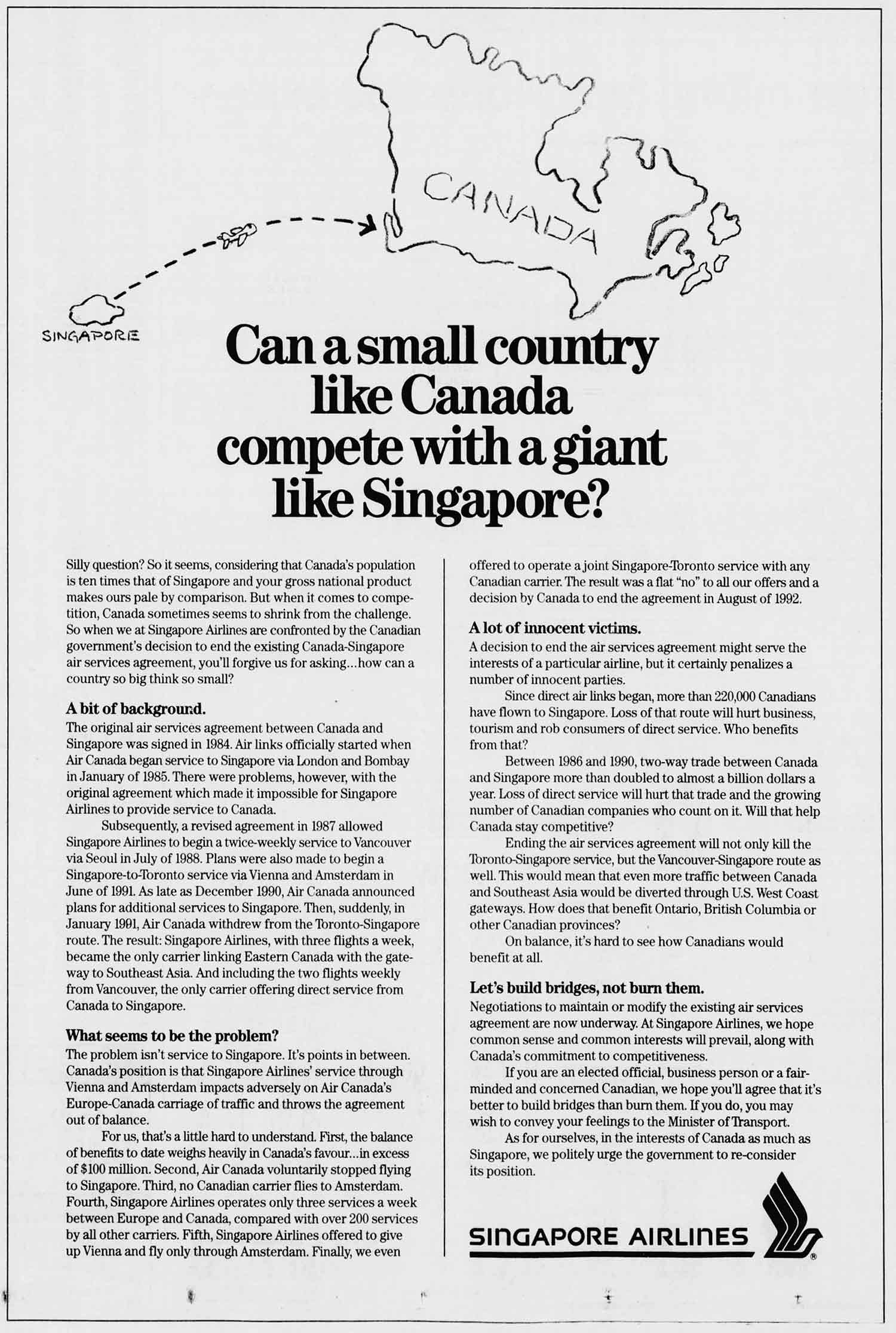
(click to enlarge)
The ad campaign proved so effective that SIA pulled it early. “We had very encouraging indications”, managing director Cheong Choong Kong explained. “We believed it served its purpose. People know about the issue”.
Among the supporters who had rallied to SIA’s cause were the Vancouver Board of Trade, and the Mayor of Toronto.
Threats and hardball
Behind the scenes, the threats flew thick and fast.
SIA warned that if Toronto was axed, Vancouver might follow. “If we have to pull out of Toronto, we may as well cut our losses and pull out of Vancouver as well”, Cheong Choong Kong declared. “It is essential we serve both Eastern and Western Canada, otherwise we don’t have a strong market presence”.
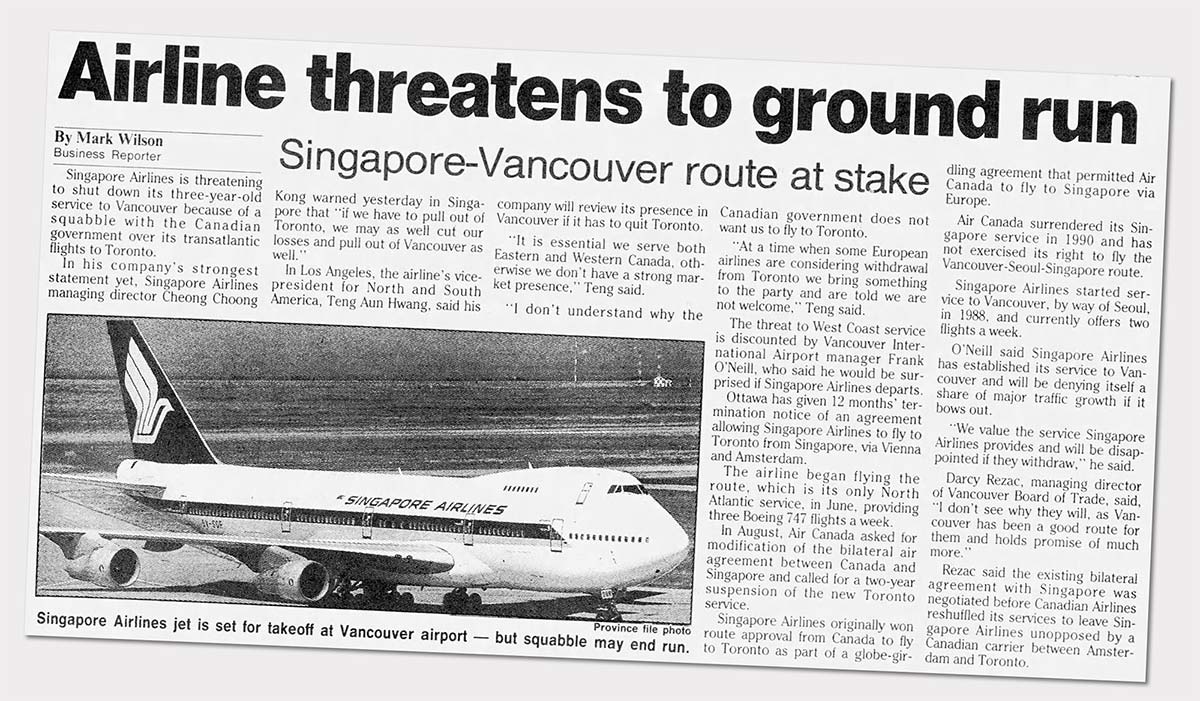
18 Oct 1991
The airline also issued veiled warnings about its substantial purchases of Canadian goods and services – including flight simulators from Montreal-based CAE Electronics. “SIA itself is not an insignificant purchaser of Canadian goods and services”, the carrier noted pointedly. “The question now is whether this latest development, which is manifestly unfair to Singapore, should affect future buying decisions”.
SIA officially denied it would boycott Canadian companies in retaliation. But when the airline later awarded a multi-million-dollar Boeing 747-400 simulator contract to America’s Rediffusion instead of CAE, reportedly for just $500,000 less, CAE’s spokesman was blunt: “Singapore Airlines has told us that [the air services dispute] was the reason we didn’t get the contract”. He would not say who in the airline passed on that news.

SIA’s top management denied any link. The Canadian High Commissioner to Singapore was more diplomatic but candid: “Obviously the air services agreement and the difficulties we have had are not helpful in any of our commercial dealings”.
Proposals rejected, patience exhausted
Singapore Airlines made several attempts to break the deadlock. It offered to drop the Vienna stopover from its Toronto route. It proposed joint services with Air Canada, allowing the Canadian carrier to sell seats on SIA flights and maintain a presence in Southeast Asia. It even offered to share revenue on the Vancouver route.
Air Canada rejected them all. “The deals were not good enough”, said spokesman Ron White.
The Canadians countered with their own proposal: SIA could continue flying to Toronto, but via Frankfurt and New York instead of Vienna and Amsterdam.
SIA scoffed at the idea.
“That’s as good as saying, ‘why don’t you forever be in the red’?”
Teng Aun Hwang, SVP Americas, Singapore Airlines
SIA had already acknowledged it was prepared to lose money on the transatlantic route for years in order to build up the market. But Frankfurt – New York – Toronto made no commercial sense whatsoever.
The talks dragged on through the autumn of 1991 and into 1992. By January, SIA was “becoming discouraged”. The news from Canada was “not good”, with “no movement on the Canadian side”.
In its final position on the matter in February 1992, Air Canada reiterated the proposal: SIA should reroute its Toronto service via Frankfurt and New York. The airline dismissed it as “unthinkable”.
Toronto abandoned
On 15th April 1992, Singapore Airlines announced it would suspend its Toronto service effective 1st July. The last flight would operate on 30th June.

16 Apr 1992
“The situation became untenable”, Teng Aun Hwang said. “We lost the summer season because the airline faced losing its right to fly to Canada in August, and we’ve got other opportunities, so we decided to reallocate our resources elsewhere”.
The carrier took out another advertisement in Canadian newspapers, this time a sombre announcement rather than a provocation. “Singapore Airlines regrets to announce the suspension of our service out of Toronto’s Pearson Airport”, it read. The airline acknowledged the decision would have “an adverse impact on the local economy, and on trade and tourism development between our two countries”.

(click to enlarge)
Air Canada spokesman Denis Couture said he was “surprised and disappointed” by the decision.
“Air Canada was not after them to get off the route but to resolve the issue of excessive fifth-freedom rights.”
Denis Couture, Spokesman, Air Canada
Other industry analysts saw it differently: Singapore Airlines had given in to Air Canada’s demands and written off the $20 million it had invested in the Toronto route, all to prevent Canada from tearing up the bilateral agreement entirely and killing the Vancouver service too.
“We tried our best to carry on, but with August 1992 fast approaching, we had to make a decision”, said Cheong Choong Kong. “The uncertainty [was] unacceptable”.
Then he added, with a note of wistfulness: “We are hopeful that someday SIA will return to Toronto”.
It was a hope that would never be fulfilled.
Vancouver survives – just
With Toronto gone, Singapore Airlines turned its full attention to Vancouver. The thrice-weekly service via Seoul, the “uncontentious” route that had escaped the transatlantic crossfire, was now the carrier’s sole Canadian operation.
But even this lifeline was precarious. Ottawa had formally cancelled the bilateral air services agreement in August 1992, though it granted SIA a year’s grace to continue operating to the west coast. The carrier found itself in an uncomfortable limbo: flying on temporary authorisation, renewed annually at the discretion of Canadian authorities.

“It’s really no surprise and we really expected it”, said Teng Aun Hwang of the treaty cancellation. “Canada has given us the right to keep our current schedule out of Vancouver for another year. It’s certainly not the best way to encourage further air links with Asia”.
Year after year, SIA’s permission to fly to Vancouver was extended – always temporary, never permanent. The airline had been operating to Canada since 1988, yet nearly two decades later it was still waiting for a proper, lasting agreement.
Rapprochement, of sorts
Relations between the two countries gradually thawed. In October 2000, Singapore Airlines and Air Canada announced a codeshare agreement, allowing the two carriers to sell seats on each other’s flights between Singapore and Toronto via London.
It wasn’t quite the return to Toronto that SIA had hoped for, but it was a step forward, made possible by SIA’s entry into the Star Alliance six months earlier, joining Air Canada as alliance partners.
Meanwhile, the Vancouver route quietly prospered. By 2007, SIA’s thrice-weekly Boeing 747 service was running at 90% load factors. One-third of the carrier’s traffic between Singapore and Vancouver was being routed through US cities, simply because passengers couldn’t get seats on the sold-out SIA flights.
“We very much wanted the right to be able to add a couple more frequencies, at least, to our existing schedule via Seoul”, said Campbell Wilson, SIA’s Vancouver-based vice-president. “But unfortunately, the negotiations didn’t provide that”.
“Plenty of bums; No seats”
The frustration was palpable. Tourism BC was losing business. Travel agents in Southeast Asia were turning away customers. And SIA was constrained to just three SQ18/17 flights a week on a route that could clearly support more.
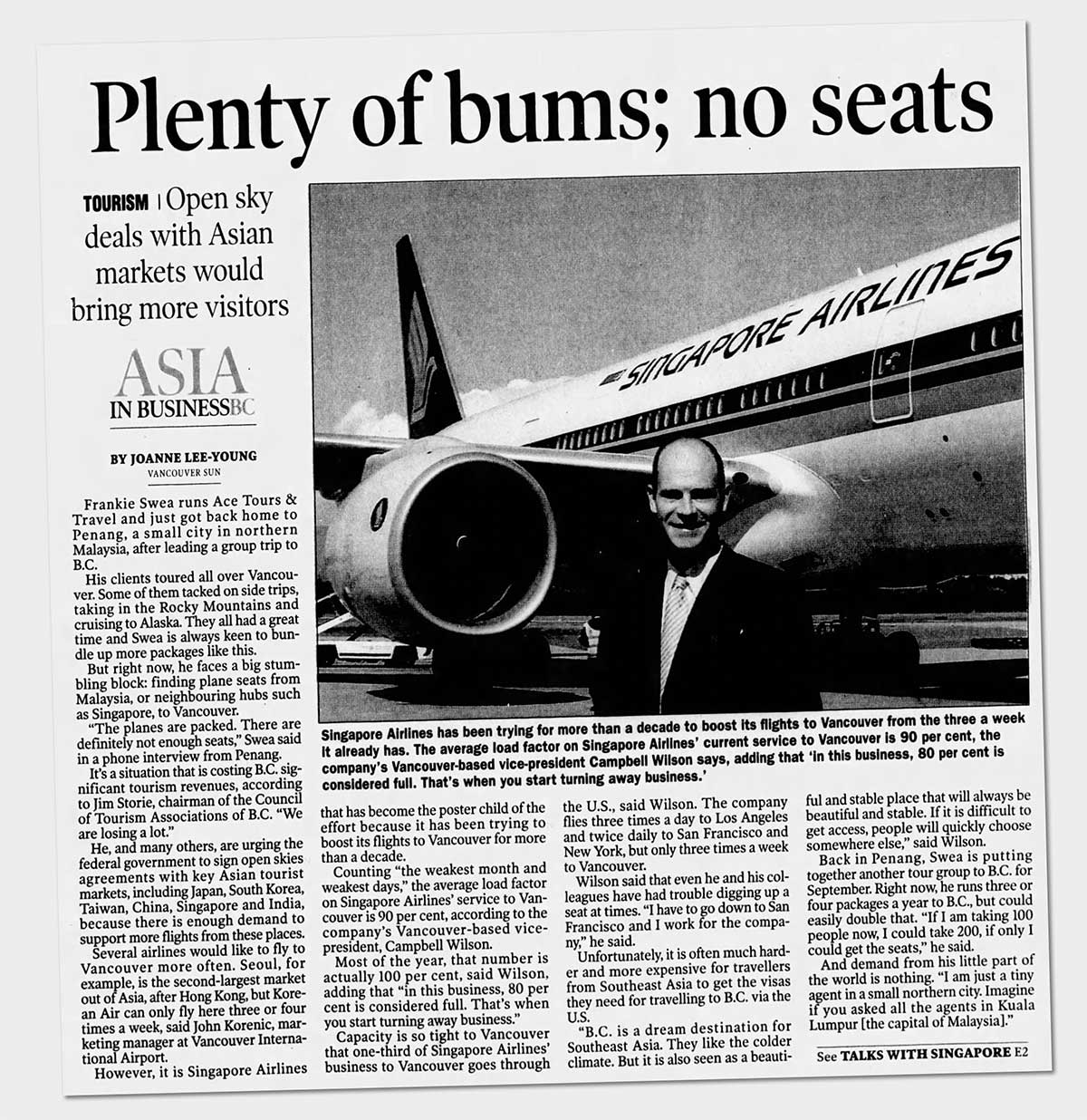
The problem, as ever, was politics. Under the existing bilateral agreement, any increase in frequency required consent from Canadian domestic airlines.
When SIA applied to boost its service to daily operations in 2007, Air Canada rejected the request, citing concerns about competition on its own Vancouver – Seoul flights.
“We pushed very hard”, Wilson said. “Even just give us one more frequency to Seoul to get us up to four. It’s been three times a week for 20 years“.
The 2007 agreement: Liberation, on paper
On 7th November 2007, Singapore and Canada finally signed a new bilateral air transport agreement, the first comprehensive update since the acrimonious negotiations of the early 1990s.
On paper, it looked like a breakthrough. The agreement removed all capacity restrictions on direct flights between the two countries, allowing unlimited frequencies, routes, and code-sharing arrangements. Airlines from either country could now operate as many non-stop passenger and cargo flights between Singapore and Canada as they wished.
Campbell Wilson welcomed the deal, primarily because SIA would no longer have to go through an annual renewal process to maintain its Vancouver service. The airline’s temporary licence, renewed every year for the best part of two decades, was finally converted to a permanent one.
“I don’t want to sound churlish”, Wilson said. “We are delighted that there is an agreement. It’s an improvement and a foundation we can build from, even if it doesn’t provide anything of benefit in the immediate term”.
That last caveat was crucial. The agreement was still beholden to restrictions on fifth freedom traffic rights via Seoul, the very rights that made SIA’s Vancouver route economically viable. The carrier picked up as much as 40% of its Vancouver-bound passengers during the Seoul stopover. Without that traffic, a Singapore – Vancouver flight simply didn’t make financial sense.
“It’s a paper agreement” Wilson said bluntly. “Yes, we are busy talking up the importance of the Pacific Gateway and wanting to increase flights through Vancouver, but here we have gone and concluded an agreement that reinforces the status quo”.
The end of the line
Then came the global financial crisis.
In February 2009, Singapore Airlines announced that it would indefinitely suspend its Vancouver service. The last flight would operate on 25th April 2009, almost exactly 21 years after the route had launched.

17 Feb 2009
“The decision to suspend service is most regrettable, as Singapore Airlines has served Canada for over 20 years. However the economic conditions and performance on the route has been badly affected by the global economic downturn.”
Singapore Airlines, February 2009
For Vancouver’s travel industry, the news came as a shock. “We just got an email that they are cancelling their flight. We never guessed it could happen”, said Ravinder Gaba, a Vancouver-based travel agent specialising in South Asia. “I have talked to other agents and no one saw it coming. They have been here for so long. And it is a surprise, because it is a big name”.
Both Singapore and South Korea were among Asia’s hardest-hit economies in the crisis, real GDP fell at an annualised rate of 13% in South Korea and 17% in Singapore in the fourth quarter of 2008.
The carrier’s Vancouver route had used a variety of aircraft types over the years:
- Boeing 747-200s and Boeing 747-300 Combis at launch, later transitioning to all-passenger Boeing 747-300s
- Boeing 747-400s between 1995 and 1998
- Airbus A340-300s between 1999 and 2002
- Boeing 777-200ERs from 2002 onwards

(Photo: Josh Akbar)
After two decades of fighting for the right to fly to Canada – the politics, the PR wars, the annual renewals, the endless negotiations – Singapore Airlines was finally leaving. Not because Ottawa forced it out, but because the numbers no longer added up.
For the first time since 1988, there would be no Singapore Airlines flights to Canada.
A surprise return
In late 2021, more than twelve years after its unceremonious exit, Singapore Airlines announced a surprise return to the Canadian market.
“Singapore Airlines (SIA) is launching four-times weekly seasonal services to Vancouver, Canada, from 2 December 2021 to 15 February 2022“
Singapore Airlines, October 2021
This time the route would be served non-stop, using Airbus A350-900 Long Range aircraft – a type that finally made the economics work without the need for an intermediate stopover. The service would continue onwards to Seattle, a reinstated destination following a brief pandemic hiatus, creating a Singapore – Vancouver – Seattle – Vancouver – Singapore routing.
The timing was no coincidence. The launch coincided with Canada being added to Singapore’s list of “Vaccinated Travel Lane” (VTL) countries, during a period when vaccination, testing and quarantine requirements were determined by your country of origin and the classification of your inbound flight.
Canada offered Singaporeans a rare opportunity for quarantine-free travel during the tail end of those pandemic restrictions.

(Photo: Vancouver Airport)
The Vancouver – Seattle hops became the airline’s shortest passenger flights, scheduled at just 45 to 50 minutes gate-to-gate. The quickest service on that segment clocked in at a mere 24 minutes of airborne time on 10th February 2022.

(Photo: Vancouver Airport)
By June that year, however, Seattle had gained its own dedicated flights from Singapore, and the two cities were split into independent services.
Vancouver was originally announced as a seasonal route, scheduled to end in mid-February 2022. It was then extended by six weeks to late March, before quietly becoming a year-round operation.
It seemed, at last, that with the Airbus A350 Singapore Airlines had found a sustainable formula for serving Canada.
The second exit
Alas, it wasn’t to be.
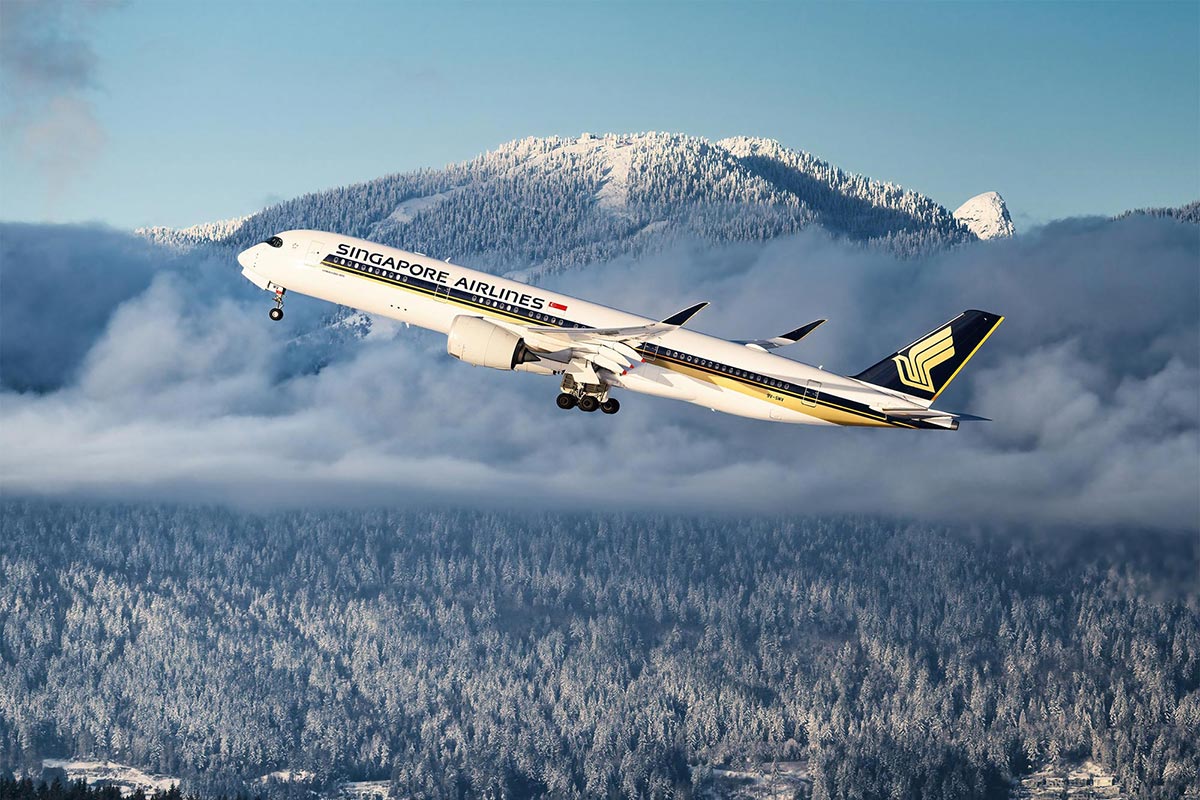
In February 2023, with the COVID-19 pandemic a fading memory across almost all of its network and VTLs a thing of the past, Singapore Airlines announced its exit from the Canadian market for the second time.
The non-stop Vancouver route would cease in October 2023.
“SIA’s services to Vancouver will be suspended with effect from October 2023, as the Group adjusts its capacity in response to demand.”
Singapore Airlines, February 2023
A rather antiseptic explanation for the end of a route that had seen four decades of political wrangling go before it.
This time, there were no full-page newspaper adverts. No accusations of unfairness. No veiled threats about flight simulator contracts. Singapore Airlines was once again leaving Canada, and that was that.
(Photo: Alvin Man / Onemoreweektogo)
It marked a quiet retreat from a market that had never quite worked out for SIA.
Air Canada returns to Singapore
A saga like this one is never complete without coming full circle.
In June 2023, just four months after Singapore Airlines had announced its latest withdrawal, Air Canada revealed it would be returning to Singapore for the first time in over 30 years.
The Canadian flag carrier revealed four times weekly non-stop Vancouver – Singapore flights using Boeing 787-9 aircraft, with service to commence in April 2024.

(Photo: SATS)
“We are committed to growing YVR as a premier trans-Pacific hub, and Singapore is a top global financial centre, a multicultural destination that offers an abundance of tourism and food experiences, as well as an important gateway to beyond destinations in Southeast Asia, Southern India and Western Australia.”
Mark Galardo, EVP Revenue and Network Planning. Air Canada
The schedule was carefully crafted to optimise connectivity: a morning departure from Singapore arriving the same morning in Vancouver (courtesy of the International Date Line), and a departure from Vancouver shortly after midnight, touching down at Changi just after 7am the following calendar day.
The timings were designed to feed Air Canada’s North American network at the Vancouver end, while tapping Singapore Airlines’ extensive connections across Southeast Asia, South India and Western Australia at Changi.
A neat irony given the decades of antagonism between the two carriers.
Changi Airport Group welcomed the news warmly.
“We are thrilled to welcome Air Canada as it makes its much-anticipated return to Singapore Changi Airport after more than three decades”, said Lim Ching Kiat, EVP Air Hub & Cargo Development. “The link to Canada is strategically significant for Changi, as point-to-point travel between the two countries has shown strong recovery, with passenger traffic surpassing 80% of pre-COVID-19 levels in the first quarter of 2023”.

(Photo: Air Canada)
By launch day in April 2024, Air Canada had already announced an increase to five times weekly from December 2024 – the same frequency that continues to this day, offering 1,500 seats per week on the route in each direction.
Just as in 1985, a link to the country is working again for Air Canada. And just as in 1985, Singapore Airlines is left watching from the sidelines.


Summary
What started with optimism in 1984 ended in quiet retreat in 2023. In between lay three to four decades of frustration.
Singapore Airlines launched its first Canadian flight in 1988, a full four years after signing a bilateral agreement that was supposed to open the market. It took another three years to reach Toronto, only for that service to be killed off within thirteen months amid accusations of unfair competition.
The Vancouver route limped on for two decades under temporary annual authorisations, survived a new agreement in 2007 that changed little in practice, and finally succumbed to the global financial crisis in 2009.
A surprise return in 2021, enabled by newer aircraft and spurred by limited pandemic-era travel lanes, lasted barely two years before SIA pulled out for a second time.
Today, Air Canada is once again the sole operator of direct flights between Singapore and Canada, with a five times weekly Boeing 787 service to and from Vancouver.
After four decades of political wrangling, broken agreements, last-minute deals, launches, suspensions and withdrawals, the outcome is almost perverse: it’s still the Canadians, and only the Canadians, flying this route.
Singapore Airlines, who battled for years to serve the Great White North, no longer flies to Canada at all. The maple leaf proved elusive to the end.
Oh Canada, indeed!
(Cover Photo: Shutterstock)
Amazing drama back then. These days SIA wouldn’t say boo to a goose! Not publicly at least. Anyway I doubt they will ever return to Canada – CX, BR, CI, CA, JL, NH etc have that market wrapped up from Asia. CX alone has 3 daily HKG-YVR and 3 daily HKG-YYZ in summer. SIA can never break this market now, too late sadly.
You might be right on alot of this but your missing a little thing about the 90s service to YVR it was on hiatus due to air worthiness, heavy corrosion on the B 747 combis .
Nice article! Would like to see this for other destinations too.
An excellent read. Thanks for the effort!
Fascinating history. Does SQ still have 5th freedom USA-Canada rights? If so something like SIN-LAX-YYZ could work now I think with A350
What is perverse is Toronto is now served by Emirates daily A380, Etihad daily A380, Qatar daily 777. I don’t recall those airlines having any issues starting these flights or fighting the government for it. SIA should be part of this mix today! SIA was unfairly treated by Canada and has now given up on the country – sad.
Emirates, Etihad and Qatar had issues in launching flights to Canada. Emirates and Etihad were each restricted to only 3/weekly flights to Toronto for more than 10 years. Emirates even had a dispute with Canada causing the UAE to force Canadian troops to leave the Mirage airbase they were using in the UAE. Qatar Airways too operated 3/weekly flights to Montreal for more than 10 years. I find Canada to be full of drama when it comes to aviation. Shutting out a high quality airline like SIA is nothing but childish and foolish. I still don’t understand why Canada put too many restrtictions on SIA while Cathay Pacific operates multiple daily flights to both Toronto and Vancouver.
The ME3 had really had the gung-ho attitude of SQ back in the day. That explains their massive expansion, of course charged by their investors (ie. govts) massive capital injections.
Great research! Thanks.
For investors:
Market cap Jan 9 2026:
AC.TO $5.8 billion cad
C6L.SI $20 billion sgd
.93 cad to 1 sgd
For passengers:
Service level & cabin experience… I’ve flown both airlines many times. Must say SIA wins on both fronts.
I think you meant to say 1 CAD to .93 SGD
hi, thanks for the correction. Cheers
Wondering if sq was short of aircraft and had to prioritise other more profitable routes and hence their withdrawal from yvr. Ac could make yvr sin work…
This is fantastic article. Thank you so much for that 🙂 Looking for more to come.
What an incredible article. Subscribed.
Thank you!