

Perhaps the most anticipated new passenger airliner set to grace our skies in the coming years is the Boeing 777-9, now the largest new commercial jet available for airlines to buy, and its superior efficiency over existing types has made it a popular choice among many carriers around the world.
Singapore Airlines is no exception – eager to replace its ageing Boeing 777-300ERs, and of course eventually its Airbus A380 superjumbos too, some of which will be hitting 20 years old as soon as 2030.
There’s one problem though – and that’s extensive delays to the Boeing 777X programme, which incorporates both the 777-9 and 777-8 models, with a fresh (but frankly not unexpected) postponement to first delivery of the type now confirmed.
Boeing 777-9 delayed until 2026
Yesterday Boeing formally announced that its first 777-9 will not be delivered to a customer airline until 2026, a full seven years behind schedule.
“The company now anticipates first delivery of the 777-9 in 2026 and the 777-8 freighter in 2028.”
Boeing
This almost seems like confirmation of an undeniable truth.
A trio of vocal launch customers – Emirates, Qatar Airways and Lufthansa – have already been publicly pointing to a 2026 service entry date at the earliest, for quite some time.
“Officially, the planes should arrive at the end of 2025. No one believes it internally anymore – not at Lufthansa, probably not at Boeing either.”
Lufthansa CEO Cartsen Spohr, in a message to employees in September 2024

(Image: Emirates)
In some cases these operators have even flagged Q2 2026 as the likely timeframe (though last month Qatar Airways was still expressing hope for a Q1 2026 delivery).
Singapore Airlines, Cathay Pacific, Etihad and All Nippon Airways are the other four launch customers for the aircraft type, with both SIA and Cathay sticking to a 2025 delivery prediction only recently.
(Photo: Matt Cawby)
That was probably out of respect for Boeing’s official stance at the time, but a position one industry expert described to me at the time as “delusional”.
The latest setback
Unfortunately it’s not just past delays to the testing programme that have caused Boeing to formally restate its expected Boeing 777-9 delivery schedule.
Type Inspection Authorisation (TIA) was finally granted by the Federal Aviation Administration (FAA) earlier this year, allowing the manufacturer to commence certification test flights in July 2024, a process that then usually lasts 12-18 months.
Then, just a month later in August 2024, the manufacturer discovered a severed thrust link component after a routine test flight, grounding the type.
This means that one of the two titanium beams responsible for transferring thrust from the massive General Electric GE9X engine to the wing strut, had broken.

(Photo: Dan Nevill)
Subsequent checks of the three other 777-9 test aircraft found that the same component was cracked in all cases, even on a test aircraft that had accumulated only 180 flight hours, and hadn’t flown for almost three years.
To put that in perspective, 180 flight hours is roughly the amount of flying that carriers like Singapore Airlines will expect their 777-9s to complete every 12 days.
At the time of writing, the test programme remains paused as Boeing “[works] to understand the root-cause corrective action… to understand the path forward, and any impact to scheduling”, according to Chief Financial Officer Brian West.
Boeing 777X production delays
This latest issue is far from the only delay the Boeing 777X programme has faced. Believe it or not, the first aircraft was originally supposed to enter service five years ago.
Boeing launched the 777X programme in 2013, with a goal to certify the aircraft in 2019, and achieve entry into service with its launch customer later that same year.
A lot of water has gone under the bridge since then.
Here’s a summary of how the Boeing 777X programme has slipped in recent years.
- June 2019: A compressor anomaly found with the aircraft’s GE9X engines delayed the first flight from June 2019 to January 2020.
- September 2019: A passenger door blew off the 777X static test airframe during its FAA-observed ultimate load test, which was being conducted with the airplane stressed and pressurised beyond normal operating limits.
- July 2020: Boeing delayed the programme due to the industry situation caused by COVID-19, pushing first customer deliveries to 2022.
- January 2021: Boeing was forced to make actuator control modifications to satisfy regulators, further delaying the programme.
- May 2021: The FAA forced Boeing to slow 777X certification, in a “sternly worded letter” citing a long list of concerns including a serious flight control incident on a test flight in December 2020, when the aircraft pitched abruptly without input from the pilots. This setback pushed certification to at least 2023.
- March 2022: The FAA again wrote to Boeing stating that the certification schedule for the 777X was “outdated and no longer reflect[s] the program activities”.
- April 2022: Boeing delayed first 777X deliveries to 2025.
- November 2022: Flight testing of the 777X was halted following an in-flight engine failure in October 2022. Test flights resumed in mid-December 2022.
- July 2024: The FAA finally allowed Boeing to commence formal certification flights, following Type Inspection Authorisation (TIA) approval.
- August 2024: Test flights were grounded following the discovery of a severed thrust link component, a titanium beam that transfers thrust from the 11-ton engine to the wing strut.
- August 2024: Subsequent inspections found cracks in the thrust links on all other 777-9 test aircraft, including one that has clocked only 180 hours of flight time and hasn’t taken to the skies for nearly three years.
- October 2024: Boeing delays first 777X deliveries to 2026. The flight test certification programme remains suspended.

(Photo: Matt Cawby)
For perspective, the original Boeing 777-200 was launched in October 1990, then the aircraft first flew in 1994 and entered commercial service in June 1995.
That’s project launch to passenger flights in less than 5 years – for a brand new aircraft type.
Here we have a variant of the same type that won’t enter commercial service for at least 13 years after launch.
Even the Airbus A380, which suffered many well-documented development delays of its own, went from formal launch to commercial service entry in less than 7 years.
Bad news for Singapore Airlines
Singapore Airlines has 31 Boeing 777-9s on order, to replace its Boeing 777-300ER and Airbus A380 aircraft in the years ahead.
The first one was due to arrive in 2021, and it’s reasonable to assume that the carrier probably banked on having at least a dozen of the type in its operating fleet by now, some three years later.

(Image: SilverKris Magazine, July 2018)
Why is this latest delay a problem for Singapore Airlines?
Well quite simply, the carrier is holding back on introducing its latest cabin products in all four cabins – First, Business, Premium and Economy – until the 777-9s arrive, a decision that other carriers like Cathay Pacific, Emirates and Lufthansa have adapted due to the delays.
When you consider that the 2017 J seat Singapore Airlines uses on its Airbus A380s is only marginally different to the 2013 J seat, we now haven’t seen a major product refresh in the carrier’s long-haul Business Class cabin for 11 years.
When you further consider that it will be 2026 at the earliest before a new product can be launched on the Boeing 777-9, we’re looking at up to 13 years without a major step-change in Business Class cabin design – and that’s not like SIA at all, as outlined below.
Singapore Airlines
Long-haul Business Class Product Evolution
| Product | Launch |
 SpaceBed SpaceBed |
May 2002 |
| 4 years | |
 2006 J 2006 J |
October 2006 |
| 7 years | |
 2013 J 2013 J |
July 2013 |
| 4 years | |
 2017 J 2017 J |
November 2017 |
| 8-9 years? | |
 2026 J 2026 J |
2026* |
* At the earliest
Next week Cathay Pacific will launch its new Aria Suite closed-door Business Class on a refitted Boeing 777-300ER aircraft, while Lufthansa is pushing ahead with its new First Class suites and closed-door Business Class seats on Airbus A350s and Boeing 787s.
In both cases, these plans are necessary because the airlines can’t wait any longer for their Boeing 777-9s, in order to debut these products.
SIA already shunned the idea of fitting its latest Business Class and Premium Economy Class seats to its Airbus A350 ULR aircraft this year, as each of the seven jets cycles through a routine hangar visit lasting around five weeks, which seems to us like a massive missed opportunity.

That could have been a great opportunity to also install the airline’s brand new under-wraps long-haul Business Class product designed for the Boeing 777-9, and then showcase it on the longest flights in the world.
Airlines like Cathay Pacific are having to postpone their latest First Class seats (in this case “The Halo Suites”) until the 777-9s arrive, but at least they are pushing forward with a new Business Class product on older jets in the meantime.
More widely, Singapore Airlines is standing still with new product launches in comparison to many other competitors in recent years, including regional rivals Qantas and Malaysia Airlines.

(Photos: Malaysia Airlines)
Let’s see if this latest delay to the 777-9’s delivery is enough to encourage SIA to start rolling out its new products on existing types before 2026.
What’s in store for SIA’s Boeing 777-9s?
Unless Singapore Airlines now bites the bullet and introduces some of its new under-wraps cabin products on existing aircraft types like the Airbus A350 ULR, Airbus A350 Long Haul or Boeing 777-300ER, it will still be the Boeing 777-9 introduction in 2026 (at the earliest) that will see these seats finally unveiled.
The annoying thing here for many of our readers is that there’s lots to look forward to, including:
- A brand new First Class Suite
- A brand new Business Class seat, likely with closing privacy doors for a ‘Suite-style’ experience
- A brand new Premium Economy Class seat, hopefully including additional privacy
- Bigger windows, better cabin pressure, higher humidity and lower noise levels
- A wider cabin, thanks to thinner insulation

(Image: Boeing)
On the downside though, it’s 10-abreast seating (3-4-3) in the Economy Class cabin, meaning seat width of around 17.5 inches in what could be one massive 20-21 row section at the back of the plane, with no bulkhead dividers or doors to break up the space, and minimal extra legroom seat options.
We’ve got a full rundown about the many features, both known and likely, of these new ~300 seat aircraft in our dedicated article.

Which 777-9s will SIA get?
Singapore Airlines is the third-largest customer for the Boeing 777X, after Emirates and Qatar Airways, with 31 firm orders, all of which are for the 777-9.
Boeing 777X Passenger Aircraft Orders
as of October 2024
| Airline | Aircraft | ||
| 777-8 | 777-9 | ||
 |
Emirates | 35 | 170 |
 |
Qatar Airways | — | 70 |
 |
Singapore Airlines | — | 31 |
 |
Lufthansa | — | 20 |
 |
Etihad | 8 | 17 |
 |
Cathay Pacific | — | 21 |
 |
Korean Air | — | 20 |
 |
All Nippon Airways | — | 18 |
 |
British Airways | — | 18 |
 |
Air India | — | 10 |
 |
Ethiopian Airlines | — | 8 |
| Total | 43 | 403 | |
SIA has shown no public interest in the smaller (but longer range) 777-8 passenger variant, which is a more direct replacement for the 777-300ER in terms of capacity, and as you can see it’s not alone. Only Emirates and Etihad have committed to a relatively small number of that type, which won’t start being delivered until 2030 (…ish?).
Singapore Airlines has been allocated line slots for its first six Boeing 777-9 aircraft, but don’t get too excited – because they aren’t particularly early slots on the list.
Boeing 777-9 Production List
| Line Number | Customer | |
| 1605 | |
Emirates |
| 1611 | |
Emirates |
| 1615 | |
Emirates |
| 1620 | |
Emirates |
| 1624 | |
Emirates |
| 1629 | |
ANA |
| 1633 | |
ANA |
| 1638 | |
Lufthansa |
| 1642 | |
Emirates |
| 1647 | |
Emirates |
| 1651 | |
Emirates |
| 1656 | |
Qatar Airways |
| 1659 | |
Emirates |
| 1668 | |
Qatar Airways |
| 1670 | |
Lufthansa |
| 1672 | |
Qatar Airways |
| 1674 | |
Lufthansa |
| 1677 | |
Lufthansa |
| 1680 | |
ANA |
| 1682 | |
Emirates |
| 1685 | |
Lufthansa |
| 1688 | |
Lufthansa |
| 1723 | |
Singapore Airlines |
| 1728 | |
Singapore Airlines |
| 1737 | |
Singapore Airlines |
| 1740 | |
Qatar Airways |
| 1746 | |
Singapore Airlines |
| 1781 | |
Lufthansa |
| 1785 | |
Singapore Airlines |
| TBC | |
Singapore Airlines |
| TBC | |
Qatar Airways |
Source: Aviation Flights Group
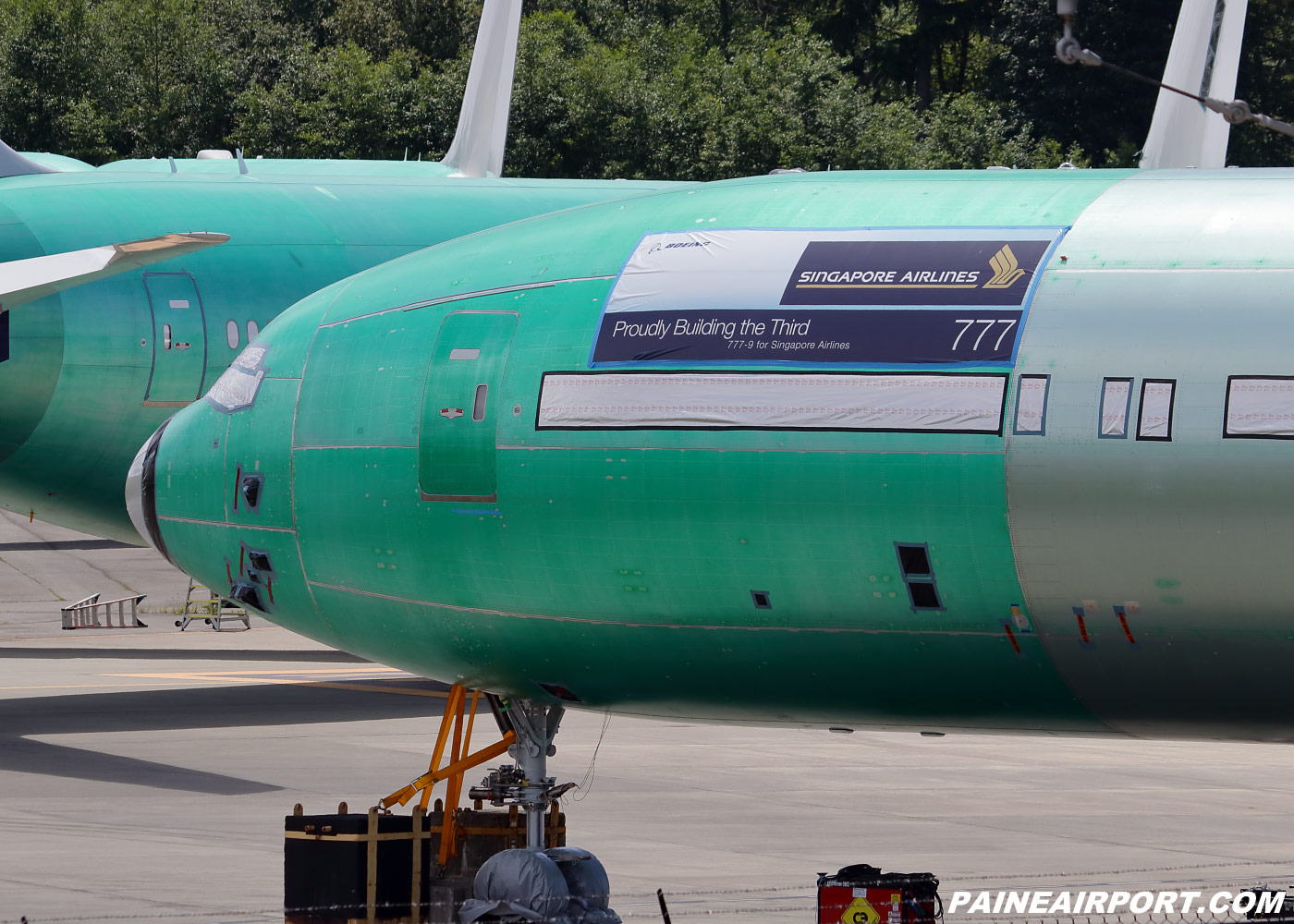
Nonetheless, at least three of SIA’s Boeing 777-9s have already been built – so delivery could be at a relatively quick pace, once the aircraft is finally certified.

Summary
In an unsurprising announcement, Boeing has confirmed that it won’t be delivering any 777-9s to customers until 2026 at the earliest, a one-year postponement many less-than-happy airline CEOs had already effectively announced months ago.
With the test programme currently stalled following discovery of a thrust link component issue, it’s not even clear at this stage how extensive the latest delay might be for the manufacturer, which has already been plagued with issues throughout the type’s development.
For Singapore Airlines, this is yet another deferral for its long-awaited reveal of brand new cabins, which the carrier seems dead set to hold back for the 777-9s, rather than generate the buzz of what we see as a much-needed long-haul product launch on some older types instead.
Will this latest delay convince the carrier that new products are needed before 2026, to stop it being increasingly left behind by the competition in the premium cabin space?
(Cover Image: Boeing)
It’s just too bad. They missed the opportunity like you said to show the new cabin products. I feel Singapore Airlines has gotten complacent.
Does SQ have any backup plans apart from the A350 they already have or being delivered (specifically the long haul A350’s)?
Like especially with SQ12/11 and SQ26/25? I know one problem is the 359’s do not have F but the downgrade is not significant, or at least 12/11 can be converted to a nonstop morning flight identical to 32/31.
Also backup in terms of aircraft alternatives? Boeing 787-9 or possibly A350-1000? This is a long wait for SQ and while I sympathetize with Boeing for the strike and impacts beyond their control, this is unacceptable. If I was an airline, I would probably look out for interim aircraft before the 779’s come and still replace the oldest 77W (and those remaining redeploy to short haul).
Looking at timelines, I think it’s more realistic to expect the Boeing 777-9s to be delivered from 2026. I am quite eager to see how the new First and Business Class products will look like and what routes they’ll be used on.
I am also guessing that the first batch of Boeing 777-9s will be a replacement for the following aircraft retired due to COVID-19:
– Five Boeing 777-300/ERs (9V-SWA, 9V-SWD, 9V-SWE, 9V-SWF and 9V-SWN)
– Seven Airbus A380s (9V-SKF to 9V-SKL)
If we were to look at it in this manner, I foresee that Singapore Airlines will continue to operate several of its Boeing 777-300/ERs following the delivery of its Boeing 777-9s, as it sees fit. Some aviation fans like me will probably see the Boeing 777-9s as more of a replacement for the Airbus A380s than the Boeing 777-300/ERs.
This program is cursed.