


Last year we reported on Qatar Airways’ plans to become one of the first airlines to commit to SpaceX’s new Starlink in-flight Wi-Fi system, able to offer speeds of up to 350 Mbps, free for all passengers on selected aircraft and routes.
Last week the airline launched its first aircraft with the new system installed into regular service, which means fast, free gate-to-gate Wi-Fi – with speeds you usually see at home – is now a reality… on one plane at least!
Thankfully the airline has also shared a rapid rollout plan for its entire Boeing 777-300ER aircraft fleet over the next 14 months, with Airbus A350s also starting to receive their Starlink upgrades from the middle of next year.
Starlink Wi-Fi launched on Qatar Airways
Qatar Airways has rolled out its first aircraft with Starlink Wi-Fi, a Boeing 777-300ER, which also features the Qsuite in Business Class.
It’s the first time Starlink has been installed on a Boeing aircraft, following the approval of a Supplemental Type Certificate (STC).
The service was inaugurated on 22nd October 2024 on QR1 from Doha to London, with Qatar Airways Group CEO Badr Mohammed Al Meer making a live video call on board with SpaceX CEO Elon Musk, as you can watch here.

“Passengers can now stay entertained and connected throughout their journey, streaming their favourite shows and live sports, enjoying online gaming, or working seamlessly at 35,000 feet – all completely free of charge.”
Qatar Airways
While Starlink’s maximum 350 Mbps is probably not realistic on a connection shared with over 300 other passengers, those on the inaugural flight from Doha to London reported solid speeds.
“On my flight from London to Qatar with the same airline, I paid $10 for inflight WiFi, which typically had a download speed of around 5 megabits per second. I could watch some YouTube videos in 360p and stream music, but I had to be patient with buffering.
Pete Syme, Business Insider
“By contrast, the Starlink WiFi was as high as 215 megabits — faster than most home internet speeds. However, I saw it dip as low as 11 Mbps as we flew over the Black Sea before returning to three figures over central Europe.”
Even the slowest reported speeds, over regions where the satellite coverage is perhaps poorer, are around twice that of the regular connection, while the top reported speed of 215 Mbps is around 40 times faster than in-flight connections we are currently used to.
The aircraft fitted with Starlink, which is registered A7-BEV, has not yet flown to Singapore, even though Boeing 777-300ERs are sometimes used on the route.
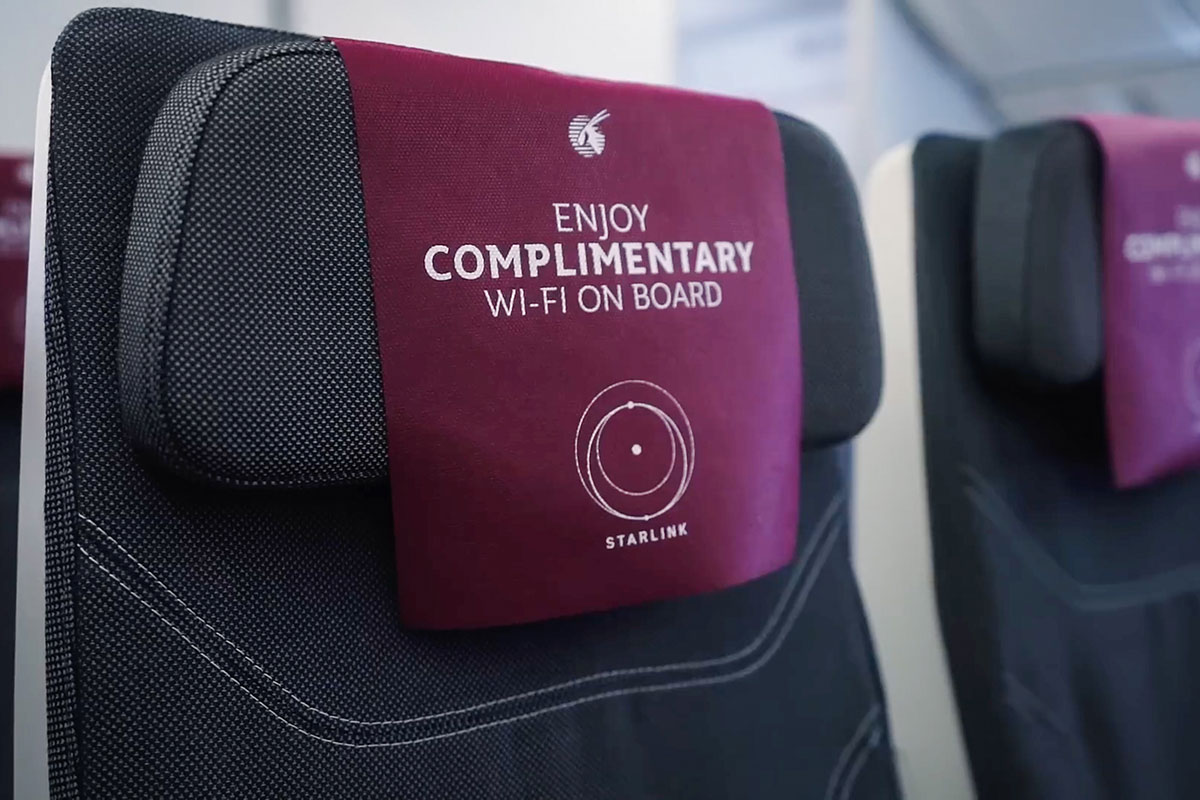
(Image: Qatar Airways)
Over the last week a variety of cities have seen the Starlink-equipped jet in action, including London, Melbourne, Adelaide, New York, Tokyo and Amsterdam, but there’s no apparent guaranteed services yet – the jet is simply slipping into the regular Boeing 777-300ER network as required.
Qatar Airways Starlink rollout
While at this stage there is a very limited chance of being on board this sole Qatar Airways Starlink-equipped aircraft, that should start to change quite quickly over the coming months.
The carrier had initially planned to rollout three Boeing 777-300ERs with Starlink Wi-Fi by the end of 2024, but is now set to significantly exceed this target with 12 aircraft being upgraded by the end of this year, over 20% of the Boeing 777 fleet.
All 57 Boeing 777-300ERs in the fleet will have Starlink by the end of 2025, a year ahead of the original schedule, while the 59-strong Airbus A350 fleet will start to be refitted from summer 2025 onwards.
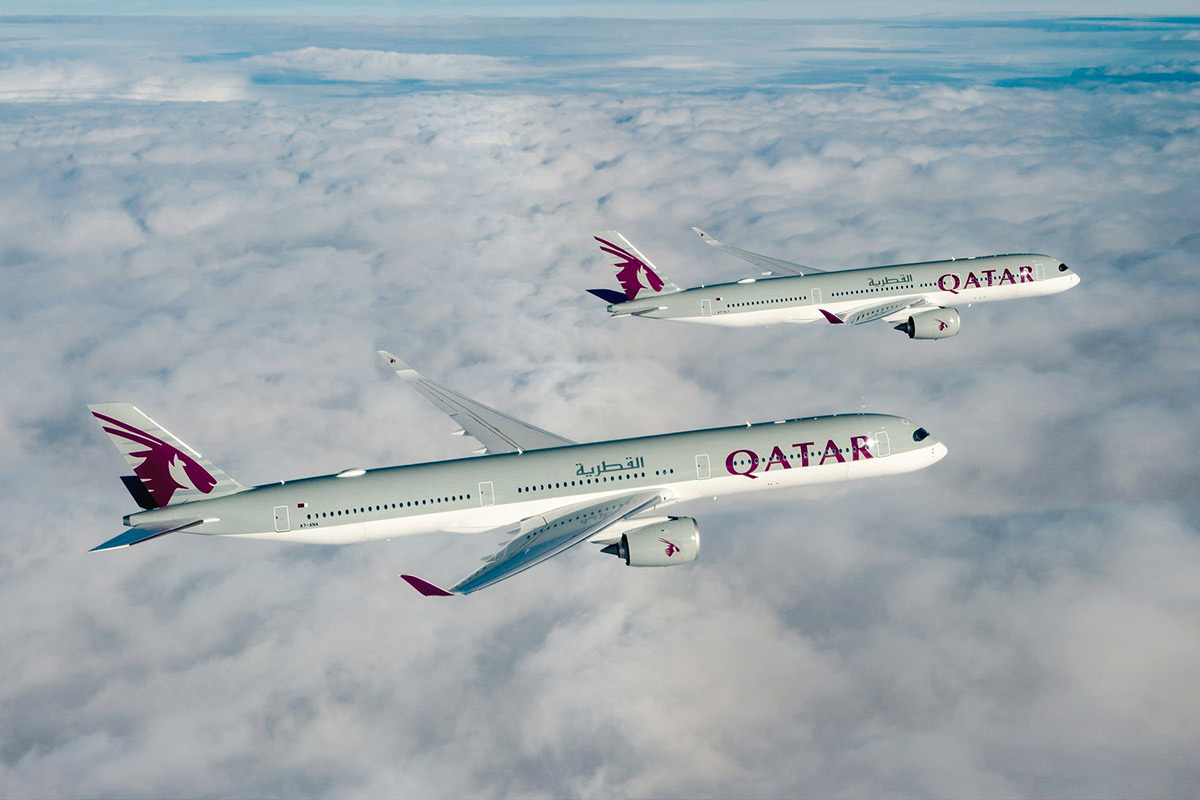
(Photo: Qatar Airways)
Although the carrier hasn’t provided an exact timeline for installing Starlink across all its A350s, we can optimistically expect completion by the end of 2026, assuming the 14-month refit timeline for the Boeing 777 fleet is replicated here as well.
So far Qatar Airways has not announced any firm plans to fit Starlink Wi-Fi to other aircraft types in its fleet, like the Boeing 787 and Airbus A380.
What makes Starlink faster?
Qatar Airways has been progressively rolling out its “Super Wi-Fi” in recent years, which is powered by the Inmarsat (now Viasat) Global Xpress (GX) Ka-band satellite network, though some aircraft like the carrier’s A380s still only offer the old slow SITA OnAir connection.
With advertised download speeds of “up to 50 Mbps”, we actually found around 16 Mbps to be the realistic maximum in our review of the carrier’s GX connection.
Starlink, on the other hand, uses a network of Low Earth Orbit satellites, which sit at around 550km altitude, compared to more typical geostationary satellites, like Inmarsat’s, that sit almost 36,000km above the earth.

This allows for faster speeds and much lower latency (delay), compared to the satellite Wi-Fi connections we are currently used to on board carriers like Singapore Airlines, and on non-Starlink Qatar Airways flights.
Starlink already boasts the world’s largest satellite internet constellation, consisting of over 5,000 satellites.
Most satellite internet services come from single geostationary satellites that orbit the planet at 35,786 km.
Starlink
As a result, the round trip data time between the user and satellite—also known as latency—is high, making it nearly impossible to support streaming, online gaming, video calls or other high data rate activities.
Starlink is a constellation of thousands of satellites that orbit the planet much closer to Earth, at about 550km, and cover the entire globe. Because Starlink satellites are in a low orbit, latency is significantly lower—around 25 ms vs 600+ ms.
The latency is the ‘ping’ time you see when doing an internet connection speed test, and it sure does come in at around 600ms when we’ve done so on most of our flights using more traditional satellite connections (even 900ms is not uncommon).

Starlink is now installed on all 42 of Hawaiian Airlines’ Airbus A321 and Airbus A330 aircraft, and this recent detailed review gave the free service high praise, with ping times of 36ms to 124ms, a fraction of the current norm on most carriers.
Will Singapore Airlines jump on board?
Singapore Airlines recently made unlimited Wi-Fi connectivity free of charge for all passengers across its fleet, with the exception of the seven (now six) ex-SilkAir Boeing 737-800s, which don’t have any internet connection, but will be leaving the fleet by the end of 2025.
Those travelling in Economy and Premium Economy need to be KrisFlyer members in order to benefit, but in Business Class and First Class it doesn’t matter either way. Full details of SIA’s inflight Wi-Fi service are available here.
With typical speeds of between 4 Mbps and 9 Mbps on board, not to mention those typical 600ms+ ping times, the airline is running the risk of being left behind in the Wi-Fi connectivity stakes as more carriers follow the likes of Qatar Airways and upgrade to the Starlink system.

(Photo: Singapore Airlines)
Last month United Airlines became the largest customer to sign up to Starlink Wi-Fi, announcing that the technology would be rolled out to provide free Wi-Fi across more than 1,000 aircraft, with installations starting in 2025.
Air France has also announced that it will be installing Starlink to provide free Wi-Fi to all its Flying Blue members on board flights from 2025, with plans to eventually equip its entire fleet – including regional aircraft.
Even smaller carriers are getting on board, with Air New Zealand set to commit, planning to adopt the technology to provide free Wi-Fi across its entire domestic fleet, subject to the results of a trial on one aircraft later this year.
Singapore Airlines was the first airline in the world to adopt GX Aviation Ka-band Wi-Fi on its Airbus A380s, currently its fastest system also installed on some other aircraft types in the fleet, but its capabilities are hugely eclipsed by the speeds Starlink now offers.
So far the airline has been quiet about any future plans for on-board Wi-Fi connectivity, but let’s hope Starlink is being considered as an option, since it would significantly improve the in-flight connectivity experience.


Summary
Qatar Airways is now flying its first aircraft with Starlink Wi-Fi, and a rapid rollout will see all 57 of the carrier’s Boeing 777-300ERs sporting this fast, free gate-to-gate connectivity by the end of next year.
The Oneworld carrier’s Airbus A350s will also go under the knife from mid 2025, for their own Starlink upgrades.
Meanwhile Singapore Airlines is surely not ignoring this major step change in the industry, as carriers like United and Air France also get on board with Starlink, so there’s a possibility that we might even see this enhanced connectivity make its way to SIA aircraft in the years ahead.
(Cover Image: Qatar Airways)