

Here’s our review of the DBS Altitude credit cards issued in Singapore. It forms part of our series of credit card reviews, which are all summarised on our dedicated Credit Cards page.
Dollar amounts refer to SGD, and ‘miles’ refer to KrisFlyer miles, except where stated. This review was updated on 16th July 2020.
| Fast Facts
Annual fee: $192.60/yr (first year free) |
Foreword
The DBS Altitude comes in two varieties, a Visa and an American Express version. The fees, miles and benefits of the two cards are identical, except where we’ve specified otherwise.
Annual Fee
The annual fee for the DBS Altitude cards is $192.60, though the fee is waived for the first year and at renewal if you spent at least $25,000 on the card in the last membership year.
If you don’t meet the spend threshold in your membership year however, and therefore have to pay the annual fee, you’ll also receive a 10,000 miles bonus on renewal (i.e. paying 1.93 cents per mile), which is reasonable. You can also voluntarily pay the annual fee, even if you spend over $25,000 in a membership year, and receive the 10,000 miles bonus.
Sign-up bonus
10,000 bonus miles for spending $6,000 within the first 3 months for new DBS/POSB credit card customers, or those who have not held a DBS/POSB credit card in the last 12 months. The offer is for the DBS Altitude Visa or American Express card. Ends 31st July 2020.
Effectively the annual recurring bonus is 10,000 miles, provided you are either required to pay the annual fee, or choose to pay it voluntarily, however this is not available when first issued the card. As mentioned above, it’s the equivalent of ‘buying’ the miles for 1.93 cents each.
As we value KrisFlyer miles at 1.9 cents each, those 10,000 miles are worth at least $190 against future redemptions, so the card comes close to paying for itself, even if you don’t use it much. Having said that, we would prefer not to ‘buy’ miles at this rate.
Earning rates
The DBS Altitude cards earn 1.2 miles for every $1 spent locally (i.e. transacted in SGD), and 2.0 miles for every $1 spent overseas (i.e. transacted in foreign currency).
There are some higher earning rates for using the card at certain airline and travel companies, which we’ll look at later on.
50% more miles on the Amex card
DBS is currently running a promotion for new applicants for the DBS Altitude Amex card with 50% more miles than usual for the first 3 months, with the bonus miles capped at 10,000 miles.
| Spend category | Regular Rate | 50% Bonus Rate |
| Local | 1.8 mpd | |
| Overseas | 3.0 mpd | |
| Online Flight / Hotel* | 4.5 mpd |
* Includes online spend at sites including singaporeair.com, cathaypacific.com, qatarairways.com and expedia.com.sg
In some spend categories that’s worth 4.5 miles per dollar, and means you can relatively easily earn a total of 50,000 miles in the first three months with the American Express card with the sign-up bonus, spend bonus and annual fee bonus combined (though you may want to opt out of the latter).
Remember the enhanced miles bonus is capped at 10,000 miles, to hit that you’ll need to spend the following amounts (assuming all spend is in a single category):
- Local spend (bonus 0.6 mpd): $16,666
- Overseas spend (bonus 1 mpd): $10,000
- Online Flight / Hotel Spend (bonus 1.5 mpd): $6,666
The bonus miles earned as part of this promotion are in addition to the 10,000-mile sign-up bonus, provided you meet the $6,000+ spend in the first 3 months. Apply by 31st July 2020. Full details can be found in our article here.
Are KrisFlyer miles credited directly?
No, in fact rather than being credited miles directly you’ll accrue ‘DBS Points’ for your regular spending on this card. These transfer to KrisFlyer miles at a 1:2 ratio, so for $10,000 of local spending, you’ll net 6,000 DBS Points, which can be converted to 12,000 KrisFlyer miles.
Do DBS Points expire?
No they don’t, which is great because as you will probably know once transferred into KrisFlyer miles they will then only last for three years. That means there’s no need to keep an eye on the expiration date at the DBS side, just transfer to KrisFlyer when you need to.
What is the transfer cost to KrisFlyer miles?
It’ll cost $26.75 (including GST) each time you transfer DBS Points to KrisFlyer miles.
Is there a minimum transfer amount?
The minimum volume of miles you can transfer into KrisFlyer is 10,000 (i.e. 5,000 DBS Points). Thereafter they must then be transferred in blocks of 10,000.
How long do miles take to credit to KrisFlyer?
The official line is “approximately 10 working days”. In other words, about 2 weeks. That’s a bit on the long side if you’re chasing a currently available redemption ticket.
Luckily the FlyerTalk forum post where KrisFlyer members share the actual number of days taken to transfer miles across from various banks, suggests that 1 to 4 days is more typical from DBS, with some reporting to receive their miles the same day (presumably on a working day with a transfer request submitted in the morning).
That’s much more reasonable.
Which loyalty schemes can I transfer into?
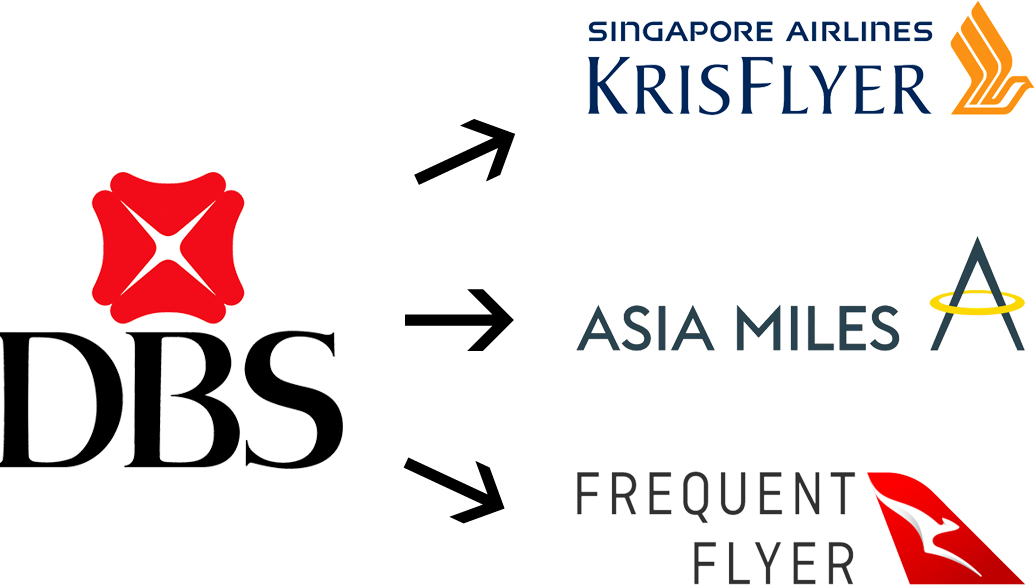
Singapore Airlines KrisFlyer, Cathay Pacific Asia Miles and Qantas Frequent Flyer Points. The same earning rate, transfer cost, and minimum transfer ‘blocks’ apply if you choose to credit to Asia Miles or Qantas.
You can also transfer your DBS Points to Air Asia BIG Points, here 500 DBS Points will transfer into 1,500 BIG Points (a 3:1 ratio), though it won’t be much interest to our readers – BIG Points are worth only about $0.0034 each (0.34 cents), or about 6 times less than we value a KrisFlyer mile / Asia Mile.
Auto Miles Conversion (KrisFlyer)
An alternative to converting your DBS Points ‘manually’ to KrisFlyer miles as and when you need to, and paying $26.75 each time, is to enrol in the Auto Conversion Programme. Here you’ll instead pay $42.83 per annum, and your points will automatically be converted at the end of each quarter (i.e. around 10th January, 10th April, 10th July and 10th October each year, for points accrued in the previous calendar quarter).
The minimum transfer amount is also reduced from 10,000 to just 1,000 KrisFlyer miles (500 DBS Points), so if you have only 2,200 DBS Points at the quarterly cutoff date, for example, you’ll have 4,000 KrisFlyer miles credited (with 200 DBS Points carried forward to the next quarter).
Under the normal system, you’d have to wait until you had accrued at least 5,000 DBS Points in order to transfer 10,000 KrisFlyer miles across.
Bear in mind as we mentioned above that DBS Points never expire, but as soon as they are transferred to KrisFlyer miles they will only be valid for 3 years. That means when you use the Auto Conversion Programme, the expiry clock will start ticking sooner.
Whether this scheme works out better for you depends on your usual miles transfer patterns. If you would usually only make one annual transfer to KrisFlyer miles from the card, it’s better to stick with the single payment of $26.75 once per year than use the Auto Conversion Programme. Provided you’d probably transfer twice or more per year, or if you use this card to accrue smaller volumes of miles, you may want to consider enrolling in Auto Conversion.
If you are enrolled for the Auto Conversion scheme, and you wish to make an ad-hoc conversion to KrisFlyer miles in between the regularly quarterly ones (for example following a large purchase), you are free to do this and will not be charged the $26.75 fee which would otherwise apply. The minimum transfer of 10,000 KrisFlyer miles (and 10,000 mile blocks) then applies, however.
Remember this scheme is only available to those converting DBS Points to KrisFlyer, not to Asia Miles, Qantas Points or Air Asia.
Instant free transfer to KrisFlyer miles via KrisPay
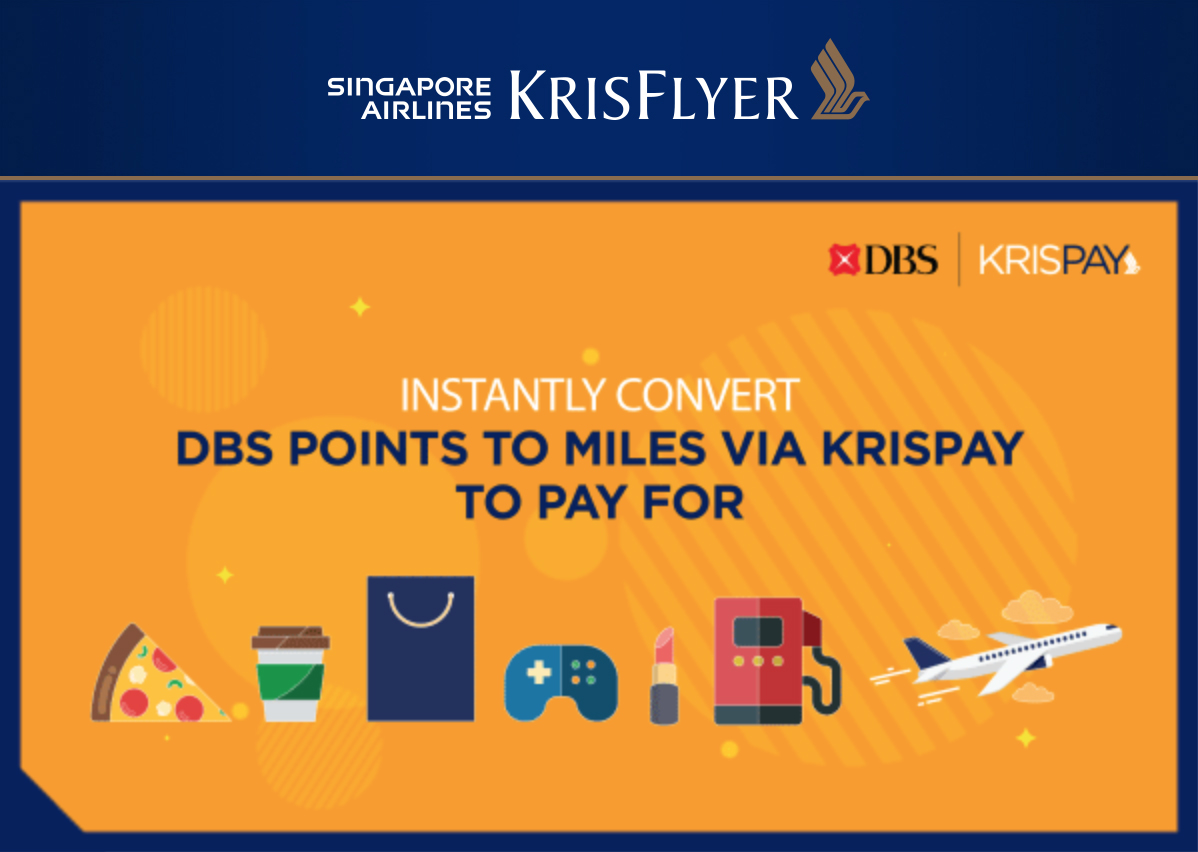
Since mid-June 2019 you have been able to link your DBS Points and KrisPay account and instantly transfer as little as 100 points into KrisPay miles.
The transfer ratio is 1:1.7 (e.g. 100 DBS Points = 170 KrisPay miles)
You won’t want to be using them there due to the awful value against purchases of 0.67 cents per mile, but you can transfer them 1:1 into KrisFlyer miles.
As you’ll notice this is a 15% hit on the usual DBS Points to KrisFlyer transaction rate, so it’s only of interest if you need a small amount to meet a specific redemption threshold, or have a small balance ‘stuck’ in DBS Points (less than 5,000) which you aren’t going to be adding to in future. You shouldn’t be using it as your regular DBS Points to KrisFlyer transfer method.
There are two golden rules to be aware of, firstly you’ll have to move any points transferred from DBS to KrisPay into KrisFlyer miles within 7 days, otherwise they are stuck in KrisPay (where you definitely don’t want them).
The second is just as important, you cannot use any of the KrisPay miles you have earned from your DBS Points transfer for any KrisPay purchase, no matter how small, as that automatically renders the entire transfer stuck in KrisPay forever.
The golden rule therefore is to transfer in to KrisPay, then transfer straight out to KrisFlyer. Even with that 7-day window available, our advice is don’t wait.
Points rounding
DBS doesn’t have the simplest rounding policy for issuance of its DBS Points when you make a purchase using the Altitude cards.
“DBS Points shall be awarded to the Principal Cardmember based on the amount of retail purchases charged to the Card Account on a per transaction basis, rounded down to the nearest whole number.”
DBS Rewards Terms and Conditions
That means each transaction you make, whether in SGD or foreign currency, will first be rounded down to the next whole dollar before DBS Points earning is assessed (e.g. $57.99 is rounded down to 57).
Now for the trickier part.
“DBS Altitude Cardmembers earn 5 DBS Points for every S$5 equivalent in foreign currency purchase and 3 DBS Points for every S$5 local currency purchase. Cardmembers earn an additional 2.5 DBS Points for every S$5 equivalent in foreign currency online flight & hotel purchase and an additional 4.5 DBS Points for every S$5 local currency online flight & hotel purchase, capped at S$5,000 spend on online flight & hotel purchases per calendar month.”
DBS Rewards Terms and Conditions
That suggests points will only be awarded in $5 spend blocks, however it’s not quite that simple.
Your rounded down transaction (57 in the $57.99 example above) is then divided by 5 before being multiplied by the appropriate number of DBS Points.
While DBS does not then mention it specifically, only whole DBS Points can be awarded for your transaction so it’s another ’round down’ at the end to the next whole point.
For example, assuming a $57.99 local transaction:
- $57.99 rounds down to 57
- 57 / 5 = 11.4 x 3 (local purchase) = 34.2
- 34.2 rounds down to 34
- 34 DBS Points awarded (equivalent to 68 miles, so you’re getting 1.17 mpd)
Here’s how it works for a $57.99 foreign currency transaction:
- $57.99 rounds down to 57
- 57 / 5 = 11.4 x 5 (FCY purchase) = 57
- 57 rounds down to 57
- 57 DBS Points awarded (equivalent to 114 miles, so you’re getting 1.97 mpd)
Minimum spend to earn points
Since you’ll need to accrue at least 1 DBS Point to earn miles for your transaction (0.99 DBS Points rounds down to zero), the minimum spend in SGD on the DBS Altitude card to earn points is:
- Local transaction: $1.67
- FCY transaction: $1.00 (after conversion)
- Online flight / hotel transaction: $0.67
Foreign currency fee / cpm overseas
DBS imposes a rather steep 3.25% fee on transactions made in foreign currency on the Altitude cards. With a 2 cents per mile overseas earn rate that makes it one of the less competitive cards to use for these transactions, with an effective cost per mile of 1.71 cents using the DBS Altitude Visa card.
Cost per mile on overseas credit card transactions by card
(Best to worst, June 2020)
| Card | Fee | Miles per $ | Cost per mile |
 SCVI SCVI |
3.5% | 3.0* | 1.22¢* |
 HSBC VI HSBC VI(Step up rate) |
2.8% | 2.25** | 1.33¢** |
 KF Ascend KF Ascend(Jun & Dec) |
2.5% | 2.0 | 1.36¢ |
 OCBC Voyage OCBC Voyage |
3.0% | 2.2 | 1.45¢ |
 UOB PRVI Miles UOB PRVI Miles |
3.25% | 2.4 | 1.43¢ |
 Maybank Horizon Visa Maybank Horizon Visa |
2.75% | 2.0 | 1.48¢ |
| HSBC VI (Regular rate) |
2.8% | 2.0 | 1.50¢ |
 OCBC 90°N OCBC 90°N |
3.0% | 2.1 | 1.52¢ |
 BOC EM BOC EM |
3.0% | 2.0 | 1.60¢ |
 DBS Altitude Amex DBS Altitude Amex |
3.0% | 2.0 | 1.60¢ |
 DBS Altitude Visa DBS Altitude Visa |
3.25% | 2.0 | 1.71¢ |
 Citi PM Visa Citi PM Visa |
3.25% | 2.0 | 1.71¢ |
 X Card X Card |
3.5% | 2.0 | 1.83¢ |
 KrisFlyer UOB KrisFlyer UOB |
3.25% | 1.2 | 2.86¢ |
* 3 mpd earn rate for the SCVI card is subject to a minimum spend of S$2,000 (any currency) in the same statement cycle.
** Step up earn rate for HSBC VI is only applicable from year 2 of card membership onwards, provided you spent at least S$50,000 in the previous year.
As you’ll notice though, the DBS Altitude Amex card has a slightly lower 3% FCY fee and therefore a more competitive 1.6 cents cost per mile for these transactions.
Cost per mile also accounts for an additional 0.3% ‘spread’ over money changer currency rates, though this doesn’t apply to all banks and all foreign currencies, so is a worst-case scenario.
What else can DBS Points be used for?
There are a variety of rewards other than airline miles you can use your DBS Points for, though as usual they all represent much poorer value.
We know that 1 DBS Point can be converted into 2 KrisFlyer miles, which we value at 1.9 cents each, so that’s approximately 3.8 cents value to a DBS Point when used this way.
Other transfer options are largely for shopping and retail vouchers, for example a $10 FairPrice voucher will set you back 690 DBS Points. The same number of points should be getting you 1,380 KrisFlyer miles, worth about $27.60. You should never be using your DBS Points for anything other than KrisFlyer miles, Asia Miles or Qantas Points transfers.

Other benefits
As a relatively low (or no) fee card, DBS Altitude isn’t showered with additional benefits, but some of the key ones which will be of most interest to our readers are:
- 3 miles per $1 spent* on online flight and hotel bookings, including at singaporeair.com, cathaypacific.com, qatarairways.com, and expedia.com.sg
- 7 miles per $1 spent* on overseas hotel bookings at Agoda until 31st December 2020. See our article for full details.
- 10 miles per $1 spent* on local (Singapore) hotel bookings at Agoda until 31st December 2020. See our article for full details.
- 10 miles per $1 spent* on hotel stays with Kaligo.
- 2 complimentary lounge access visits within each 12-month period of Priority Pass membership (exclusive to DBS Altitude Visa)
- DBS Altitude Butler Service
* Capped at $5,000 spend per calendar month, with one ‘shared’ limit for all of the above, not per category.
Recurring promotions
DBS Altitude run occasional miles promotions, most recently a 3 miles per $1 on overseas spending (physical, not online), and a double miles promotion by category for any spending between $2,500 and $5,000 per month.
None of these promos are currently running, but it’s nice that you should expect to take advantage of one or two of these offers per year with this card.
Our summary
The DBS Altitude cards are a good entry-level option for the miles earner, with an attractive low income requirement, but still featuring a decent local miles earning rate.
It has some nice features – especially 3 miles per $1 spent online at Singapore Airlines, Cathay Pacific and Qatar Airways. It also has our favourite 10 miles per $1 Kaligo promo, which is now exclusive to this card since UOB and Citi withdrew some of their products from the offer.
For those with sufficient income, we would suggest the Citi PremierMiles or UOB PRVI Miles cards instead, especially Citi for the more attractive sign-up bonus usually on offer.
That said, this remains a good card with a few nice perks, occasional miles promotions, and a fee-free renewal option for those spending at least $25,000 per year. Both cards also have a 10,000 miles sign-up bonus until 31st March 2020, and are fee-free for the first year.
The DBS Auto Miles Conversion programme also has the potential to reduce the miles transfer fees for many people.

Links on Mainly Miles may pay us an affiliate commission.
You ought to mention that dbs points are accrued in $5 blocks. Ie every transaction you make is rounded to the lowest multiple of 5, and every $5 earns you 3 dbs points, and in turn gets you 6 miles. So the 1.2 miles for $1 spending isn’t practically true.
Dear Ansen.. The age-old-saying, that blood is thicker than water, isn’t practically true either.. You can’t possibly expect every single morsel or nugget of information to be spoon-fed to you..besides, it isn’t Mainly Miles’ onus to highlight all these things to you, when even your banks don’t!
By the way, did you know that ALL bank have different exclusions as to what is deemed as a “qualifying charge”? That even if you’re paying International School Fees of $60k p.a. or double that (if you had two kids).. if on some (several) cards.. you’ll earn NOT ONE SINGLE POINT (or Mile)?! Who would you go crying to, in event you did something like that? Sue Andrew? Sue the bank?
AMEX cards for the dummies. Either it is accepted and you get rewards or it is not.
How is it for dummies, when, in 60 days of getting the card, it’s got me Marriott Gold, Hertz Gold Plus, 2 nights stay at MO HKG, 2 free nights at Shangri-La, USD200 in F&B credits at Shangri-La, SQ KF Gold/ Star Alliance Gold, Unlimited Plaza Premium +3, Hilton Diamond and 1.6 million Hilton Points..?
Be careful with the 3 mpd for online air tickets purchases. On the one hand, you get 3 mpd on virtually any airline website. I got 3mpd booking on fairly mainstream ET, but also on more exotic Z8 and OB. On the other hand, bookings on Expedia, if payment is not processed by Expedia, becomes a problem. My recent purchases of AV and CI tickets through Expedia were deemed to be offline payments, as payments were processed by the airlines (Hahn Air in the case of AV tickets). I’ve lodged an appeal to DBS. Let’s see if it gets me anywhere.