


If you’ve been flying with – or simply following – Singapore Airlines over the past few decades, you might recall something you no longer see on their aircraft as you prepare to board: a name proudly displayed on the forward fuselage.
This tradition of assigning a unique ‘mark’ or name to each aircraft type in the fleet was once a beloved detail, appreciated by aviation enthusiasts and frequent flyers alike. However, it began to fade away in 2003, during the early tenure of CEO Chew Choon Seng, as the airline adopted a more international branding.
Still, it’s the perfect excuse to take a nostalgic look back at this chapter in the airline’s history – and revisit the names these aircraft once proudly carried.
Airbus A300: Superbus
Singapore Airlines marketed the Airbus A300, a type it flew for a short period between 1980 and 1985, as the ‘Superbus’, with newspaper adverts in 1981 such as:
- Our new A300 Superbus departs Singapore for Kuala Lumpur daily at 9am
- From 1 April, SIA’s new A300 Superbus departs Singapore for Bangkok at 1.45pm daily

While we originally believed that ‘Superbus’ was only used as a marketing tagline, a photo from 1982 confirms it was indeed printed alongside the aircraft type at the rear of the aircraft.

(Photo: Aero Icarus)
However, it seems like in subsequent years the ‘Superbus’ titles were no longer included.

(Photo: Doug Green)
Airbus A310: 3TEN
Singapore Airlines’ Airbus A310s bore the somewhat uninspired ‘3TEN’ titles just below the flight deck windows on either side of the aircraft.

(Photo: Tim Rees)
A total of 23 of these aircraft were deployed in the SIA fleet between 1984 and 2005.
Airbus A340-300: Celestar
The Airbus A340-300s were named ‘Celestar’, with the title used heavily in the aircraft’s branding when they joined the fleet in 1996.
For example, newspaper advertisements for daily non-stop flights to Sydney and Paris that year boasted of “The comfort of the Celestar A340, the most sophisticated Airbus in the world”.

(Photo: Calixius Casper Koh)
The name always seemed a little perplexing to us, since pretty much all of the other aircraft names SIA used were more obviously meaningful, or self-explanatory.
One possibility we came up with was that it related to a previous Singapore Airlines trademark ‘Celestel’, the world’s first global sky telephone service, which launched in September 1991.

Perhaps the A340-300, which arrived in 1996, was the first aircraft type to be fully fitted with the system? This would make some sense as the aircraft was also the first in the fleet with a guaranteed KrisWorld IFE system at every seat.
Thanks to reader Kenneth, we now know that the name ‘Celestar’ was a result of an internal naming competition among SIA staff.
Airbus A340-500: LeaderShip
Singapore Airlines pioneered ultra long-haul services way back in June 2004, with a record-beating 15,300km non-stop service from Singapore to Newark, taking over 18 hours.
These services were made possible by a brand new fleet of five Airbus A340-500 aircraft, which the airline named ‘LeaderShip’.

(Photo: Rinaldi Hanafi)
Non-stop flights to Los Angeles followed, however the operating economics of using a four-engined aircraft at a time of record fuel prices later led to these services being discontinued in November 2013.
The ‘LeaderShip’ titles didn’t last long in fact, as CEO Chew Choon Seng did not favour the policy, and a revised livery design with larger ‘Singapore Airlines’ titles occupied the space formerly used for them.

(Photo: Rinaldi Hanafi)
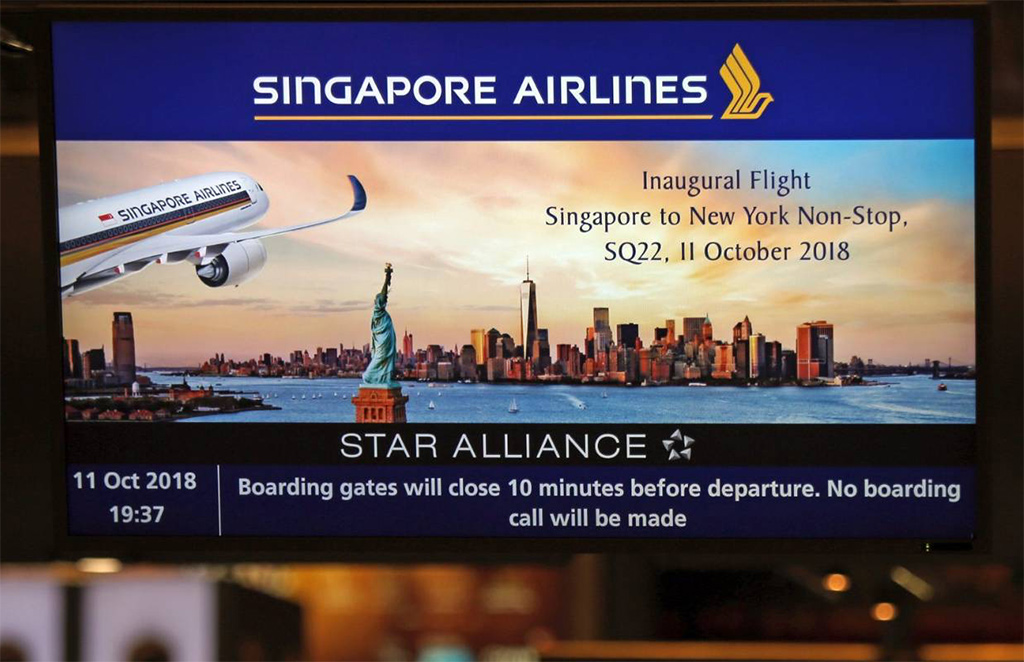
Non-stop flights to Newark and Los Angeles restarted in late 2018, using the airline’s efficient new Airbus A350 ULR aircraft.
(Photo: Maye E Wong / Shutterstock)
Boeing 747-200: Super B
Singapore Airlines referred to the Boeing 747-200B as the ‘Super B’ in its advertising, though this label appeared on the aircraft itself only in small lettering near the rear of the fuselage, alongside the aircraft type.

(Photo: Frank C. Duarte Jr)
You can just make out the small titles at the back in this photo of a 747-200 landing in Los Angeles.

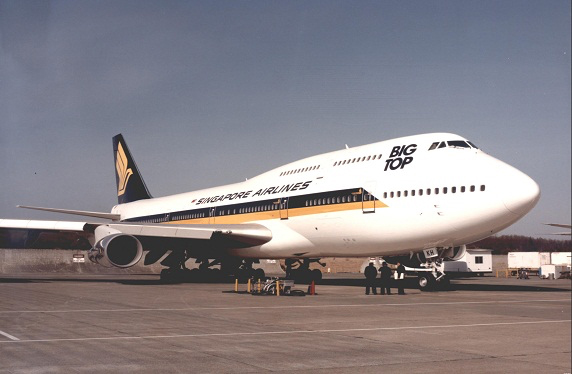
Boeing 747-300: BIG TOP
Singapore Airlines started operating the Boeing 747-300 in 1983, continuing to do so until 2001 with a 14-strong fleet of the type, before they were eventually replaced by the more advanced Boeing 747-400.
The aircraft had a significantly stretched upper deck compared to the Boeing 747-200, leading SIA to christen it ‘BIG TOP’.
(Photo: Singapore Airlines)
The stretched upper deck accommodated 40 Business Class passengers in a 2-2 layout, compared to 16 passengers in the same format on the Boeing 747-200.
Fun facts:
- Three of SIA’s Boeing 747-300s were ‘Combi’ aircraft, with the rear section of the main deck converted into a cargo compartment, with its own side loading door. This reduced the passenger capacity from 380 to 304 and was used on ‘combi-cargo’ flights to Australia and Europe.
- The Boeing 747-300 allowed Singapore Airlines to launch what it promoted as “express daily BIG TOP one-stop services to London” in 1984. Non-stop London services only came with the advent of the Boeing 747-400, which could fly 2,500km further than the -300 without refuelling.
- The advent of the Singapore Airlines safety video came on the ‘BIG TOP’ 747-300s in May 1983. It was the first time SIA cabin crew had not performed the safety demonstration to passengers manually.
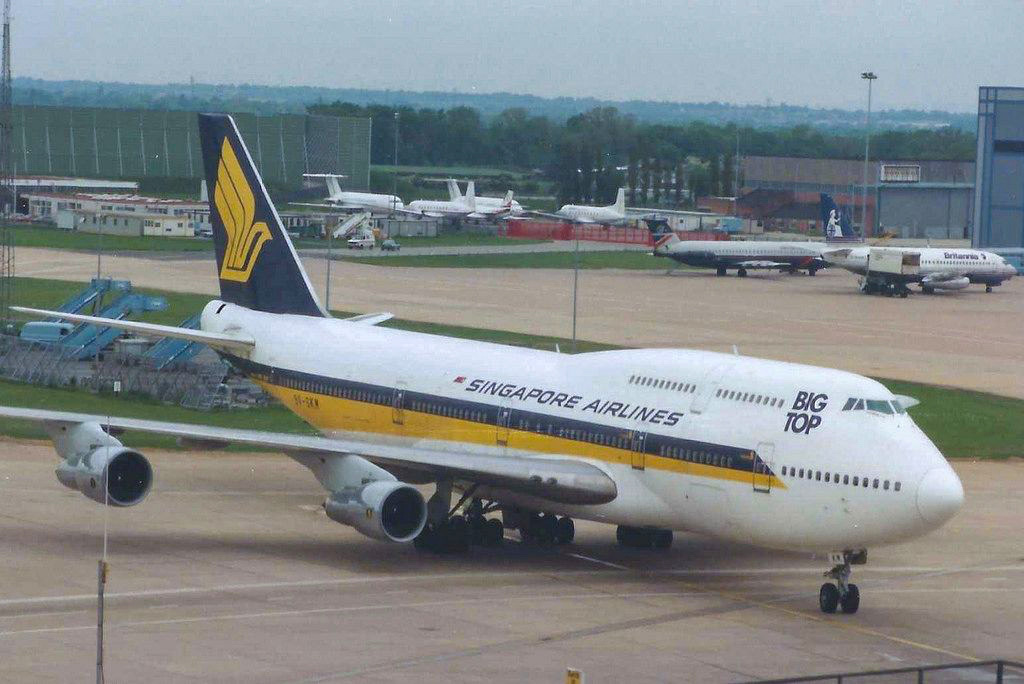
SIA’s 14 Boeing 747-300s really paved the way for a significant international expansion, then perfected by its 43 Boeing 747-400s. They retained the ‘BIG TOP’ titles until retirement.
Boeing 747-400: MEGATOP
Perhaps the most well known aircraft name in the Singapore Airlines fleet belonged to the airline’s large Boeing 747-400 fleet. With ‘BIG TOP’ already used, it was ‘MEGATOP’ chosen for what became by far SIA’s largest long-haul fleet of aircraft in the 1990s and 2000s.
The Star Alliance logo took the place of the old ‘BIG TOP’ titles, so the ‘MEGATOP’ branding was moved above the forward upper deck passenger windows.

(Photo: Norbert Genci)
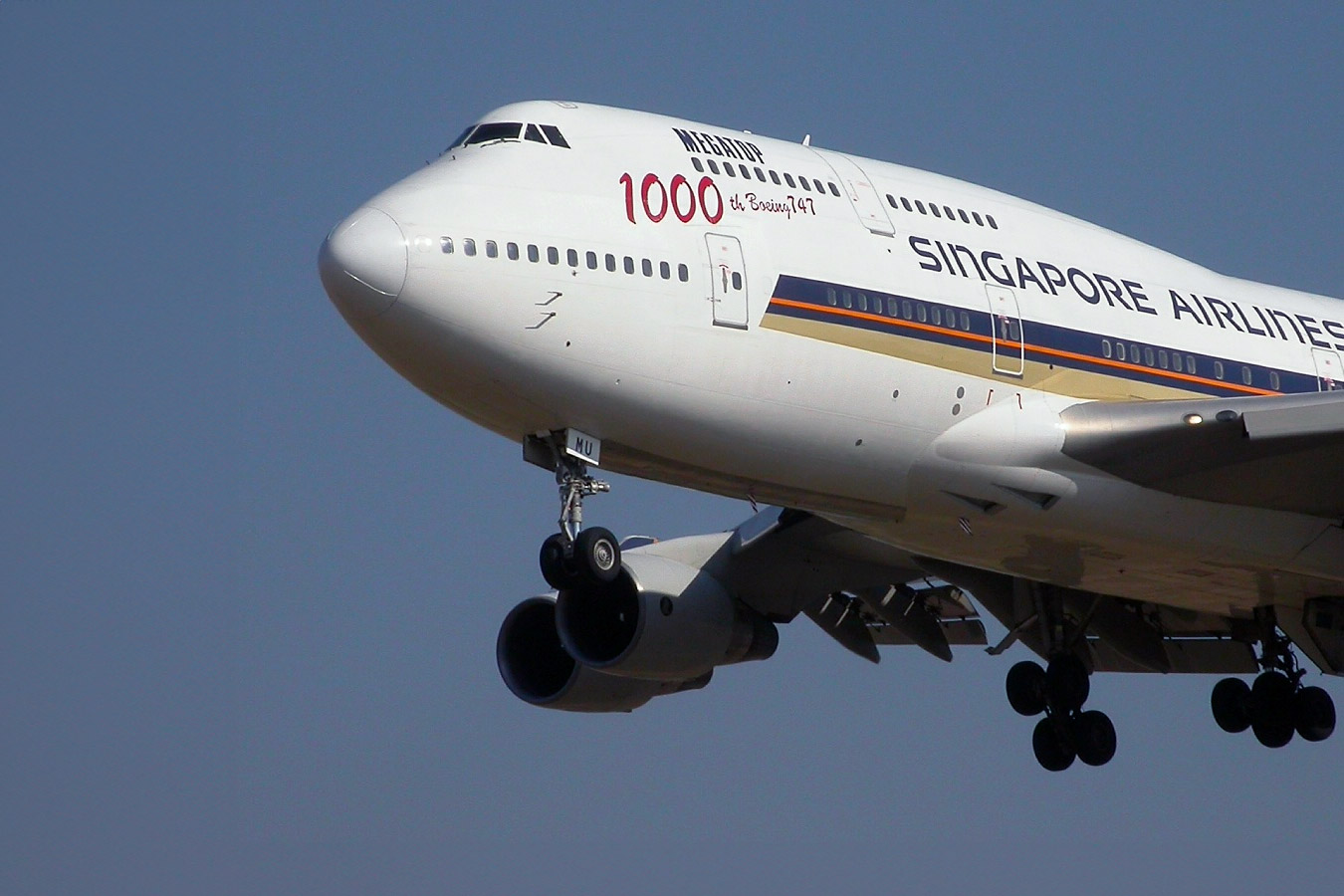
The ‘MEGATOP’ titles were gradually removed from 2003. The final aircraft to have its ‘name’ scrubbed was Boeing 747-400 9V-SMU (a registration now used on an Airbus A350 Long Haul).
(Photo: Michiel Haspeslagh)
It lost its ‘MEGATOP’ titles in mid-2006, probably coinciding with a major maintenance check.
For a trip back in time, here’s SIA’s 1989 promotional video for the Boeing 747-400 MEGATOP.
Boeing 747-400F: MEGA ARK
Singapore Airlines went for a biblical reference for its Boeing 747-400 freighter aircraft, referring to its fleet as ‘MEGA ARK’, presumably after the story of Noah’s Ark.

(Photo: Chris Finney)
These titles were phased out around the same time as the Boeing 747-400 passenger fleet branding, gradually disappearing between 2003 and 2005.
Boeing 777-200/-200ER/-300: Jubilee
SIA’s first Boeing 777s arrived the same year the airline was celebrating its 50th anniversary since it was founded as Malayan Airways, which commenced operations with single pilot six-seater wartime planes on 1st May 1947, flying (then) domestic flights between home base Singapore and Kuala Lumpur, Ipoh and Penang.
Half a century later the airline marked the first delivery of its far more technologically advanced Boeing 777-200ER aircraft by naming the new fleet ‘Jubilee’.

(Photo: Boeing)

(Photo: Chris Finney)
The Boeing 777-300s, first delivered in 1998, also carried the ‘Jubilee’ name.
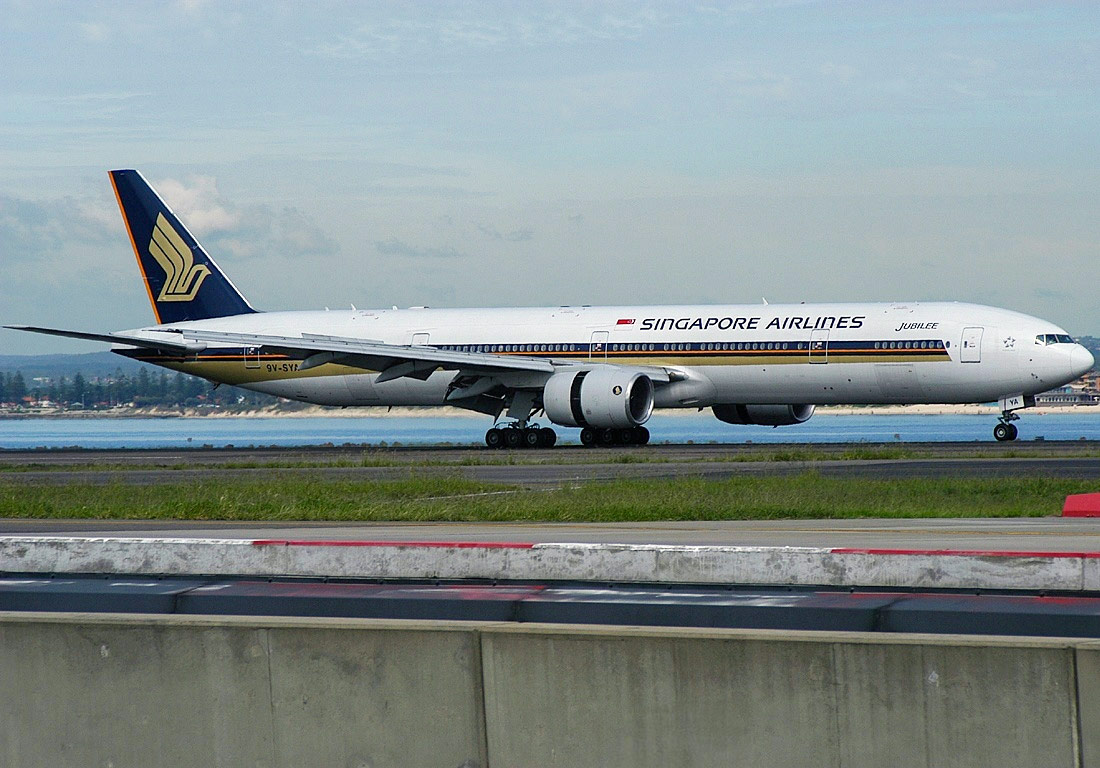
(Photo: Grahame Hutchison)
Never named
Some Singapore Airlines aircraft types never received a name, either because they left service before the naming policy began, or for the more recent types because they entered service after naming ceased.
Prior to naming:
- Aérospatiale-BAC Concorde (1977-1980, actually operated by British Airways, with SIA titles down one side)
- Boeing 707 (1972 – 1982)
- Boeing 727 (1977 – 1985, colloquially these were called ‘High Tails’)
- Boeing 737 (1972 – 1980)
- Boeing 757 (1984 – 1990)
- McDonnell Douglas DC-10 (1975 – 1985)

(Photo: Aero Icarus)
Since naming ceased:
- Airbus A330 (2009 – 2020)
- Airbus A350 (2018 – present)
- Airbus A380 (2007 – present)
- Boeing 737-800 (2021 – present)
- Boeing 737-8 MAX (2021 – present)
- Boeing 777-300ER (2006 – present)
- Boeing 787 (2018 – present)
Other special colour schemes
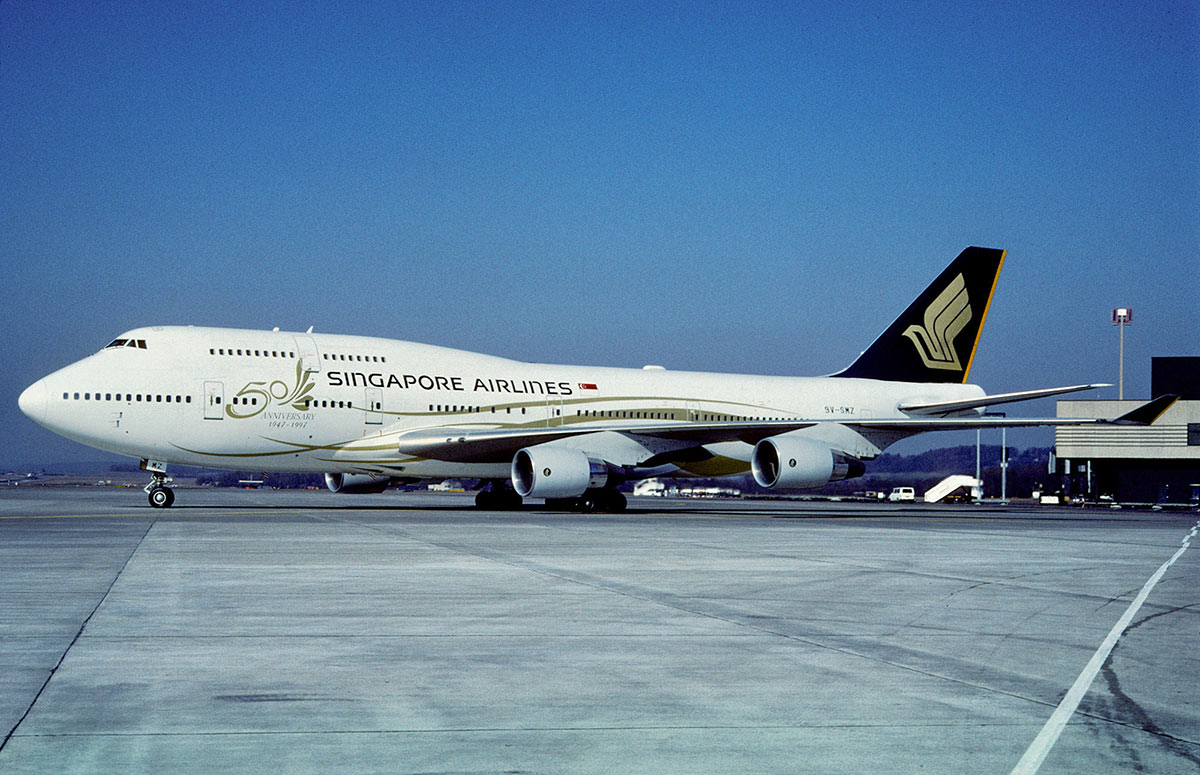
The special 50th anniversary paint job made its way to several aircraft across the fleet in the late 1990s, including this Boeing 747-400 (9V-SMZ).
(Photo: Aero Icarus)
There were then the pair of ‘tropical’ liveried Boeing 747-400s, which had an elaborate paint scheme applied in September 1998 to promote the airline’s latest First and Business Class products.
Those were the long-gone ‘Skysuite’ First Class and Ultimo Blue / Purple recliners in Business Class. How times have changed!
Unfortunately one of these aircraft, 9V-SPK, crashed while attempting to takeoff on a closed runway at Taipei in October 2000.

(Photo: Martin Oertle)
Sister ship 9V-SPL, which also had the tropical livery, was removed from service and repainted back into standard SIA colours after the accident.
Finally in June and July 2015 a pair of the airline’s flagship Airbus A380s, 9V-SKI and 9V-SKJ, were painted in a commemorative livery to celebrate Singapore’s 50th anniversary of independence.

(Photo: Masakatsu Ukon)
The aircraft were returned to their usual colours by mid-2017.
Scoot naming
Today, the only Singapore Airlines division that continues the tradition of naming its aircraft is Scoot – though with a twist.
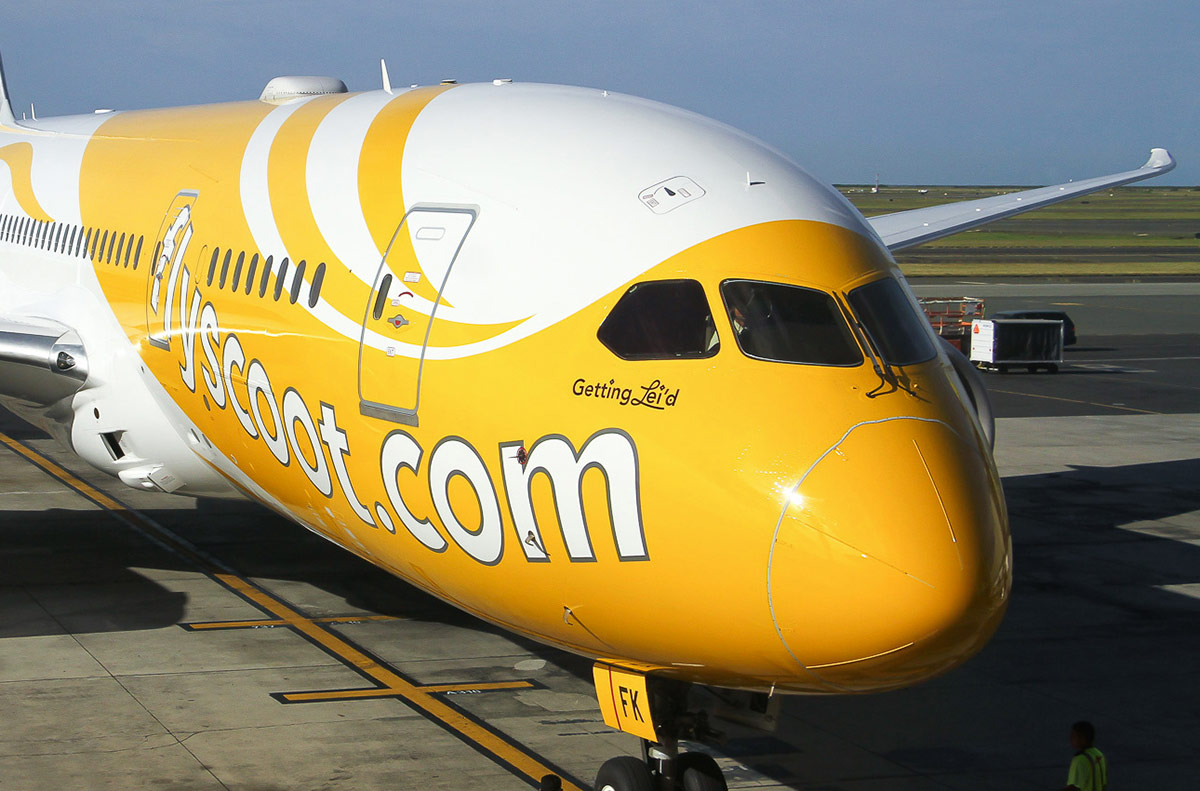
(Photo: Liam Mackinnon)
True to its playful brand identity, the low-cost carrier gives each of its aircraft a quirky, lighthearted name that reflects the carrier’s fun and cheeky marketing style.


Summary
Reflecting on the days when Singapore Airlines named its aircraft means rewinding the clock a couple of decades – a slightly sobering thought for some of us! Still, those unique names brought character to the fleet, and their quiet disappearance was a little sad to witness.
The exact reason behind the end of this tradition isn’t entirely clear, though it likely coincided with broader changes introduced by then-CEO Chew Choon Seng. Among them was the shift from the iconic ‘Raffles Class’ to the more globally recognisable – and arguably more practical – ‘Business Class’.
Did you ever fly on a named Singapore Airlines aircraft? And do you miss them? Share your memories with us in the comments below.
(Cover Photo: Chris Finney)
SQ has also stopped using the tag line A Great Way to Fly. For a short while, they changed it to More Than Ever, A Great Way to Fly.
wow, this is cool, thanks !
The A340-300 was named through a competition held internally by SIA. At the time SIA was celebrating it’s anniversary…can’t remember which. And the staff combined “celestial” and “star”…thus “Celestar”. I read it off their newsletter back in the 90s.
Would the various versions of the star alliance livery count as special liveries too? Besides their 773/333, which other aircraft type/s sport the Star Alliance livery?
Also, SQ made a small modification to their aircraft tails too under Chew. The 777s have a roof line that slopes down towards the tail of the fuselage. As with many other airlines the paint work on the tail moves along the slope. SQ instead chose to create an invisible line in a way that the golden goose sits parallel with blue paint. This is also evident on the A350, A380 and 787. I wonder if it could be a weight saving issue or just plain aesthetics?
Now that’s a great spot! This was definitely intentional in my opinion. Compared old photos of the 777 and the new ones, the blue paint on the vertical stabiliser is parallel to the ground, leaving a small streak of white underneath. Not sure why exactly, but may be aesthetics.
I believe only one of the 744s had the Star Alliance livery and that was 9V-SPP.
I like singapore airlines it the world class aircraft
Believed it was 9V-SPR, a 747-4H6 leased from MH
That is correct. I flew it from London to Singapore.
A lot of the premium SQ now commands can be attributed to “marketing BS”. Particularly in the back of the bus.
SIA’s B747-300 Big Top – and not the B747-400 Megatop – were the first to operate a regular nonstop service between London and Singapore, albeit just the one way, eastbound. However, Singapore to London was a one-stop service until the B747-400 was delivered.
I believe the 747-212 Super Bs were to distinguish the newer and more powerful 12 of the 19 * 747/212s SQ operated with JT9D-7Q engines registered 9V-SQH through to SQS. The older first 7 a/c had JT9D-7A engines, registered 9V-SIA,SIB, SQC through to SQG, and were just plain ordinary 747-212Bs
Thanks!
Thanks for this amazing article! One thing from me is that SIA actually did have the name for the B747-200 “Super B” painted on the aircraft. You just need to look hard enough. It is in fact written at the rear of the aircraft where the manufactorer and aircraft type resides. For SIA 747-200, it reads “Boeing 747 Super B”. That’s where it was! This was similar to that of the B727 where the manufactor and model was written on the tail engine, which wrote “Boeing 727 Advanced”. As such, for a long time i thought that was their name! Until I read this article and learned they were named “High Tails”, at least when marketing it. It was quite sad that the naming stopped. Would’ve been interesting to see what the new planes are called.
Would love to read an article on this.
Kinda sad that Singapore Airlines did not publicly announce the finalised design of its 70th Anniversary livery competition and imprint it onto its aircrafts like how they used the Singapore flag for SG50. It was then known that the 70th Anniversary design was imprinted onto its aircraft merchandise (an A380) sold in KrisShop instead.
It’s widely reported that Chew Choon Seng ranted endlessly within Airline House at what he called “marketing BS” – he didn’t believe in it, didn’t like spending money on it and didn’t like many of the products that came from it. Removing these names was his small way of putting his stamp on the place, much like his other hobby of obliterating the loyalty program. Do we remember 2007? A well known and very, very highly regarded former EVP once remarked that “under Chew, this place has changed, and not for the better”.
Most at SIA breathed a heavy sigh of relief when he was finally removed. The fear, short-mindedness and strategic blunders of Chew almost sent the airline to the ground, and took more than a decade to recover from. A nasty, dark period in SIA’s history that I hope won’t be repeated again.
Don’t know all the names. But thanks for the article. Nostalgic to recall some of them.
The tropical liveried aircraft were nicknamed “Rainbow”.
The airline’s livery is looking a little dated IMHO. The cheatline looks retro, underscored by the fad of airlines going retro by reverting from their modern, cleaner liveries to cheatline liveries (see Lufthansa, Thai, Malaysia). I know SQ likes to keep things timeless, but how about a little updating for the times? The larger “SINGAPORE AIRLINES” titles did not look good on the A380 – it screamed out on the aircraft and diminished the scale of the aircraft. Something a little more subtle would have worked better.
I was with Cabin Crew from 1961 for 41 years. When I read the heading of the article and tried to recall names given to the various aircraft. I failed. Thank you for this interesting article and helping me remember the good old nostalgic days of “A Great Way to Fly”.
“The Star Alliance logo took the place of the old ‘BIG TOP’ titles, so the ‘MEGATOP’ branding was moved above the forward upper deck passenger windows.”
That’s not completely accurate. The SIA 747-400 flew with the MEGATOP branding above the forward upper deck passenger windows *without* the Star Alliance logo at all, for several years from its introduction into the fleet to 2000, when SIA joined Star Alliance. That is when the alliance logo was added to the SIA aircraft.
I was directed here because i remembered flying the 747 Big Top when i was younger! I didn’t realise that it was a Singapore Airlines specific thing!
My first ever flight was on the return leg of the first non stop Singapore – London flight on a 747-400 big top , there was less that 50 passengers on the plane and I got to be in the cockpit as we made our final approach into Singapore. The most amazing and memorable flight of my life , shame they aren’t all Like that .
They will soon call the A350 the No Double Jeopardy Cruiser in honor of the SVP Flight Operations
I always remembered “Mega Top”. Made quite an impression when I was a young student moving to Singapore for the first time
It’s not true that The Star Alliance logo took the place of the old ‘BIG TOP’ titles, resulting the ‘MEGATOP’ branding was moved above the forward upper deck passenger windows.
The Star Alliance was found in 1997 while Megatop had been joined the SIA fleet since April 1989, that’s mean Megatop had been flying for 8 years without Star Alliance logo.
I have the opportunity to flew on all the above mentioned name plane by SIA. Oops! So you knowhow old am I 🤣🤣🤣🤣🤣🤣🤣🤣
Flew on 747-300 9V-SKA from London nonstop to Singapore in April 1985. It was on of the first nonstop Europe to Singapore flights. Didn’t have range to do Singapore to London nonstop
I flew a Celestar A340 in First Class from Brunei a long time ago. I also flew Megatop B747 in Ultimo Raffles Class to London around 1997.
The 747-200 Super B was painted on the second batch of 747 orders (9V-SQH and onward). They were powered by Pratt & Whitney JT9D-7Q engines. The first seven (9V-SIA, -SIB, -SQC through -SQG) had JT9D-7A engines and only had “Boeing 747” painted on the aircraft.