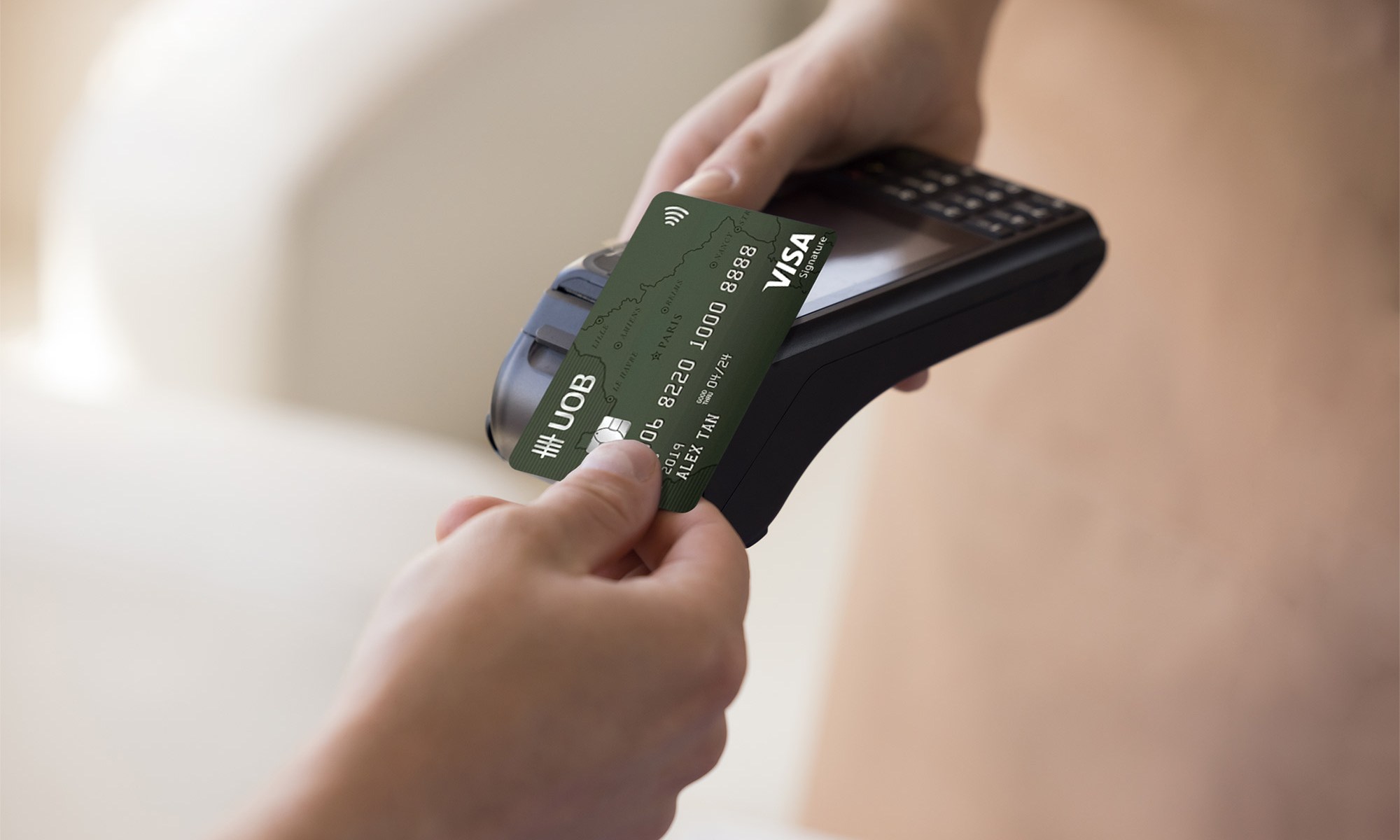

Here’s our review of the UOB Visa Signature credit card issued in Singapore. It forms part of our series of credit card reviews, which are all summarised on our dedicated Credit Cards page.
Dollar amounts refer to SGD, and ‘miles’ refer to KrisFlyer miles, except where stated. This review was updated on 29th July 2026.
| UOB Visa Signature | |||
 |
First year free |
4 mpd overseas |
4 mpd contactless |
| APPLY HERE | |||
| UOB Visa Signature | ||
|
||
|
First year free |
4 mpd overseas |
4 mpd contactless |
| APPLY HERE | ||
Mainly Miles Says
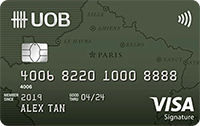
The UOB Visa Signature (UOB VS) is the higher‑ceiling sibling of the UOB Preferred Visa. It earns 4 mpd on overseas spend, petrol, and contactless payments – now including SimplyGo transit – on up to S$2,400 of spend each statement period, split across two categories.
That’s double the Preferred Visa’s monthly cap, and with the right spend profile it’s good for as many as 115,200 miles per year, transferable to KrisFlyer or Asia Miles. The catch is that you’ll only get there by clearing a S$1,000 minimum in each category and keeping a close eye on where every dollar lands.
Let’s take a look.
| Pros | Cons |
|
|
Eligibility
- Minimum Age: 21
- Minimum Income (age 21-55): $30,000/yr
- Minimum Income (age 56+): $15,000/yr
- Minimum Income (non-Singaporean/non-PR): $40,000/yr
There’s a change here worth flagging for anyone who remembers this card’s history. The UOB VS used to require S$50,000 a year annual income, but UOB has since lowered it to S$30,000, the same threshold as the Preferred Visa.
It’s now an entry‑level card on income, so most of our readers will qualify.
Fixed deposit alternative
If you do not meet the minimum annual income requirement for this card, you can still be considered with a minimum fixed deposit of S$10,000, maintained with the bank until account closure.
You’ll need to visit a UOB branch for more information on these secured card applications.
Annual Fees & Interest Rates
- Annual Fee (principal): $218.00 (first year free)
- Annual Fee (supplementary): First card free, second onwards $109
This card carries an annual fee of S$218 – a little higher than the Preferred Visa’s S$196.20 – waived in year one, with subsequent fee waivers widely reported.
Watch out: UOB takes your points!
Here’s a quirk unique to UOB among Singapore banks, and one that catches out plenty of first-time cardholders.
When your annual fee falls due at each card anniversary, UOB doesn’t simply bill it to your account. If you have a sufficient UNI$ balance, the bank instead automatically deducts UNI$ from your rewards balance in lieu of the fee, without so much as a notification.
For the UOB Visa Signature, that’s a deduction of UNI$6,500 – equivalent to 13,000 miles – for a ‘full waiver’ of the S$218.00 fee.
If your balance covers only half that, UOB deducts UNI$3,250 and bills the remaining half of the fee in cash, and only if you can’t cover even a half waiver is the full fee charged in cash, like at any other bank.
Since UNI$ pool across all your UOB cards, the deduction comes out of your combined balance, and it lands on the first day of the month after your fee falls due.
Thankfully, all is not lost.
Once the deduction shows as posted (not pending) in your account, you can request an annual fee waiver via the UOB TMRW app (Accounts > select your card > Settings > Waive Fees), and as mentioned above, waivers are widely reported for this card.
If granted, the deducted UNI$ are refunded, with a silver lining that they return with a fresh two-year expiry, however close to expiring the original points were. If the in-app request fails, a call to UOB customer service (with a polite mention of cancellation) usually does the trick.
The golden rule: diarise your card anniversary and check your statement, because 13,000 miles is far too painful a sum to lose to inattention.
Regular earn rates
The UOB Visa Signature earns just 0.4 mpd (UNI$1 per S$5) on spend that doesn’t fall into a bonus category, whether in SGD or foreign currency.
As with most rewards cards, that base rate is unattractive, so this is one to reach for only when a purchase qualifies for the bonus rate outlined below – keep an alternative card for everything else.
Bonus earn rates
The UOB Visa Signature earns 4 mpd (UNI$10 per S$5) across two separate bonus categories:
- Category 1 – Overseas: transactions in foreign currency, whether in person or online
- Category 2 – Petrol, Contactless & SimplyGo: local petrol, local contactless payments, and SimplyGo transit
Back in 2025, the card’s 4 mpd structure changed significantly. The old single shared cap of UNI$4,000 (S$2,000 of spend, allocated however you liked across the categories) was replaced by two separate caps of UNI$2,400 each – one per category – as shown below.
UOB Visa Signature Bonus Earning Structure
- Category 1 – Overseas: minimum S$1,000 FCY spend, capped at UNI$2,400 (S$1,200 of spend) per statement period
- Category 2 – Petrol / Contactless / SimplyGo: minimum S$1,000 local spend, capped at UNI$2,400 (S$1,200 of spend) per statement period
- Total possible bonus‑eligible spend: S$2,400 (up from S$2,000)
- Catch: the S$2,400 must be split across both categories, and each category needs you to clear its own S$1,000 minimum spend to unlock
| UOB Visa Signature Bonus Miles Earning |
|||
| Spend Category |
Bonus Earn Rate |
Monthly Min. Spend |
Monthly Spend Cap |
| Overseas | 4 mpd |
S$1,000 | S$1,200 |
| Petrol | 4 mpd |
S$1,000 | S$1,200 |
| Contactless | 4 mpd | ||
| SimplyGo | 4 mpd | ||
Under this structure, the maximum is UNI$4,800 per statement period – 9,600 miles a month, or 115,200 miles a year – but only if you place S$1,200 in each category.
Most readers won’t naturally split their spend that evenly, which is the real sting of the change. High spenders who once poured S$2,000 into a single category (very handy on an overseas trip) are now capped at S$1,200 there, effectively a 40% cut in that category.
As with the Preferred Visa, UOB gives you no way to track your progress against either category in the UOB TMRW app.
Nothing shows a category breakdown, so unless you keep your own records, you may only discover you’ve missed a minimum or blown a cap when the bonus points fail to arrive.
What counts as contactless?
Here’s the UOB VS’s single biggest advantage over the Preferred Visa.
On the Preferred Visa, only mobile contactless earns the bonus, meaning you must pay with Apple Pay, Google Pay or Samsung Pay. On the UOB Visa Signature, the T&Cs define an eligible Contactless Transaction as one made either by tapping the physical card or by tapping a mobile device at a Visa payWave reader.
In other words, you can leave your phone in your pocket and simply tap the card. That’s a significant convenience the Preferred Visa lost back in 2020, and it’s the reason many readers keep the VS in the wallet as their default tap‑to‑pay card.
A few important limits:
- The payment must be a contactless tap. Inserting the chip or swiping the magnetic stripe earns only the base rate.
- Magnetic Secure Transmission (MST) payments, where a phone emulates a card swipe, are specifically excluded.
- SPC transactions are excluded from the contactless category.
Like the Preferred Visa, this category works on a blacklist. Anything not on UOB’s exclusion list (covered later) earns 4 mpd, which gives it one of the widest 4 mpd nets in Singapore – dry cleaners, opticians, pet shops, hawker stalls that take payWave, and so on.
What counts as overseas (Category 1)?
The Overseas category captures any transaction charged in foreign currency, in person or online, whether or not it was a contactless payment.
This is what makes the VS such a strong travel card, because it rewards spend where contactless often isn’t accepted at all. For example, a dental clinic in Bangkok, a hotel folio settled at the front desk, a restaurant that only takes chip‑and‑PIN – as long as the bill is in local currency you’re good.
Two traps to avoid:
- Don’t pay in SGD abroad (DCC)
If a terminal offers to charge you in Singapore Dollars, decline – a transaction “made overseas but effected in SGD” drops to the base rate and doesn’t count towards Overseas. - Watch the payment gateway online
An online foreign‑currency purchase only qualifies if the merchant’s payment gateway is outside Singapore. Online travel portals are the classic offender here, a foreign‑currency booking can still be processed through a Singapore gateway and therefore miss out.
What counts as Petrol?
The card earns 4 mpd on petrol under MCC 5541 and 5542, but excluding SPC and Shell, which UOB specifically names. Petrol shares Category 2’s spend cap and minimum spend with contactless and SimplyGo transactions.
If you fuel up at SPC or Shell you won’t get 4 mpd, but you’re instead pointed to UOB Fuel Power, which gives instant pump discounts at those two chains. So it’s discounts at SPC/Shell, miles elsewhere (Esso, Caltex, Sinopec).
What counts as SimplyGo?
Since ;July 2025, SimplyGo bus and MRT fares charged directly to the card earn 4 mpd, folded into Category 2. This is one of the few premium miles cards to reward public transport meaningfully.

Here your fares charged to the card will accumulate on a daily basis, then be awarded UNI$ based on the aggregate amount spent during the calendar month.
For example if you spend S$4.00 each day on Bus fares to and from work for 23 days in July, you’ll have accumulated S$92.00 in SimplyGo spend that month. Even though each transaction was below S$5.00, you’ll earn UNI$ on S$90.00 of the spend (S$92 rounded down to the next S$5).
Bonus miles for SimplyGo transactions are credited to your account on the 7th of the subsequent month (e.g. on 7th August in this example).
It’s worth noting that SimplyGo runs on a slightly different clock to the rest of the card. Fares are tallied on a calendar month basis and the UNI$ credited on the 7th of the following month, whereas every other bonus category tracks by statement period. Either way, your SimplyGo spend still counts towards the Category 2 S$1,000 minimum and S$1,200 cap.
Which spend falls where?
Here’s a table summarising which spend falls where in the UOB Visa Signature’s spend categories.
| UOB Visa Signature Spend Allocation |
||
| Transaction Type | Currency | Bonus Category |
| In-person physical or contactless |
FCY | Category 1 (overseas) |
| Online purchase (non-SG gateway) |
FCY | |
| Contactless | SGD | Category 2 (local) |
| Petrol | SGD | |
| SimplyGo | SGD | |
| Online purchase (SG-gateway) |
FCY | Neither (0.4 mpd) |
| Online purchase | SGD | |
| Physical card swipe / insert | SGD | |
Getting the categories right
This card really catches people out, so it’s worth walking through a few scenarios to help clarify the bonus structure.
Assume everything below happens in a single statement period.
- Example 1: You spend S$600 in foreign currency and S$600 on local contactless. Do you earn 4 mpd?
No. Neither category reached its own S$1,000 minimum, so everything earns 0.4 mpd. The two minimums are separate – you can’t add the categories together to reach S$1,000. - Example 2: You’ve spent S$900 abroad in foreign currency, all of it contactless taps. Is S$100 of local contactless enough to unlock 4 mpd?
No. Those FCY taps counted as Overseas, not Contactless – so far you have S$900 in Category 1 (still short of S$1,000) and nothing in Category 2. You’d need S$100+ more foreign‑currency spend to activate Overseas; S$100 of local contactless does very little for Category 1 and is nowhere near the S$1,000 local minimum. - Example 3: You spend S$1,500 in foreign currency and S$1,300 on local contactless. What do you earn?
Both minimums are met, so you earn 4 mpd up to each S$1,200 cap: 4 mpd on S$1,200 of the FCY spend and 4 mpd on S$1,200 of the local spend. The remaining S$300 (FCY) and S$100 (local) spill over to 0.4 mpd. That’s 4 mpd on S$2,400 and 0.4 mpd on S$400 – a maximum month but you went a bit too far. - Example 4: Your statement period ends on the 14th May. You spend S$1,200 in FCY on 5th May and another S$1,500 in FCY on 20th May. Do you get 4 mpd on all S$2,700?
Yes and no. The two transactions fall in different statement periods, so each is assessed on its own: each clears the S$1,000 Overseas minimum and earns 4 mpd up to S$1,200, with the excess S$300 on 20th May spilling to 0.4 mpd.
The takeaway: unlike the old shared‑cap days, you can no longer just “pick one category” to max out the monthly bonus. To go near the maximum you need to clear S$1,000 in each, and the surest way to waste spend is to dribble a few hundred dollars into a category you won’t take past S$1,000 – it all earns 0.4 mpd in that case.
Supplementary card spend counts too
Spend on a supplementary card accrues to you as the principal cardholder, so it counts towards both your S$1,000 category minimums and your S$1,200 caps. That makes a supplementary card a handy way for a couple or family to reach the minimums together.
Just remember the caps are shared, not doubled.
What about UOB$ merchants?
Longtime holders of this card will remember the old UOB$ (formerly SMART$) merchants, where spend earned cashback instead of UNI$ (i.e. miles), at far poorer value.
That made these outlets ones to actively avoid with this card.
Happily, that’s now history. Since November 2024, transactions at UOB$ merchants earn UNI$ and UOB$ cashback together, so there’s no longer any need to reach for a different card at these outlets.
What doesn’t earn points at all?
So far we’ve talked about spend earning either the bonus 4 mpd rate or the (unattractive) base rate of 0.4 mpd, but as always there’s a third tier to be aware of – transactions that earn nothing whatsoever on the UOB Visa Signature card.
UOB maintains a lengthy exclusion list, and it’s important to know what’s on it, because a payment in these categories doesn’t even collect the consolation 0.4 mpd, it’s simply dead spend from a miles perspective, better shifted to another card that does earn miles, where possible.
Here’s a summary of the main exclusions.
- Petrol
Any payment at SPC and Shell service stations (yes, these two are specifically named!) - Bills & top-ups
AXS payments, EZ-Link and FlashPay top-ups, top-ups to prepaid accounts and payment service providers, SINGPOST-SAM, iPaymy, RazerPay - Utilities
Electricity, gas and water payments - Insurance
Premiums of all kinds, including direct marketing insurance - Financial
Wire transfers and remittances, securities brokerages, forex trading platforms, cryptocurrency and other quasi-cash - Property
Rent paid via real estate agents, property management services - Medical & education
Hospitals, schools, colleges, universities, vocational and correspondence courses - Government
Tax payments, fines, court costs, bail, government postal and other government services - Organisations
Charitable, religious, political and membership organisations, professional services - Other
Parking lots and garages, gambling and lottery, cigar stores, AMAZE transactions
On top of these MCC-based exclusions, the usual suspects apply, including 0% instalment plans, SmartPay, NETS transactions, balance transfers, cash advances, annual fees, interest and other bank charges.
This list is broadly in line with UOB’s other rewards cards, and indeed most exclusions here (insurance, utilities, education, government payments) are standard fare across Singapore miles cards these days.
The one to particularly watch is the transit top-up exclusion. Remember it’s SimplyGo fares charged directly to the card that earn 4 mpd; topping up an EZ-Link card earns you nothing.
UOB also reserves the right to exclude further transactions at any time without notice, so the full list in the T&Cs document – see Section 1 – is always the final word.
Posting date, not transaction date
Whenever you make a transaction on your UOB Visa Signature card, it typically takes one to three days before the amount is actually posted to your account.
It’s the date a transaction posts to your account – not the date you made it – that decides which statement period it counts in, for both the minimum and the cap.
Overseas transactions can take several days to post, so a purchase near the end of your statement period can be difficult to place, and UOB allows no leeway here.
When are the bonus UNI$ credited?
The base UNI$1 (0.4 mpd) is credited as each transaction posts, usually within three days of your spend, but the bonus UNI$9 (3.6 mpd) (i.e. the bulk of your miles) only arrives in the following statement period.
So don’t be alarmed that your 4 mpd doesn’t show up straight away. Spend S$1,200 on eligible contactless in your May statement and the 240 base UNI$ appear as you go, but the 2,160 bonus UNI$ only land once your June statement is generated.
Do UNI$ expire?
Yes, your UNI$ expire two years after you earn them, by quarterly period.
For example, UNI$ earned in January 2027 will expire on 31st March 2029 (the last day of the same quarter, two years later).
This is a downside to the UOB cards because many other banks have less strict expiry rules for their loyalty points, or no expiry at all.
Remember your points will have a further three years validity once transferred to KrisFlyer miles, and will never expire if transferred to Asia Miles, provided you earn or redeem at least 1 mile every 18 months.
UNI$ pool between cards
If you have more than one UOB credit card, the UNI$ earned on all your cards will be aggregated for purposes of redemption of rewards, including miles transfers.
For example, if you have accumulated 20,000 UNI$ on your UOB Visa Signature card, but you also have 30,000 UNI$ on your UOB PRVI Miles card, you’ll be able to redeem 50,000 UNI$ (e.g. to 100,000 KrisFlyer miles) in a single conversion, with only one transfer fee payable.
UNI$ pool across cards. If you have 10,000 UNI$ on the UOB Lady’s Card, and 5,000 UNI$ on the UOB Preferred Visa, you can redeem 15,000 UNI$ at one shot and pay a single conversion fee.
If you cancel your Visa Signature card, any UNI$ accrued but not redeemed will be retained in your UOB Rewards account, provided you still hold at least one other UOB card that earns UNI$.
Which loyalty schemes can I transfer into?
UOB allows UNI$ transfers to three frequent flyer programmes.
| Frequent Flyer Programme | Transfer Blocks (UNI$ Miles) |
 Singapore Airlines KrisFlyer Singapore Airlines KrisFlyer |
5,000 10,000 |
 Cathay Pacific Asia Miles Cathay Pacific Asia Miles |
5,000 10,000 |
 AirAsia Points AirAsia Points |
2,500 4,500 |
Our advice? Avoid AirAsia Points, which are only worth about $0.0034 each (0.34 cents), or about a fifth of the value we put on KrisFlyer miles or Asia Miles.
UOB’s partner set is relatively weak in comparison to the likes of Amex, Citi and HSBC, as you can see in our comprehensive guide.


What is the transfer cost to miles?
It costs $27.00 (including GST) each time you transfer UNI$ to KrisFlyer miles or Asia Miles.
However, transfers are free across all pooled UNI$ held if you also hold a UOB Visa Infinite, Visa Infinite Metal, or Reserve card.
In case you were looking for it, UOB’s KrisFlyer Auto-Conversion Programme, which automatically converted UNI$ to KrisFlyer miles each month for a S$50 annual fee, was discontinued in May 2026.
↥ Is there a minimum transfer amount?
The minimum volume of miles you can transfer into KrisFlyer or Asia Miles is 10,000 (i.e. 5,000 UNI$), and they must then be in blocks of 10,000 miles thereafter.
How long do UNI$ take to credit to miles?
UOB states that you should allow “up to 5 working days” for a transfer of UNI$ to KrisFlyer miles and “up to 14 working days” for a transfer to Asia Miles.
Luckily our actual experience and that of our regular readers is that transfers to KrisFlyer tend to be completed after around 24-48 hours, though Asia Miles transfers do actually take a while – up to three weeks (i.e. the full quoted 14 working days) in some cases, though more typically within 10-12 days.
That’s certainly a bit on the long side for Asia Miles, if you’re chasing a currently available redemption ticket, or booking a short-term award.
Instant free transfer to KrisFlyer miles via Kris+
Since September 2020, it’s been possible to link your UOB Rewards and Kris+ accounts and instantly transfer as little as UNI$1,000 Points into KrisPay miles via the Kris+ app.
The transfer ratio is 1:1.7 (e.g. UNI$1,000 = 1,700 KrisPay miles).
You won’t want to be using the converted KrisPay miles against Kris+ merchant purchases, due to the poor value of 1 cent per mile, but you can immediately transfer them 1:1 into your KrisFlyer account as KrisFlyer miles.
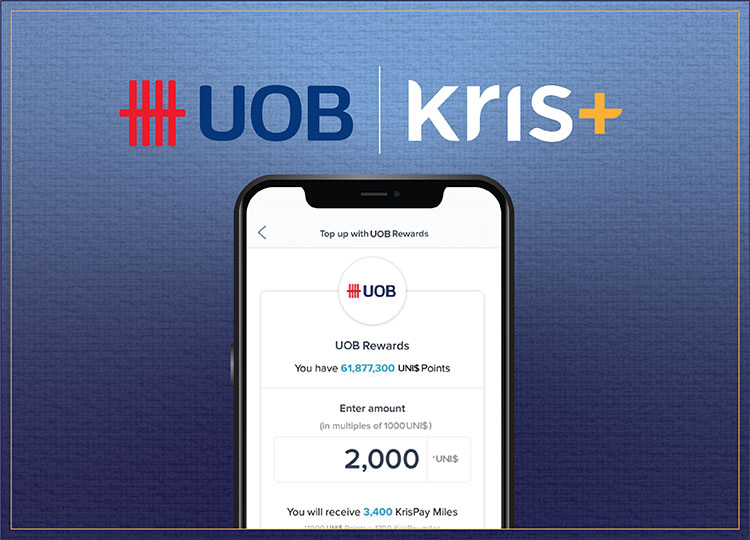
As you’ll notice the ratio means taking a 15% ‘hit’ on the usual 5,000:10,000 UNI$ to KrisFlyer miles transfer ratio, so it’s only of interest if you need a small amount to meet a specific redemption threshold, or have a small balance ‘stuck’ in UNI$ (less than 5,000), which you aren’t going to be adding to in future.
You shouldn’t be using this as your regular UNI$ to KrisFlyer transfer method, as it effectively devalues your bonus miles earning rate from 4 mpd to 3.4 mpd.
There are important factors to be aware of, firstly you’ll have to move any points transferred from UOB Rewards to KrisPay into KrisFlyer miles within 21 days, otherwise they are stuck in KrisPay (where you definitely don’t want them).
The second is just as important, you cannot use any of the KrisPay miles you have earned from your UOB Rewards transfer for any Kris+ purchase, no matter how small, as that automatically renders the entire transfer stuck in Kris+ until expiry, six months later.
The golden rule therefore is to transfer in to KrisPay miles via Kris+, then transfer straight out to KrisFlyer. Even with that 21-day window available, our advice is don’t wait.
Points rounding
One long‑standing UOB drawback is that UNI$ are awarded per S$5 block of spend, with anything below the next S$5 rounded away, so a S$9.99 charge earns the same as S$5.00, and S$4.99 earns nothing.
The good news is that the Visa Signature card handles this much more gently than other cards, including the Preferred Visa.
On the Preferred Visa, both the base and bonus points are rounded on every transaction. On the Visa Signature, only the base UNI$1 is rounded per transaction; the bonus UNI$9 is calculated on your entire month’s eligible spend, summed first (cents and all), then rounded down just once at the end.
Because the rounding happens a single time on a large monthly total rather than on every small purchase, the “wastage” is far smaller.
In practice, this makes the VS considerably friendlier for lots of small taps like coffees, bus rides, a bottle of water from 7-Eleven, compared to the Preferred Visa. It’s a significant advantage of this card.
↥ Minimum spend to earn points
Because of the way the Visa Signature aggregates bonus spend (see above), there isn’t really a minimum transaction size on this card the way there is on the Preferred Visa – but the base and bonus tiers behave differently.
- Base rate (0.4 mpd): awarded per transaction and rounded down to the nearest S$5, so any single transaction under S$5 earns no base UNI$ at all.
- Bonus rate (3.6 mpd): awarded on your whole statement period’s eligible category spend, summed and rounded down just once. A sub‑S$5 bonus‑category transaction therefore still counts. It’s added to the total and earns the bonus, provided you’ve cleared that category’s S$1,000 minimum and haven’t exceeded its S$1,200 cap.
The upshot is that a small bonus‑category tap, say S$3 on payWave at a 7-Eleven, earns 3.6 mpd on the Visa Signature, not nothing. You lose only the 0.4 mpd base portion, a real contrast with the Preferred Visa, where the same purchase earns zero.
SimplyGo is the one full‑rate exception: its base UNI$ are also pooled monthly, so bus and MRT fares earn the full 4 mpd on the aggregate no matter how small each individual fare.
FCY fee / cpm overseas
One thing you won’t be wanting to do with this card is make transactions in foreign currency at the basic 0.4 mpd earn rate.
With UOB’s 3.25% foreign currency fee, that’s equivalent to ‘buying’ miles at an obscene 8.6 cents each, way more than you can ever realistically achieve in value.
At the 4 mpd bonus rate though, which would apply for example at a Starbucks in Hong Kong or an online purchase from a florist in Perth (Australia or Scotland!), it’s a different matter altogether.
Here’s how that cost per mile compares to other credit cards in Singapore offering 4 mpd for at least some form of eligible transactions in foreign currency.
Cost per mile on overseas credit card transactions (4 mpd cards)
(Best to worst, July 2026)
| Card | Fee | Mpd | Cost per mile |
 HSBC Revo HSBC Revo |
3.25% | 4.0 | 0.86¢ |
 UOB VS UOB VS |
3.25% | 4.0 | 0.86¢ |
 DBS WWMC DBS WWMC |
3.25% | 4.0 | 0.86¢ |
 Citi Rewards Citi Rewards |
3.25% | 4.0 | 0.86¢ |
 Maybank XL Maybank XL |
3.25% | 4.0 | 0.86¢ |
 UOB PV UOB PV |
3.25% | 4.0 | 0.86¢ |
 OCBC Rewards OCBC Rewards |
3.25% | 4.0 | 0.86¢ |
Cost per mile also accounts for an additional 0.3% ‘spread’ over money changer currency rates, though this doesn’t apply to all banks and all foreign currencies, so is a worst-case scenario.
As you can see the UOB Visa Signature card comes in at a very competitive cost of 0.86 cents per mile, like practically all 4 mpd cards do when used overseas, so you should definitely be using this card for transactions in FCY, subject to the monthly cap.
What else can UNI$ be used for?
UNI$ can be used to purchase gift vouchers or achieve cash rebates, though typically this values them at 1 cent each, rather than the 3.6 cents each UNI$ can be worth when transferred to KrisFlyer miles or Asia Miles, assuming you place a 1.8 cent valuation on those.
Clearly the 1 cent option is awful, representing a poorer return than you would expect to achieve from many cashback cards, and is even 40% worse than the level you’ll achieve by transferring them into KrisPay miles in the Kris+ app then spending them at a Kris+ merchant.
Conversion into frequent flyer miles, as usual, is the best deal.
Other benefits
The UOB Visa Signature is thin on additional benefits.
- Complimentary travel insurance
Available on an opt-in basis, providing Public Conveyance Personal Accident cover of up to S$500,000, plus Emergency Medical Assistance, Evacuation and Repatriation of up to S$50,000, when you charge your full land / sea / air travel fare to the card. You’ll need to activate the cover at least five working days before you travel.
The opt-in is the important restriction here. It’s per-trip and easily forgotten, and of course makes the difference between covered and not.
Other benefits, as a Visa Signature card, include:
- Avis President’s Circle Status
- Visa Signature Luxury Hotel Collection
Terms and conditions
Here are links to the full terms and conditions applicable to the UOB Visa Signature card.
UOB Visa Signature vs. UOB Preferred Visa
The features of these two cards may look alike – both offer 4 mpd almost anywhere via a blacklist – but they fundamentally suit different people:
- Contactless: VS counts a physical card tap; the PV is mobile‑only.
- Minimum spend: VS needs S$1,000 per category to unlock; the PV has no minimum.
- Cap: VS is S$1,200 per category (S$2,400 total); the PV is S$600 per category (S$1,200 total).
- Second category: VS adds petrol and foreign‑currency spend; the PV adds selected online merchant categories.
- Tracking: VS runs on the statement period; the PV on the calendar month.
- Rounding: VS aggregates bonus spend monthly (gentler); the PV rounds per transaction.
The upshot? Smaller or irregular spenders are better off with the Preferred Visa, which never punishes you for missing a minimum.
| UOB Preferred Visa | |||
 |
First year free |
4 mpd online |
4 mpd mobile tap |
| READ OUR REVIEW | |||
| UOB Preferred Visa | ||
|
||
|
First year free |
4 mpd online |
4 mpd mobile tap |
| READ OUR REVIEW | ||
Bigger spenders and travellers get more from the Visa Signature’s higher cap, physical tap convenience and foreign currency category. Crucially, there’s nothing stopping you holding both, in which case spend on the Visa Signature first each month, so you don’t hit the Preferred Visa’s cap only to fall short of the VS’s minimum spend.
Our Summary
The UOB Visa Signature remains one of the more rewarding routes to 4 mpd in Singapore, and the August 2025 restructure, while a real cut for single‑category high spenders, left it with a potentially useful shape. Two S$1,200 categories, a S$2,400 monthly ceiling, and 4 mpd on the everyday essentials – tap‑anywhere contactless, petrol, SimplyGo and all your foreign‑currency spend.
What sets it apart from its Preferred Visa sibling is a trio of quiet advantages. You can tap the physical card rather than fish out your phone, its monthly‑aggregated bonus points shrug off UOB’s S$5 rounding, and its foreign‑currency category rewards the offline overseas spend that contactless‑only cards often miss.
Against that sit the downsides. Two separate S$1,000 minimums you have to clear, rigid caps that can’t be pooled, statement‑period tracking on posting date, UOB’s thin transfer‑partner list, two‑year points expiry, and the annual‑fee points deduction. This is a card that rewards the attentive, but quietly costs the careless.
If you can reliably put S$1,000‑plus a month through contactless – and especially if you travel and spend in foreign currency – the Visa Signature earns its keep at a competitive 0.86 cents per mile, with double the Preferred Visa’s ceiling. If your spend is small or lumpy, the Preferred Visa’s no‑minimum simplicity is the safer home, and you might treat this as the card you reach for only on big‑spend or travel months.
| Our Rating | ||||||||||||||||||||
| 4 / 5 among 4 mpd bonus cards |
||||||||||||||||||||
|
UOB Visa Signature |
||||||||||||||||||||
How we rate credit cards
|
||||||||||||||||||||
Links on Mainly Miles may pay us an affiliate commission.
(Cover Photo: Shutterstock)