
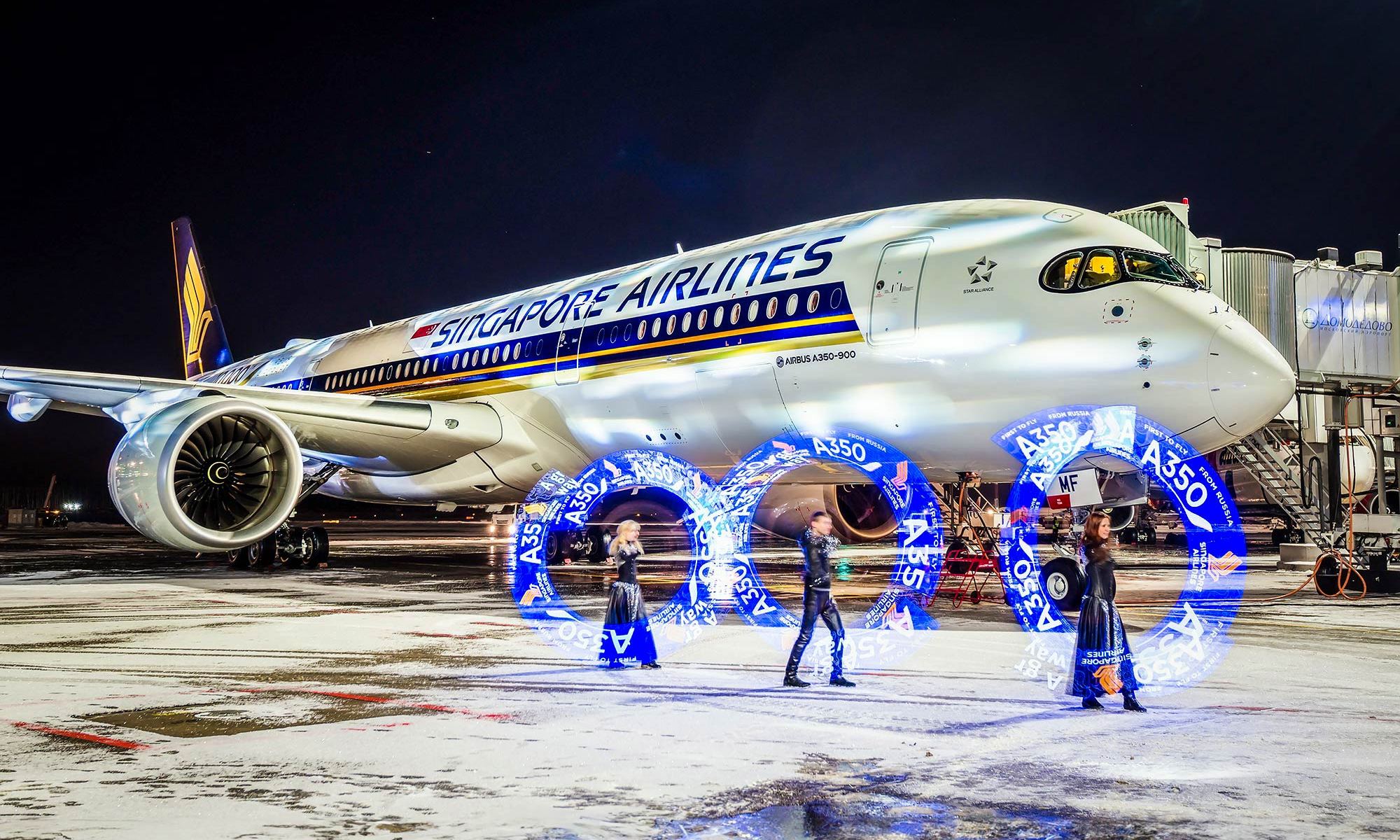

Singapore Airlines is currently the world’s largest operator of the Airbus A350 family, with 65 aircraft in service, and is also the world’s fourth largest customer for the type with 72 firm orders, pipped only by Turkish Airlines, Air France and Qatar Airways.
From short hops to and from Kuala Lumpur through to the longest passenger flights in the world between New York and Singapore, the Airbus A350 is certainly SIA’s “plane that can do anything”.
The airline now has three variants of the type in service, each tailored to perform specific roles in terms of capacity and range, plus there are ‘hidden’ sub-variants, some with quite unique capabilities, most recently including the latest A350 Long Haul ‘plus’ jets that can stretch their legs to the US West Coast without payload restrictions.

(Photo: Airbus)
Before we get down to the nitty-gritty of the fleet, here are a few interesting facts about the A350 in SIA, a type the carrier only started operating nine years ago, but which now represents 45% of the operating passenger fleet.
Based on the week of 15 – 21 December 2025:
- 42% of SIAs flights are operated by an Airbus A350.
- 70% of SIA’s 9hr+ flights are operated by an Airbus A350.
- SIA’s shortest flight (SQ106 from Singapore to Kuala Lumpur) is operated by an Airbus A350.
- SIA’s longest non-stop flight (SQ21 from Newark to Singapore) is operated by an Airbus A350.
Three A350 variants
For more than two years, Singapore Airlines operated only one version of the A350, the Long Haul variant in a 3-class configuration, using it predominantly to replace 4-class Boeing 777-300ERs on many European routes.
However, things then became a little more complicated.
The A350 ULR entered service in October 2018, re-launching non-stop flights from Singapore to Newark and Los Angeles in a two-class configuration, with only Business Class and Premium Economy seats installed.

(Photo: Maye-E Wong)
Later the same year it was a lower weight, lower thrust regional variant that made its debut, the A350 Medium Haul. With no crew rest areas, no Premium Economy cabin and the new higher-density Regional Business Class seats, it became the highest capacity version of the three, with 303 seats.

(Photo: Adelaide Airport)
These aircraft, alongside Boeing 787-10s, have since replaced Airbus A330s and regional Boeing 777s in the Singapore Airlines fleet.
Here’s a summary of the three Airbus A350 variants in the fleet.

| A350-900 Medium Haul |
A350-900 Long Haul |
A350-900 ULR |
|
| Service Entry | 17 Dec ’18 |
9 Mar ’16 | 11 Oct ’18 |
| First Route | Adelaide | Amsterdam | Newark |
| Registration Series |
9V-SH_ |
9V-SM_ 9V-SJ_ |
9V-SG_ |
| Current Fleet |
24 | 34 | 7 |
| Routes (Dec ’25) | |||
| Destinations | 24 | 28 | 3 |
| Shortest Non-stop Flight |
Kuala Lumpur (1h 5m) |
Kuala Lumpur (1h 5m) |
San Francisco (14h 40m) |
| Longest Non-Stop Flight |
Brisbane (8h 0m) |
Los Angeles (17h 50m) |
Newark (19h 10m) |
| Average Flight Duration |
4h 38m | 8h 20m | 17h 43m |
| Seats & Cabin | |||
| Business | 40 x 2018 RJ 2018 RJ(1-2-1) |
42 x 2013 J 2013 J(1-2-1) |
67 x2013 J (1-2-1) |
| Premium | — | 24 (2015 PY) |
94 (2018 PY) |
| Economy | 263 (2017 Y) |
187 (2013 Y or 2017 Y) |
— |
| Total Seats |
303 | 253 | 161 |
| Wi-Fi | GX Aviation Ka-band |
Panasonic Ku-band |
Panasonic Ku-band |
| IFE System | Thales Avant |
Panasonic |
Panasonic eX3 |
| Technical Specs. | |||
| Max. Weight | 250 t | 268 t – 280 t | 280 t |
| Engines | RR Trent XWB-75 or RR Trent XWB-84* |
RR Trent XWB-84 |
RR Trent XWB-84 |
| Thrust (x2) | 74,200 lb or 84,200 lb* |
84,200 lb | 84,200 lb |
| Cargo Capacity | 172.4 cu m | 172.4 cu m | 85.7 cu m |
| Approx. Range | ~6,000 nm | 7,270nm – 8,100 nm | 9,700 nm |
* The airline’s first four A350 MH aircraft (9V-SHA to -SHD) have the Trent XWB-84 engines, each with 84,200 lb of thrust, but subsequent A350 MH deliveries (-SHE onwards) have the lower-thrust XWB-75 engines
Fun fact: Eight cities on the SIA network are currently served by more than one variant of the A350 family:- Hanoi: A350 MH and LH
- Ho Chi Minh: A350 MH and LH
- Hong Kong: A350 MH and LH
- Kuala Lumpur: A350 MH and LH
- Male: A350 MH and LH
- Melbourne: A350 MH and LH
- San Francisco: A350 LH and ULR
- Shanghai: A350 MH and LH
A350 Long Haul
The most common A350 in the Singapore Airlines fleet is its original version – the Long Haul variant. 34 of these are currently in service, with no further deliveries planned.
This aircraft accommodates 42 passengers in Business Class (2013 J), 24 in Premium Economy and 187 in Economy Class, and is used extensively on the network from Kuala Lumpur and Jakarta right up to non-stop Los Angeles services.

(Photo: Singapore Airlines)
Singapore Airlines’ Airbus A350 Long Haul previously operated the airline’s longest direct service as SQ52 from Singapore to Houston. During the northern winter season, this journey took 26 hours 55 minutes, including a 2 hour 10 minute stopover in Manchester. However, the Houston extension was discontinued in early 2025.

(Photo: Shutterstock)
The airline’s longest current Airbus A350 Long Haul service is now Singapore to Barcelona via Milan, with a total journey time of 16 hours 20 minutes including a 1 hour 10 minute stopover.
This now plays second fiddle to SIA’s new longest direct service overall – Los Angeles to Singapore via Tokyo – which takes 20 hours 35 minutes and is operated by the Boeing 777-300ER.
The Airbus A350 Long Haul previously operated the airline’s shortest passenger flight in recent memory – a 45-minute hop between Seattle and Vancouver as a part of a longer Seattle – Vancouver – Singapore routing, between December 2021 and May 2022.
The shortest actual airborne time seen on this route was just 24 minutes, clocked on 10th February 2022.
That route ended on 1st June 2022, when Vancouver and Seattle each became served by dedicated flights, but the A350 Long Haul still features regularly on the airline’s current shortest flight – Singapore to Kuala Lumpur.
SIA’s Vancouver flights ended in 2023.
Notably 9V-SMF, delivered to the carrier in October 2016, is the 10,000th Airbus built. It has special decals to commemorate this along the rear fuselage.

(Photo: Airbus)
As you’ll read later in the article, the A350 LH fleet isn’t nearly as simple as it sounds, with three sub-variants now in play.
A350 Medium Haul
The A350 Medium Haul variant joined the Singapore Airlines fleet in December 2018, but already 24 are in service less than five years later, having helped replace ageing Airbus A330s and regional Boeing 777s in the fleet.
No further deliveries of the A350 MH are planned for the airline.

(Photo: Adelaide Airport)
These aircraft have a lower certified maximum weight compared to other A350s, which reduces overflight and landing fees, and most also have de-rated engines, which allows maintenance intervals to be extended.
These are also the only A350s in the SIA fleet not fitted with crew rest bunks, since they are designed only for flights of up to around 8 hours.
For similar reasons, they are also the carrier’s only A350s not fitted with a Premium Economy cabin.
The main difference for the passenger experience on the A350 Medium Haul is in Business Class – where you’ll find the 2018 regional product by Stelia Aerospace.
This is configured in a ‘staggered 1-2-1’ layout, offering more space efficiency for the airline, but giving passengers slightly less ‘wiggle room’. Seats are 20″ wide (extendable to 26″ with the armrests retracted), and recline into a 76″ long flat bed.

(Photo: MainlyMiles)
Thankfully unlike the older (now-retired) 2009 RJ seats, this one offers direct aisle access for all Business Class passengers.
You can read our full review of the 2018 RJ Business Class seat on the 787-10, which is the same as the Business Class seat which is installed on the A350 Medium Haul.
There are even ‘couple’ middle pairs at alternate rows with this seating layout, with a large privacy divider if you don’t know your neighbour, but good proximity if you’re flying with a partner or colleague.
We flew in a couple pair at the bulkhead row seats in 2018 and wrote a special review highlighting the differences in these seats.
A350 ULR
The Airbus A350 ULR joined the SIA fleet in late 2018, and the airline remains the sole operator of the type, which can fly for nearly 21 hours, covering 9,700 nautical miles, without refuelling.
That’s achieved in two ways – more fuel and less payload.
The “more fuel” bit is a bit of a misnomer, because Airbus merely reconfigured the fuel system to make 24,000 litres of additional fuel capacity available for use – the tanks themselves are present on all A350s.
“Some of the engineering development [for the A350 ULR] involved the relocation of sensors in the fuel system – enabling existing tanks to carry the maximum fuel load for the ULR. This eliminated the need for additional fuel tanks.”
Airbus
Less payload is achieved by configuring this aircraft in a lower capacity layout, with 67 of the 2013 J Business Class seats and 94 Premium Economy seats, including ‘solo’ window options.
There is no Economy Class cabin at all on these jets, the only aircraft type in the SIA fleet without one.

(Photo: One Mile at a Time)
The forward cargo hold is also deactivated on these aircraft, limiting the ULR’s cargo capacity to less than half that of the regular variants.
That space can be re-activated later, if SIA chooses to return these aircraft to regular range flying, subject to some certification paperwork and installation of the (heavy) cargo loading system – the motorised wheels on the cargo hold floor which drive the containers into place.

(Image Airbus)
The Singapore Airlines Airbus A350 ULR currently operates the two longest passenger flights in the world; SQ23 from New York JFK to Singapore at 18 hours 50 minutes (9,537 miles) and SQ21 from Newark to Singapore at 19 hours 10 minutes (9,523 miles).
After that, the next longest flight in the world currently operating is Qantas QF9 from Perth to London, taking 17 hours 20 minutes to fly the 9,009-mile journey, using a Boeing 787-9.
Which A350 are you flying on?
You can check which Business Class seats are scheduled for your flight using our Business Class seats by Route resource, a continually updated list of all planned Singapore Airlines seat configurations for the next few months.
Since every Singapore Airlines aircraft features Business Class, this page also shows which version of the A350 is scheduled to operate on any specific route and flight number, where applicable.
Take the Singapore – Shanghai route as an example.
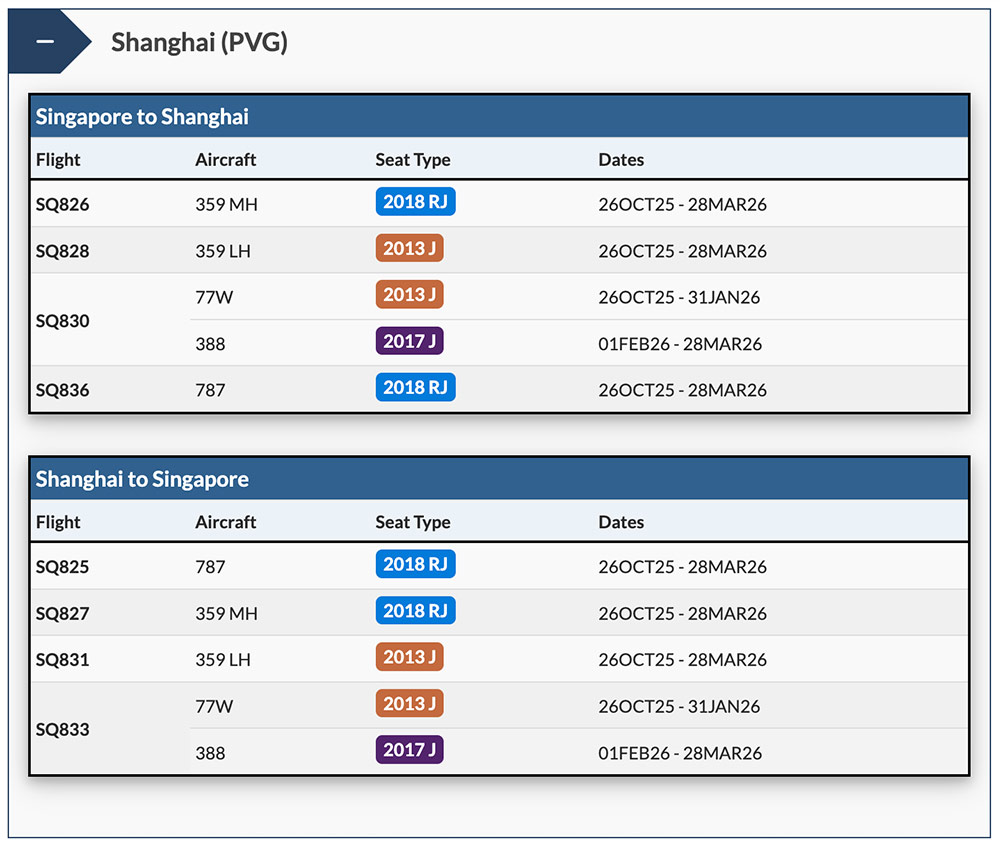
As you can see out of two Airbus A350 services on this city pair, one is operated by the A350 Medium Haul variant (SQ826/827), while the other is flown by the A350 Long Haul variant (SQ828/831).
Another way to identify which A350 you’ll be travelling on is to check the seat map.
SIA Airbus A350 Business Class seat maps
 |
 |
 |
| A350 MH Business Class |
A350 LH Business Class |
A350 ULR Business Class |
If you’re flying in Business Class and the seat map ends at row 22, you’re on an A350-900 LH aircraft, if it ends at row 21 you’re on an A350-900 MH aircraft, and if it ends at row 29 you’re on an A350-900 ULR aircraft.
If you’re flying Premium Economy Class and the seat map goes up to row 33, you’re on an A350-900 LH aircraft. If it goes up to row 43, you’re on an A350-900 ULR. The A350-900 MH does not feature a Premium Economy cabin.
If you’re flying Economy Class and the seat map goes up to row 62, you’re on an A350-900 LH aircraft. If it goes up to row 70, you’re on an A350-900 MH. The A350-900 ULR does not feature an Economy cabin.
Singapore Airlines previously did not identify which variant of the A350 you would be travelling on when you book a flight or award ticket, simply labelling the aircraft the same way on its website regardless of the variant used.
However, this has thankfully changed – so you can now see the variant displayed by clicking ‘More details’ in the flight search results, whether booking a cash ticket or a redemption.

Where to sit onboard SIA A350 flights
Once you’ve established which version of the Singapore Airlines Airbus A350 you’re flying on, we’ve got full guides on where to sit including detailed seat maps (and which seats to avoid!) in all cabin classes.


Three sub-variants of the A350 LH fleet
Singapore Airlines was the launch customer for the Airbus A350 back in 2016, and so it’s not surprising that the first model it received, the A350 Long Haul, has evolved somewhat over the years in technical and performance terms.
That means there are actually now three hidden sub-variants of the A350 LH family within SIA.
Airbus A350 Long Haul
sub-variant differences
| A350-900 Long Haul ‘lite’ |
A350-900 Long Haul |
A350-900 Long Haul ‘plus’ |
|
| Registrations | 9V-SMA 9V-SMB 9V-SMC 9V-SMD 9V-SME 9V-SMF 9V-SMG 9V-SMH 9V-SMI 9V-SMJ 9V-SML 9V-SMM 9V-SMN 9V-SMO 9V-SMP 9V-SMR |
9V-SMK 9V-SMQ 9V-SMS 9V-SMT 9V-SMU |
9V-SMV 9V-SMW 9V-SMY 9V-SMZ 9V-SJA 9V-SJB 9V-SJC 9V-SJD 9V-SJE 9V-SJF 9V-SJG 9V-SJH 9V-SJI |
| Seats | |||
| Economy | 2013 Y | 2013 Y |
2017 Y |
| Technical Spec. | |||
| Max. Weight | 268 t | 275 t |
280 t |
| Engines | RR Trent XWB-84 |
RR Trent XWB-84 |
RR Trent XWB-84 |
| Winglets | Original |
Original |
Extended |
| Approx. Range | 7,270 nm | 7,750 nm |
8,100 nm |
From the passenger experience perspective, its the LH ‘plus’ variant that provides the most differentiation, fitted with the latest 2017 Economy Class seats rather than the older 2013 version seen on the carrier’s other A350 aircraft.
Otherwise for SIA it’s the increased takeoff weight of the newer versions, and the added range that comes with that, which is the major benefit, allowing non-stop services to and from the US West Coast with few (if any) payload restrictions that would impact the earlier models.
Before these enhancements, such routes were the preserve of the A350 ULR.
A350 LH ‘plus’ aircraft (9V-SMV onwards) also have extended winglets, first introduced on the A350 ULR to improve aerodynamic performance and reduce fuel burn. These are visibly taller (by 1.5 ft) and less stubby than the original version, fitted to the carrier’s older A350s.


Old vs. new A350 winglets. (Photos: Plane’s Portrait Aviation Media / Malcolm Lu)
These larger winglets are fitted to all the carrier’s A350 ULR and MH jets.
Aircraft with enlarged winglets also have their actual wings twisted upwards outboard of the engines by about one degree, and have more pointy flap track fairings (those boat-shaped devices at the back of the wing the flaps travel on), but these aerodynamic improvements are barely noticeable to the naked eye.
SIA deploys the LH sub-variants differently
As you might imagine, having increased capabilities for several of the newer A350 LH family doesn’t escape SIA’s attention, and these aircraft are actually deployed differently on the network to maximise their potential range and fuel saving.
Looking at the last two weeks in November 2025, we found that the actual clocked average flight time of each sub-variant, based on FlightRadar24 analysis, highlights this difference.
- A350 LH ‘lite’: Average 06:34
- A350 LH: Average 07:16
- A350 LH ‘plus’: Average 09:39
The A350 LH ‘lite’ variants operated the shortest A350 flights on average, followed by the 275-tonne LH variants, which stretched their legs for an hour and a half longer per flight on average.
Finally the 13 A350 LH+ aircraft had by far the longest average flight duration of 9 hours 39 minutes.
The LH+ aircraft still fly to the likes of Jakarta and Kuala Lumpur in between their long-haul duties, but those long flights always tend to include Los Angeles, Seattle or San Francisco, while the ‘Lite’ and standard A350 LH sub-variants almost never fly to these places.
You can effectively guarantee that you’ll be on an A350 LH+ when travelling non-stop to or from the US West Coast (unless you’re on a ULR), but elsewhere on the network – it’s pot luck.
Indeed the LH+ aircraft were used to operate the inaugural non-stop Singapore – New York JFK flights back in late 2020, while flight loads were low due to the COVID-19 pandemic and the A350 ULRs were all taped up in storage.
For the last two weeks of November 2025, 100% of A350 LH services to and from Los Angeles, San Francisco and Seattle used an A350 LH+ aircraft.

(Photo: Vancouver Airport)
From a passenger experience perspective, this most significantly affects Economy Class passengers, who can more or less guarantee the 2017 seat product on non-stop US West Coast routes.

(Photo: Singapore Airlines)
More efficient engines
Rolls Royce improved the Trent XWB-84 engines for the Airbus A350 a few years ago with a more efficient ‘EP’ model.
We understand the Trent XWB-84 EP (Enhanced Performance) engines were first delivered to Singapore Airlines in late 2019 with 9V-SMZ. These boast a 1% fuel consumption improvement and are fully interchangeable and intermixable with the baseline Trent XWB-84 engines.

(Photo: Emily Rusch)
1% saving sounds like nothing, but it equates to around 950kg less fuel burn on a 15-hour A350 flight between Singapore and San Francisco, for example, assuming you’ve got an EP engine strapped to both wings.
Since engines are sometimes swapped between aircraft, these EP variants could now be installed on any A350 LH or ULR aircraft in the fleet, and some aircraft may even have an EP engine on one wing and non-EP one on the other.
Fun fact: Each Airbus A350 engine weighs 7.3 tonnes, the weight of four large family cars. They are by far the most expensive components of the aircraft, costing US$25 million each at list price, which is why airlines often do finance deals for the engines that are quite separate from the purchase or lease of the aircraft itself.No more passenger A350 deliveries
Back in November 2024, Singapore Airlines took delivery of its final passenger Airbus A350 aircraft on order – 9V-SJI – a long-haul variant.
It is the last new long-haul aircraft to join SIA’s fleet for a number of years, until Boeing 777-9s finally begin to arrive from 2027 (at the earliest).
9V-SJI also represented the last new aircraft in the Singapore Airlines fleet to be delivered with the 2013 long-haul Business Class seats, marking the end of an era for SIA’s Business Class offering, as the carrier transitions into a new phase of product evolution from early 2026.

Singapore Airlines will also be the launch customer for the Airbus A350 Freighter, with seven aircraft to be delivered from the second half of 2027, which will replace the airline’s seven ageing Boeing 747-400 Freighters.
The agreement includes purchase options on a further five A350Fs, which SIA says will provide “the ability to adapt our requirements to future demand in the cargo market”.

(Image: Airbus)
The aircraft will be 70.61m long, 3.8m longer than the A350-900 but 3.2m shorter than the A350-1000, and will be able to fly 4,700nm (around 10 hours) with a full payload.
The A350Fs will have more powerful Rolls-Royce Trent XWB-97 engines, currently only fitted to the larger A350-1000, with 97,000 lb of thrust each.
The A350F offers 40% better fuel efficiency than the Boeing 747-400F, but can carry an almost identical cargo payload over a slightly longer range, according to the following data released by Singapore Airlines.
Airbus A350 Freighter
vs. 747-400F
| Airbus A350F |
Boeing 747-400F |
|
| Length | 70.61m | 70.66m |
| Max. Takeoff Weight | 319 t | 395 t |
| Max. Payload | 111 t* | 116 t |
| Max. Volume | 728 cu m | 738 cu m |
| Range | 4,700nm | 4,500nm |
| Engines | RR Trent XWB-97 | Pratt & Whitney PW4056 |
* Recently increased from 109 t
You can learn more about the A350F here.
A350 Wi-Fi
All of Singapore Airlines’ Airbus A350s have Wi-Fi connectivity on board, now free and unlimited for those in Business Class and for KrisFlyer members in Premium Economy and Economy Class, but the systems themselves aren’t created equal.
Airbus A350 Long Haul and ULR aircraft have Panasonic Ku-band Wi-Fi systems, while the Airbus A350 Medium Haul has the faster GX Ka-band (SITAOnAir) kit.
That’s good news for speed if you’re flying on the A350 MH, but bad news for coverage because the GX system does not offer connectivity when flying over the landmass of India.

(Photo: Singapore Airlines)
Additionally, there are two areas on SIA’s A350 network that suffer from poor satellite coverage and therefore suffer from little to no connectivity:
- Polar regions
- South Indian Ocean
According to Singapore Airlines, this means you may encounter the following approximate Wi-Fi outage periods on the following A350 flights:
- SQ478 SIN-JNB: Around 4h 45m into the flight, for around 1h 30m
- SQ479 JNB-SIN: Around 2h 45m into the flight, for around 1h 15m
- SQ22/24 SIN-EWR/JFK: Around 9h 30m into the flight, for around 2h 30m
- SQ21/23 EWR/JFK-SIN: Around 4h 30m into the flight, for around 2h 30m
Actual outage times and periods will depend on the exact routing your flight takes on the day.
For further details, check out our comprehensive and continually-updated guide to Wi-Fi connectivity on Singapore Airlines flights.

There’s good news for the A350 fleet from 2026, with SIA confirming that its retrofitted Airbus A350 Long Haul aircraft will also be picking up Low Earth Orbit (LEO) Wi-Fi connectivity, likely provided by Starlink, for fast, free, low-latency broadband connectivity offering the equivalent of home broadband speeds, gate-to-gate.
Other aircraft in the fleet will have the same systems retrofitted in the coming years.
Live TV streaming
Singapore Airlines offers live TV streaming on selected aircraft in its fleet, but it only applies to jets fitted with the Panasonic IFE system, which for the A350 means:
- A350 Long Haul
- A350 ULR
If you’re on an Airbus A350 Medium Haul, unfortunately there’s no Live TV option available.

(Image: Singapore Airlines)
If there’s an important event like a sports game you want to watch during your flight, avoid the A350 MH and try for the LH or ULR variants, or one of the following aircraft in the fleet if that’s also serving your route.
- Boeing 737-8 MAX
- Boeing 787-10
There is no Live TV on the 737-800 (non-MAX) and for the Boeing 777-300ER, only aircraft with newer (Panasonic) IFE systems offer the service, which unfortunately is impossible to determine in advance.
Aircraft ownership
Singapore Airlines originally purchased all its Airbus A350 aircraft outright, but during the COVID-19 pandemic it was necessary to shore up the company’s liquidity and so a sale-and-leaseback arrangement was conducted in 2021.
This involved the company selling seven Airbus A350 Medium Haul aircraft and four Boeing 787-10s to lessors, then immediately leasing them back, helping to raise over S$2 billion in cash.
Here’s a summary of the A350 aircraft that are now leased.
SIA Airbus A350s on operating leases
| Registration | Owner / Manager |
Lease End |
| 9V-SHD | Aergo Capital | 2031 |
| 9V-SHG | Altavair | 2031 |
| 9V-SHK | Altavair | 2031 |
| 9V-SHL | Altavair | 2031 |
| 9V-SHM | Crianza Aviation / EastMerchant Capital |
2032 |
| 9V-SHN | Altavair | 2032 |
| Undisclosed (A350 MH) |
Muzinich and Co. | Undisclosed |
The airline’s remaining three Airbus A350 Long Haul aircraft and seven Airbus A350 Freighters still on order are due to be purchased directly by Singapore Airlines, not via lessors.
Spot the difference
From the outside, you can identify the difference between the airline’s A350 variants in a few ways, but the easiest is the registration, if you can see it:
- 9V-SH* = Medium Haul
- 9V-SM* and 9V-SJ* = Long Haul
- 9V-SG* = ULR
The full registration is printed at the back of the fuselage near the rear door, while the final two letters of the registration (e.g. ‘HA’) also appear on the nose wheel doors, often more easily visible from the terminal building or gate lounge.
If you can’t see the registration, count the number of ‘blanked’ windows directly behind the second main passenger door on either side of the aircraft.
If there are no blanked windows, it’s an A350 Medium Haul, two blanked windows is a Long Haul and three blanked windows is a ULR.

(Photo: Plane’s Portrait Aviation Media / Malcolm Lu)
This results from different galley configurations for the three variants.

(Photo: Singapore Airlines)
There are also different ‘blanked window’ patterns behind the first door and in front of the second door, but these are not unique to each variant like the pattern behind the second door is.
Unfortunately it’s sometimes difficult to see how many ‘blanked’ windows the aircraft has from a distance.
Why is Singapore Airlines the only A350 ULR operator?
It’s sometimes curious to wonder why the Airbus A350 ULR variant hasn’t caught on more widely with other major airlines around the world, given its excellent 9,700 nautical mile range capability.
The simple answer is geography.
- Middle East carriers don’t need the ULR’s range, because it would allow them non-stop access only to an almost completely uninhabited area of the South Pacific Ocean.
- American carriers would only need the ULR’s range to reach Singapore, Indonesia and Australia non-stop from the US East Coast – unnecessary because they can all do so from West coast hubs like Los Angeles with existing jets.
- European carriers would only need the ULR’s range to reach New Zealand and the East cost of Australia non-stop – too limited a market in their business models for such a significant investment.
Here’s the only part of the world outside the 8,100 nautical mile range of the current Airbus A350-900 from Dubai.

There’s one exception of course, and that’s Qantas.
Under the Australian carrier’s “Project Sunrise” plan, Airbus A350 ULR aircraft will be able to link the East coast of Australia (e.g. Sydney, Melbourne and Brisbane) non-stop with the likes of New York, Paris and London, on flights of up to 20 hours – even eclipsing SIA’s non-stop services – from late 2026.
Qantas has selected modified Airbus A350-1000 ULR aircraft for the job, a bigger aircraft than Singapore Airlines uses for these flights, in a four-cabin configuration including six First Class suites.

(Photo: Airbus)
These aircraft gain their capability for such long non-stop services thanks to an additional 20,000-litre fuel tank, a similar principle SIA’s A350-900 ULRs tap to unlock their enhanced range.
Also note that while Emirates has started taking delivery of Airbus A350-900s described by the airline as “Ultra Long Range” models, this is an internal airline designation used on all its types that sacrifice passenger seats for crew rest areas.
While they may have higher weight limits than existing “Regional” A350s in the fleet, they are not true ULR variants like those operated by Singapore Airlines – still the world’s only operator of that type for now.


Summary
Knowing which variant of the A350 in the Singapore Airlines fleet you’ll be flying on is quite important from the passenger experience perspective, especially if you’re flying in Business Class as there is both a regional and a long-haul product in the mix, often on the same route.
The seat map for your flight is a certain check for which variant you’ll be boarding. Remember we also have a regularly updated Business Class seats by route page, which will also help you determine when the A350 Medium Haul is flying (2018 RJ) as opposed to the Long Haul or ULR (2013 J) variants.
Deeper below the skin, there are many other nuances of SIA’s 62-strong Airbus A350 fleet, including no fewer than three sub-variants of the long-haul fleet, which primarily affects which Economy Class seat you can expect on board, but also works to improve efficiency for the airline itself.
If you’re planning an A350 flight with SIA or will be flying on the aircraft soon, don’t forget to bookmark this page for reference. We’ll keep it updated as necessary.
(Cover Photo: Shutterstock)
I’m always curious about why other South East Asian airlines also don’t order the ULR. Like KL to NYC. Jakarta to NYC.
Or from India like Bangalore to SFO. Or does existing planes already make the range and somehow only Singapore is out of the range of Existing planes?
Hi Bill,
In my view, ULR operations remain a niche segment. Only a small number of city pairs actually require such ultra-long ranges, and many of these are already dominated by early movers like SIA.
Because the market is niche, achieving sustainable profitability on ULR routes is challenging. Fuel burn is significantly higher, especially when carrying only about half the usual passenger load over such long distances. On top of that, there are additional operating costs to consider — training, maintenance, and cabin reconfiguration.
At the end of the day, some airlines may find it more strategic to invest in a more flexible variant that can serve existing high-demand, proven profitable routes, rather than committing resources to the uncertainties of ULR operations; an already small slice of the pie.
Cheers.
ULRs command a premium pricing & even though BLR-SFO can support that, India airlines are in limbo currently with Air India in bad shape & Indigo not interested, United scheduled the route on a 789 but what followed was not conducive enough.
MediumHaul is Uniquely SQ creation for high capacity and less comfort for pax.
Tight space in C and
Hate it in Y, so cramped