
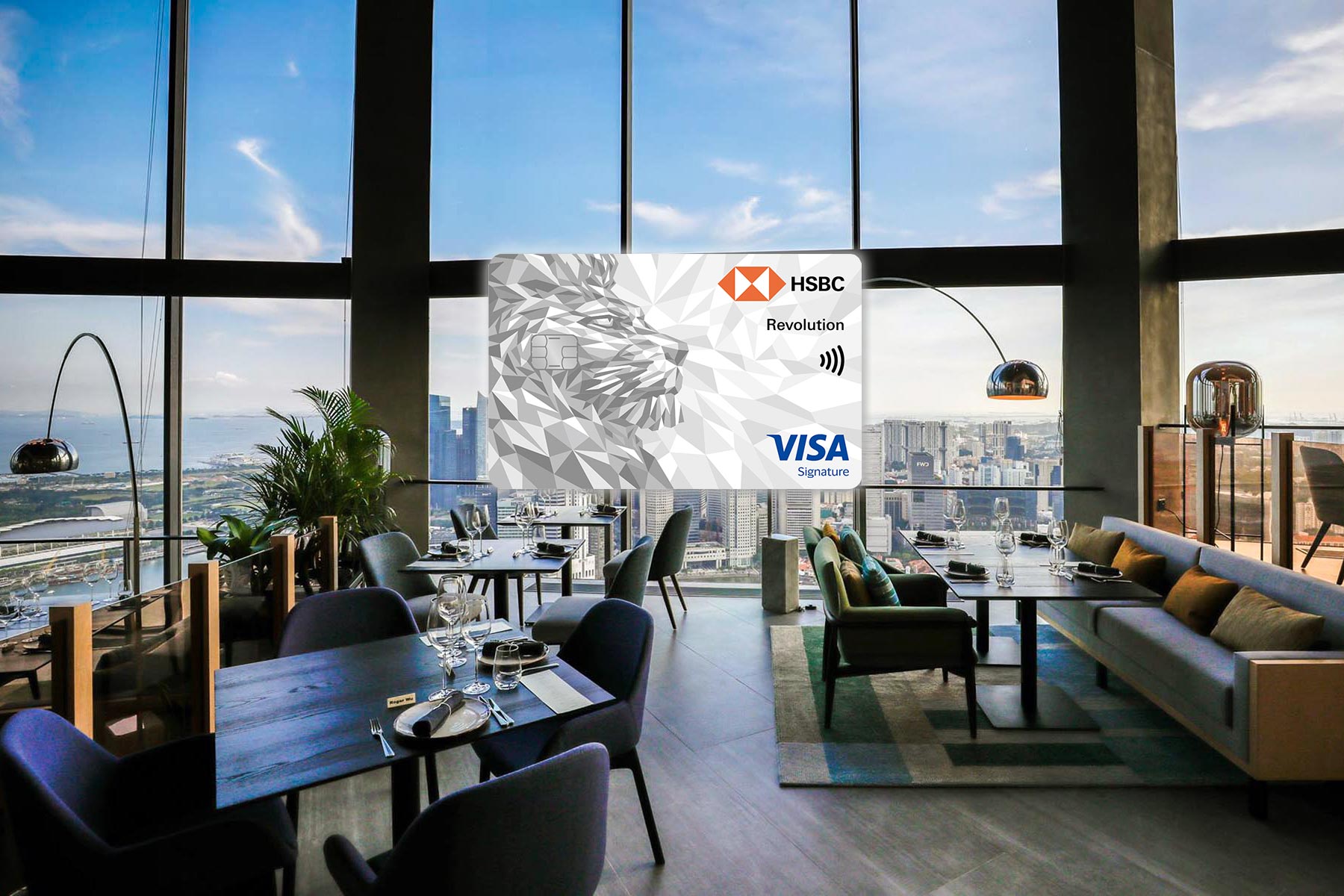

Here’s our review of the HSBC Revolution credit card issued in Singapore. It forms part of our series of credit card reviews, which are all summarised on our dedicated Credit Cards page.
Dollar amounts refer to SGD, and ‘miles’ assume HSBC’s 2.5:1 airline transfer partners, except where stated. This review was updated on 12th August 2026.
| HSBC Revolution | |||
 |
No annual fee |
4 mpd online & contactless |
8 mpd with EGA |
| APPLY HERE | |||
| HSBC Revolution | ||
|
||
|
No annual fee |
4 mpd online & contactless |
8 mpd with EGA |
| APPLY HERE | ||
Mainly Miles Says
Few cards in Singapore have been through as much as this one. The HSBC Revolution spent 2024 being steadily dismantled – travel, groceries, food delivery and contactless bonuses all stripped out, and complimentary travel insurance withdrawn – before a temporary reprieve in July 2025, and then a full pardon.
Since 1st April 2026 the 4 mpd earn rate for online and contactless spend is permanent once more, and there’s now even an 8 mpd tier for anyone prepared to keep S$50,000 in an HSBC Everyday Global Account. The card was quietly upgraded to Visa Signature at the same time, and the travel insurance perk was reinstated.
| Pros | Cons |
|
|
No annual fee and a broad set of bonus categories make it an easy card to justify holding, provided you can get through the door, which is harder than it used to be.
Eligibility
- Minimum Age: 21
| Minimum Income | ||
| Applicant | With HSBC TRB S$50,000+ |
Everyone else |
| Singaporean / PR (salaried) |
S$30,000 | S$65,000 |
| Singaporean / PR (self-employed / on commission) |
S$40,000 | S$65,000 |
| Foreigner | S$65,000 | S$65,000 |
The S$30,000 figure may look familiar, but there’s a catch that didn’t exist a couple of years ago. Since October 2025 it applies only if you already hold a Total Relationship Balance (TRB) of at least S$50,000 with HSBC. Without that, the bar is S$65,000 a year, and that applies to Singaporeans, PRs and foreigners alike.
Your TRB doesn’t have to sit in cash. Equities, unit trusts, bonds and insurance policies held with HSBC all count towards it, which gives you some flexibility in how you clear the threshold.
The same S$50,000 that unlocks the lower income requirement can sit in an Everyday Global Account and simultaneously unlock the card’s 8 mpd earn rate – more on that later.
Fixed deposit alternative
If you can’t meet the income requirement, a secured card remains an option, though it’s no longer as simple as placing a single deposit. HSBC now requires a Total Relationship Balance of at least S$50,000, of which a minimum of S$10,000 must be a fixed deposit specifically committed against the card.
Annual Fees & Interest Rates
- Annual Fee (principal): Free
- Annual Fee (supplementary): Free
The HSBC Revolution’s S$160.50 annual fee was removed back in August 2020, and thankfully hasn’t returned since. Both principal and supplementary cards are free for life, so there’s no waiver to call up and request each year.
Up to five supplementary cards can be added to your account, also for free.
Other fees and interest rates for the HSBC Revolution card include:
- EIR: 27.8%
- Interest-free period: 20 days from statement date
- Minimum payment: 3% (min. $50, or balance if less)
- Late payment fee: $100
- Cash advance fee: 8% (min. $15)
- Overlimit fee: $40
Sign-up bonus
Unlike the cashback and luggage offers of years gone by, the HSBC Revolution’s current welcome gift is paid in miles – 42,000 HSBC Reward points for new cardholders who spend S$1,000 from their card account opening date to the end of the following month.
That’s 16,800 miles with a 2.5:1 transfer partner like Asia Miles or British Airways Avios, or 14,000 KrisFlyer miles at the less generous 3:1 ratio. Existing HSBC cardholders get a more modest S$50 cashback, on a lower S$500 spend.
The offer runs until 30th September 2026, with details available here and full terms and conditions available here.
Regular earn rates
The HSBC Revolution card earns:
- 0.4 miles for every S$1 of general spend
That applies to transactions in Singapore and overseas alike, and it’s every bit as bad as it looks. Worse, in fact, if you’re transferring to KrisFlyer, where the 3:1 ratio drags the effective rate down to just 0.33 mpd.
You should be earning at least 1.2 – 1.4 mpd on general local spend and 2.0 – 2.2 mpd overseas with a decent general spend card, so the Revolution has no business handling anything outside its bonus categories.
Bonus earn rates
The HSBC Revolution card earns:
- 4 mpd for spend on selected online purchases and contactless payments; or
- 8 mpd for the same spend, if you maintain S$50,000 in an HSBC Everyday Global Account
Both rates apply to the same set of spending categories, and to both online transactions and contactless payments. That wasn’t the case between June 2024 and March 2026, when contactless spend earned nothing extra at all, so if you’re returning to this card after writing it off, that’s an important change to note.
Which of the two rates you get comes down to a single question: how much cash you’re keeping with HSBC.
The two earning tiers
Every Revolution cardholder falls into one of two groups each calendar month.
- Standard cardholders earn 10x Reward points per S$1 on eligible spend, made up of 1x base points and 9x bonus points. At the best transfer ratios, that’s 4 mpd
- Enhanced cardholders earn 20x Reward points per S$1, 1x base and 19x bonus. That’s 8 mpd to a good transfer partner.
To qualify as enhanced, you need to maintain a Deposits ADB of at least S$50,000 in a sole HSBC Everyday Global Account, denominated in Singapore dollars, for the calendar month in which the transaction posts.
Three details are vital:
- Sole accounts only. Money in a joint EGA doesn’t count towards the calculation at all.
- Cash only. Unlike the Total Relationship Balance used for the income requirement, this one won’t accept unit trusts, equities, insurance policies or fixed deposits. It has to be sitting in the EGA as a deposit.
- It’s assessed monthly. Your ADB is the sum of your daily balances across the month, divided by the number of days in it. Hit S$50,000 and you get 8 mpd on everything that posted that month. Fall short and you drop to 4 mpd until the following month.
That last point catches people out. Depositing S$50,000 halfway through September gives you an ADB of around S$25,000 for September – not enough. To qualify for a given month, the money generally needs to be there from the start of it.
There’s no minimum spend to worry about, but there is a ceiling.
Standard cardholders are capped at 9,000 bonus points per calendar month, which equates to S$1,000 of eligible spend. Enhanced cardholders get 22,800 bonus points, equating to S$1,200.
Note that the enhanced tier’s cap is only 20% higher in spend terms, even though the earn rate is double.
Reward points shall be calculated based on the total amount of Eligible Transactions posted into HSBC’s credit card system within each qualifying calendar month, rounded down to the nearest SGD1. Bonus Points are subject to a cap of 9,000 Bonus Points per calendar month; or 22,800 Bonus Points per calendar month if the Cardholder maintains a Deposits ADB of at least SGD50,000 in the Eligible EGA Account with HSBC for that calendar month. Base Points are not subject to any cap.
HSBC
Eligible spend beyond the cap drops back to the base 1x rate – 0.4 mpd, or 0.33 mpd to KrisFlyer. Base points themselves are uncapped, but at that rate they’re barely worth counting.
Maxing out the cap every month would look like this over a year:
| Standard | Enhanced | |
| Bonus earn rate | 10x points 4 mpd |
20x points 8 mpd |
| Monthly bonus cap | 9,000 points (S$1,000 spend) |
22,800 points (S$1,200 spend) |
| Annual eligible spend | S$12,000 | S$14,400 |
| Annual points earned | 120,000 points | 288,000 points |
| Annual miles (2.5:1 partners) |
48,000 miles | 115,200 miles |
| Annual miles (KrisFlyer, 3:1 partners) |
40,000 miles | 96,000 miles |
Those figures include the 1x base points, which are uncapped.
Is parking S$50,000 in the EGA worth it?
The 8 mpd tier is clearly designed to pull deposits into the bank, and whether it’s worth taking the bait comes down to arithmetic most people won’t have done.
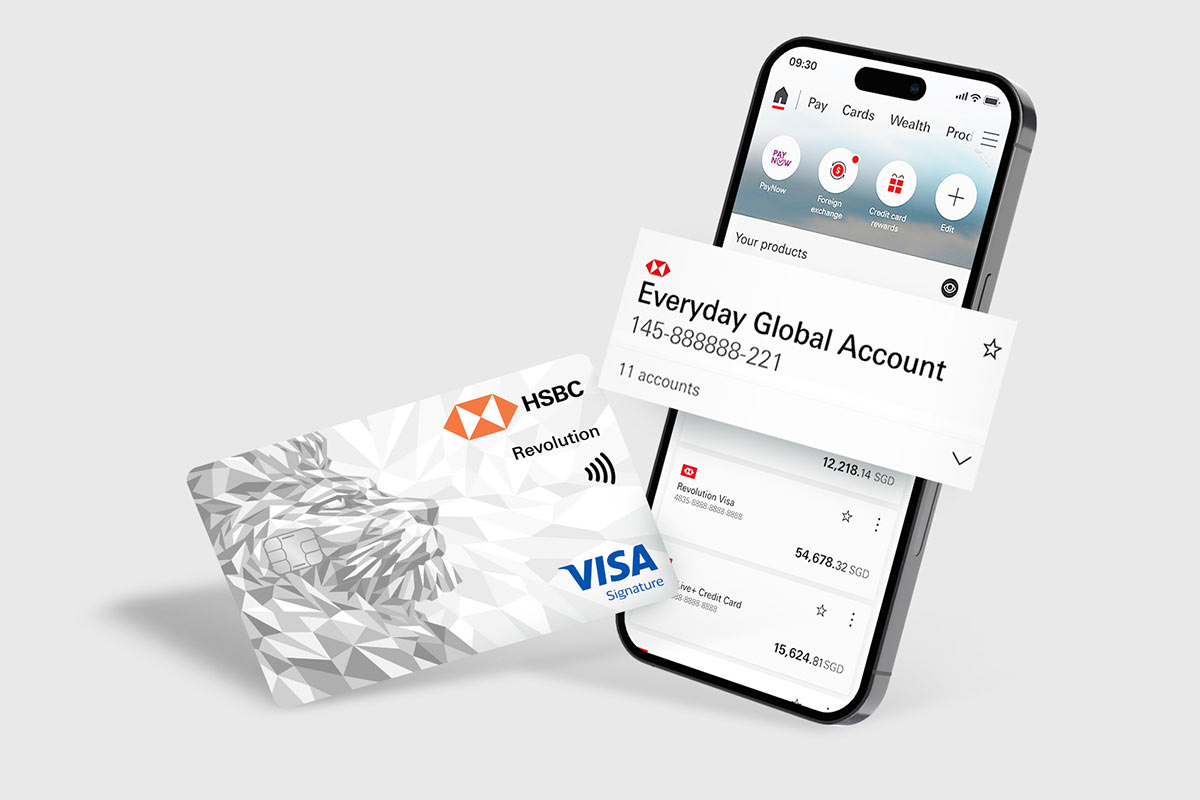
Here’s the shape of it.
- What you gain: 13,800 extra bonus points a month, or 165,600 a year – worth 66,240 miles at a 2.5:1 partner, and around S$1,192 on our 1.8 cent valuation
- What it assumes: that you spend the full S$1,200 in bonus categories every single month. Spend half that and the benefit halves with it
- What it costs: the EGA pays a prevailing rate of 0.01% p.a., so the real price is the interest you’re giving up. Against a savings account or T-bills at 2.5%, that’s roughly S$1,245 a year on S$50,000
On those numbers alone, a cardholder maxing the cap every month roughly breaks even, and anyone spending less than that is behind.
There are two things that can shift the balance. HSBC runs rolling bonus interest promotions on the EGA, currently paying up to 1.68% p.a. on incremental balances, and the same S$50,000 does double duty against the Total Relationship Balance that drops this card’s income requirement from S$65,000 to S$30,000. Both narrow the gap, but neither closes it on their own.
For most readers, the honest answer is that it isn’t worth moving money for. If you already keep S$50,000 in cash at HSBC, take the 8 mpd and enjoy it. If you don’t, the standard 4 mpd tier is a perfectly good card, and you should treat the enhanced rate as marketing aimed at someone else.
Online or contactless purchases
The Revolution’s bonus applies to two transaction types, and the same MCC list governs both.
Online transactions are those made over the internet and processed as an online transaction type through the Visa network. That includes credential-on-file payments, where you’ve stored your card details with a merchant for future purchases – so recurring subscriptions charged to a saved card are included.
Contactless payments are those made at a contactless terminal. That covers tapping the physical card via Visa payWave, and all three mobile wallets: Apple Pay, Google Pay and Samsung Pay.
What doesn’t count is inserting the card and using the chip, or swiping the magnetic stripe. If the terminal doesn’t accept tap and you can’t pay online, you’re earning 0.4 mpd on that transaction whatever the merchant sells (use another card).
Eligible MCCs
These online and contactless purchases must fall under the following MCCs to earn at the 4 mpd rate for the first S$1,000 of monthly spend, or the 8 mpd rate for the first S$1,200 if you qualify for the enhanced tier. Anything else earns the basic 0.4 mpd rate.
| Travel Airlines, Car Rental, Hotels and Cruise Lines |
|
| Eligible MCCs | Example Merchants |
| 3000 to 3350, 4511 3351 to 3500 3501 to 3999, 7011 4411 |
Singapore Airlines, Scoot, Cathay Pacific, Qantas, Hertz, Avis, Hilton, Hyatt, Marriott, Royal Caribbean |
| Department Stores and Retail Stores | |
| Eligible MCCs | Example Merchants |
| 4816, 5045, 5262, 5309, 5310, 5311, 5331, 5399, 5611, 5621, 5631, 5641, 5651, 5655, 5661, 5691, 5699, 5732, 5733, 5734, 5735, 5912, 5942, 5992, 5999 5944 to 5949 5964 to 5970 |
Amazon, Shopee, Isetan, Takashimaya, TANGS, Uniqlo, Zara, H&M, Pandora, ASOS, Zalora, Apple, Dell, Best Denki, Harvey Norman, Courts, Guardian, Watsons |
| Dining | |
| Eligible MCCs | Example Merchants |
| 5441, 5462, 5811, 5812, 5813 | Jumbo Seafood, Fish & Co, Atlas Bar, Brewerkz, Wine Connection, Providore, most restaurants and bars |
| Transportation and Membership Clubs | |
| Eligible MCCs | Example Merchants |
| 4121, 7997 | Comfort, Grab, gojek, TADA, Ryde, Fitness First, True Fitness, Sentosa Islander |
The strongest categories here are dining and general retail, both of which cover a lot of everyday spending, and both of which now work whether you tap in store or check out online.
Flights and hotels booked direct with the airline or hotel qualify, as do ride-hailing trips with Grab, gojek, TADA and Ryde. Gym memberships are included too, under the membership clubs MCC.
Groceries, though, are gone. Supermarkets were removed from the bonus categories in April 2024 and haven’t returned, so the likes of Cold Storage, FairPrice, Sheng Siong and RedMart all earn the base rate now. If you previously held this card specifically for grocery spend, that reason sadly no longer exists.
The gaps in the list
The Revolution operates a whitelist. If a merchant’s MCC isn’t on the list above, the transaction earns the base rate and nothing more, even if it obviously looks like dining, shopping or travel.
Several of the omissions are counterintuitive enough to catch out even careful cardholders:
| MCCs excluded from bonus points | ||
| MCC | Description | What it means in practice |
| 4722 | Travel Agencies and Tour Operators | Agoda, Booking.com, Expedia, Hotels.com, Klook, KKday, Pelago, Trip.com, Kayak, Traveloka, Airbnb (though sometimes you’ll get lucky with 7011 here) |
| 5814 | Fast Food Restaurants | McDonald’s, KFC, Burger King, Starbucks, most Ya Kun outlets, food delivery apps, and some PS.Cafe outlets |
| 5411 | Grocery Stores, Supermarkets | FairPrice, Cold Storage, Sheng Siong, Giant, RedMart |
| 5499 | Misc. Food Stores | 7-Eleven, Cheers, FamilyMart, Bee Cheng Hiang |
| 4111 | Local and Suburban Transport | SimplyGo – so no bonus on MRT or bus rides |
| 5541 | Service Stations | All petrol stations |
| 7512 | Auto Rental, Not Elsewhere Classified | Smaller car rental firms that don’t code into the 3351-3500 range |
| 5712 | Furniture and Home Furnishings | IKEA, while Courts and even Harvey Norman sometimes code here too |
The travel agency exclusion is the one that stings the most. Booking a hotel through Agoda or an experience through Klook earns 0.4 mpd, while booking the same hotel direct on its own website earns 4 mpd.
Fast food is the other trap, but a subtler one. MCC 5814 codes in places you really wouldn’t expect – cafes and casual restaurants sometimes code there rather than under 5812. There’s no reliable way to tell from the shopfront, so if a particular spot matters to you, it’s worth checking the MCC.
There is at least a way to find out after the payment. The HSBC Singapore app now shows the MCC against completed transactions, so a single visit tells you how a merchant codes, and you’ll know for next time.
Merchants that earn nothing at all
There’s a second, more severe list. Alongside the whitelist that governs bonus points, the terms carry a separate blacklist of 48 MCCs which earn no Reward points whatsoever – not even the base 1x (0.4 mpd).
| MCCs excluded from all points earning | |
| MCC | Description |
| 4829 | Money Transfer |
| 4900 | Utilities – Electric, Gas, Water and Sanitary |
| 5199 | Nondurable Goods |
| 5960 | Direct Marketing – Insurance Services |
| 6010, 6011, 6012 | Financial Institutions – cash disbursements and debt repayment |
| 6050, 6051 | Quasi-cash, foreign currency and cryptocurrency |
| 6211 | Security Brokers / Dealers |
| 6300 | Insurance Sales, Underwriting and Premiums |
| 6513 | Real Estate Agents & Managers – Rentals |
| 6529, 6530, 6540 | Stored value card load |
| 6532, 6533 | PSP payment transactions |
| 6534, 6536, 6537, 6538 | Money transfer and Moneysend |
| 6555 | Mastercard Initiated Rebate |
| 7299, 7399 | Other Services and Business Services, Not Elsewhere Classified |
| 7349 | Cleaning, Maintenance and Janitorial Services |
| 7511 | Quasi Cash – Truck Stop |
| 7523 | Automobile Parking Lots and Garages |
| 7801, 7995, 9754 | Gambling, betting and lotteries |
| 8062 | Hospitals |
| 8211, 8220, 8241, 8244, 8249, 8299 | Schools, colleges and educational services |
| 8398 | Charitable Social Service Organizations |
| 8651 | Political Organizations |
| 8661 | Religious Organizations |
| 8999 | Professional Services, Not Elsewhere Classified |
| 9211, 9222, 9223 | Court costs, fines, bail and bond payments |
| 9311, 9399, 9402, 9405 | Tax payments and government services |
HSBC can revise this list at any time without notice, so it’s worth a look at the current terms for the latest exclusions.
4 mpd for dining in hotel restaurants
One persistent annoyance with dining-bonus cards in Singapore is that they work beautifully right up until you eat at a restaurant inside a hotel.
Even bars and restaurants in hotels that claim they code under dining MCC 5812, usually don’t. The hotel MCC, typically 3501 – 3999 (for larger hotels like the Ritz-Carlton) or 7011 (for smaller hotels like Capella and Raffles) almost always takes precedence.
That can render your (often expensive) meal at just 0.4 mpd earning instead of the 4 mpd you were expecting!

(Photo: Capella Hotels)
The HSBC Revolution sidesteps this entirely. Hotel MCCs sit in its travel bonus category, so a meal that codes as lodging earns exactly the same 4 mpd as one that codes as dining. You don’t need to know or care which way the restaurant codes.
The only requirement is that you must tap to pay, or settle online. Hand the card over to be inserted into a terminal and you’ll drop to 0.4 mpd, at which point your best general spend card would have served you better.
Contactless features
One of the bonus categories for the HSBC Revolution card is for selected contactless payments. Apart from Visa payWave, the card can also be added to Apple Pay, Google Pay or Samsung Pay.

Samsung Pay support is a relatively recent addition, HSBC having been the notable holdout among Singapore card issuers for several years.
You can also download the HSBC Singapore app and use it as a virtual card on your mobile phone.
Transaction types that earn nothing
Separately from the MCC blacklist, the terms exclude a list of transaction types from earning any Reward points at all. Posted retail purchases qualify, including recurring payments, but these don’t:
- Foreign exchange transactions (including but not limited to Forex.com);
- Donations and payments to charitable, social organisations and religious organisations;
- Quasi-cash transactions (including but not limited to transactions relating to money orders, traveler’s checks, gaming related transactions, lottery tickets and gambling);
- Payments made to financial institutions, securities brokerages or dealers (including but not limited to the trading of securities, investments or crypto-currencies of any kind);
- Payments on money payments/transfers (including but not limited to Paypal, SKR skrill.com, CardUp, SmoovPay, iPayMy);
- Payments to any professional services provider (including but not limited to GOOGLE Ads, Facebook Ads, Amazon Web Services, MEDIA TRAFFIC AGENCY INC);
- Top-ups, money transfers or purchase of credits of prepaid cards, stored-value cards or e-wallets (including but not limited to EZ-Link, Transitlink, NETS Flashpay and Youtrip);
- Payments in connection with any government institutions and/or services (including but not limited to court costs, fines, bail and bond payment);
- Any AXS and ATM transactions;
- Tax payments (except HSBC Tax Payment Facility);
- Payments for cleaning, maintenance and janitorial services (including property management fees);
- Payments to insurance companies (including but not limited to sales, underwriting, premiums and insurance services);
- Payments to educational institutions;
- Payments on utilities (electricity, gas, water and sanitary);
- The monthly instalment amounts under all card instalment plans (including HSBC 0% Card Instalment Payment Plan, HSBC PayLater Instalment Plan and HSBC Spend Instalment);
- The total purchase amount under HSBC 0% Instalment Payment Plan and HSBC PayLater Instalment Plan;
- Balance transfers, fund transfers, cash advances, finance charges, late charges, HSBC’s Cash Instalment Plan, any fees charged by HSBC;
- Any unposted, cancelled, disputed and refunded transactions.
Source: HSBC Revolution Reward Points T&C
A few of these need clarification.
“Foreign exchange transactions” has nothing to do with spending abroad. HSBC means currency trading, and names Forex.com in the terms to make the point. Buy a coffee in Sydney and you’ll earn normally, bonus rate included if the MCC qualifies.
The PayPal entry is narrower than it appears. HSBC is targeting the send-money-to-a-friend function, not the checkout button. If you’re paying a merchant, the transaction is treated like any other card payment and earns as normal.
The HSBC Tax Payment Facility carve-out is a fossil. That facility was discontinued in January 2023, but the exemption has survived every subsequent revision of the terms. Tax payments earn nothing.
GrabPay top-ups are excluded as e-wallet loads, which is easy to forget given that Grab rides themselves earn the full bonus rate. The same applies to YouTrip, EZ-Link, Transitlink and NETS FlashPay.
Posting date, not transaction date
For spend in the two bonus categories, it’s the date the transaction is posted to your account not the date the transaction was made that determines which calendar month it is apportioned to.
For example, a 30th July transaction which posts on 1st August counts towards August’s cap, not July’s.
Spending heavily in the last few days of a month risks pushing transactions into the next one, where they may impact a cap you’d otherwise have had spare. If you’re relying on the enhanced tier, the ADB test is applied to the month the transaction posts in, so a late-month purchase could be assessed against a month in which your balance didn’t qualify.
HSBC gives you no way to track your progress against the cap. The app won’t show you how much eligible spend you’ve accumulated, so if you’re spending close to the ceiling you’ll need to keep your own count.
Are KrisFlyer miles credited directly?
No. Your spending accrues HSBC Reward points, which you then convert into miles with the programme of your choice.
The ratio depends on the partner, and this is where the headline earn rates need a health warning. The advertised 4 mpd and 8 mpd figures assume a partner converting at 2.5:1, 25,000 Reward points for 10,000 miles.
KrisFlyer isn’t one of them. Since January 2025 it converts at 3:1, meaning 30,000 Reward points for 10,000 miles, which drags the real earn rate down to 3.33 mpd standard or 6.66 mpd enhanced.
So S$10,000 of bonus category spend as a standard cardholder yields 100,000 Reward points, worth 40,000 Asia Miles or Avios, but only 33,333 KrisFlyer miles.
What does it cost to transfer?
Nothing at all, which is a significant improvement on how this used to work.
HSBC previously charged a S$40+GST annual enrolment fee to join its Mileage Programme, covering unlimited transfers for twelve months. That suited frequent converters and penalised anyone making a single annual transfer.
That fee has since been abolished. Conversions are now made through the HSBC Singapore app, free of charge. HSBC describes the arrangement as lasting “until such a time as determined by HSBC”, so it isn’t contractually permanent, but there’s no indication of a change coming.
Which loyalty schemes can I transfer into?
Twenty of them, covering sixteen airline programmes and four hotel programmes. That’s a dramatic expansion on the two partners available when we last reviewed this card, and it’s now one of the broadest transfer networks of any Singapore issuer.
The partners don’t share a common ratio, though, and choosing poorly can halve your effective earn rate.
| HSBC Points to Airline Miles |
||||
| FFP |
Ratio | Effective Earn Rate | ||
| Standard | Enhanced | |||
 |
Air France / KLM Flying Blue |
2.5:1 | 4 mpd | 8 mpd |
 |
British Airways Club |
2.5:1 | 4 mpd | 8 mpd |
 |
Cathay Pacific Asia Miles |
2.5:1 | 4 mpd | 8 mpd |
 |
Etihad Guest |
2.5:1 | 4 mpd | 8 mpd |
 |
EVA Air MileageLands |
2.5:1 | 4 mpd | 8 mpd |
 |
Qantas Points |
2.5:1 | 4 mpd | 8 mpd |
 |
Vietnam Airlines Lotusmiles |
2.5:1 | 4 mpd | 8 mpd |
 |
Singapore Airlines KrisFlyer |
3:1 | 3.33 mpd | 6.66 mpd |
 |
Thai Airways Royal Orchid |
3:1 | 3.33 mpd | 6.66 mpd |
 |
Air Canada Aeroplan |
3.5:1 | 2.86 mpd | 5.71 mpd |
 |
Hainan Airlines Fortune Wings |
3.5:1 | 2.86 mpd | 5.71 mpd |
 |
Qatar Airways Privilege Club |
3.5:1 | 2.86 mpd | 5.71 mpd |
 |
Turkish Airlines Miles&Smiles |
3.5:1 | 2.86 mpd | 5.71 mpd |
 |
United Airlines MileagePlus |
3.5:1 | 2.86 mpd | 5.71 mpd |
 |
Japan Airlines Mileage Bank |
5:1 | 2 mpd | 4 mpd |
 |
AirAsia Rewards |
1.25:1 | 8 ppd* | 16 ppd* |
* AirAsia rewards points aren’t miles, they are worth considerably less. The favourable-looking ratio and ppd rates sadly don’t translate into good value.
The seven partners at 2.5:1 are where this card earns as advertised. Asia Miles and British Airways Avios are the obvious choices for most Singapore-based readers, and Avios opens a further door – Balance Boost lets you multiply a transferred balance for a reasonable fee, unlocking redemptions you may not have thought you could afford, a topic we’ve covered separately.
One FFP to avoid outright: don’t transfer directly to Qatar Airways Privilege Club. The direct ratio is 35,000 points for 10,000 Avios. Transfer instead to British Airways at 25,000 points for the same 10,000 Avios, then move those Avios across to Qatar at 1:1, instantly and free of charge. Identical destination, 29% fewer points needed.
For KrisFlyer addicts the picture is less cheerful. The January 2025 devaluation to 3:1 leaves this card earning 3.33 mpd, which is respectable but not exceptional. If you’re set on KrisFlyer specifically, other cards will serve you better, though at the enhanced tier 6.66 mpd remains hard to argue with.
Here’s how transfer ratios to HSBC’s hotel partner programmes look. Since hotel points aren’t miles, we’ve shown these as points per dollar (ppd) rather than mpd, and it’s worth remembering that a hotel point and a mile are nowhere near equivalent in value.
| HSBC Points to Hotel Points |
||||
| Programme |
Ratio | Effective Earn Rate | ||
| Standard | Enhanced | |||
 |
IHG One Rewards |
2.5:1 | 4 ppd | 8 ppd |
 |
Marriott Bonvoy |
2.5:1 | 4 ppd | 8 ppd |
 |
Wyndham Rewards |
3:1 | 3.33 ppd | 6.66 ppd |
 |
Accor ALL |
5:1 | 2 ppd | 4 ppd |
Accor looks the weakest of the four on ratio alone, though ALL Reward points differ from most hotel points in having a fixed cash value.
2,000 ALL points buy you EUR 40 (~S$59) of spend at an Accor property, which at least makes the maths easy. Work it back and 25,000 HSBC points gets you around S$147 towards an Accor stay, or 0.59 cents per HSBC point, good but still short of the 0.72 cents you’d get transferring the same points to a 2.5:1 airline partner, based on 1.8 cents per mile valuation.
↥ Is there a minimum transfer amount?
The minimum transfer to any partner is 10,000 miles, which costs 25,000 Reward points at the best ratio. Accor is the exception, with a 5,000-point minimum block, though since the ratio is 25,000 HSBC points to 5,000 ALL points, it costs you exactly the same 25,000 points.
After that initial block, increments drop to just 2 miles, which is unusually flexible and means you can clear out an awkward remainder rather than leaving orphan points behind. If you were sitting on 41,236 Reward points, for instance, you could move 41,235 of them across as 16,494 Asia Miles and leave a single point behind.
When do points credit?
Base points arrive quickly – they’re computed and credited usually within a few days of the transaction posting.
Bonus points are slower. The terms commit HSBC to crediting them by the last day of the following calendar month, appearing in your statement no later than the end of the second calendar month after the transaction. In practice they arrive as a single lump sum, and cardholder reports put that somewhere in the middle of the month, rather than on any fixed date.
Unfortunately it means this is the wrong card for topping up a points balance in a hurry. An eligible purchase today could take up to six weeks to deliver its bonus points, so if you’re a few thousand miles short of a redemption you’re better off with a card that credits in-cycle.
Do HSBC Reward points expire?
Yes, points expire at the end of a 37-month period commencing from the month subsequent to the month in which such points were awarded.
That gives you three years and one month of validity. Points earned in February 2026, for example, expire on 31st March 2029.
Convert to KrisFlyer and the miles carry their own three-year expiry from the date of transfer. Asia Miles work differently. Under the policy Cathay introduced in January 2020, your miles won’t expire at all provided you earn or redeem at least one Asia mile every 18 months.
HSBC Reward points now pool
Since May 2024, Reward points earned across all your HSBC credit cards sit in a single combined balance. Hold the Revolution alongside a TravelOne or Premier Mastercard and you can draw on the lot for one redemption.
Pooling doesn’t protect you on cancellation, though, because points are redeemed on a first-in-first-out basis, meaning your oldest points always get used first. Meanwhile, HSBC’s position is that points earned on a card you close are forfeited when you close it.
Combine those policies and a problem emerges.
Say you’ve held the Revolution for three years and added a Premier Mastercard last year, and now want to cancel the Premier Mastercard. Because redemptions draw on the oldest points first, you can’t extract the Premier Mastercard’s points without first converting every Revolution point earned before it. Cancelling without doing so means losing the Premier Mastercard balance entirely.
If you were planning to cash out the lot anyway, no harm done. If you weren’t, you may find yourself making a much larger transfer than intended just to reach the points you actually want.
How long do transfers take?
Transfers are instant, in almost all cases. Conversions made through the app land in your frequent flyer account immediately, which is a substantial improvement on the weekly batch processing this card was subject to in the past.
Two partners are exceptions: JAL Mileage Bank takes around ten working days, and Hainan Fortune Wings Club around five.
For everything else, you can now spot an award seat and transfer the points to grab it in the same sitting, something that simply wasn’t possible with this card two years ago and, amazingly, still isn’t with most credit cards on the market in Singapore.
Points rounding
Base points and bonus points are calculated differently, which is unusual and works in your favour.
Base points (1x) are worked out per transaction. Each charge is rounded to the nearest Singapore dollar, up or down, and multiplied by one.
Example:
- $20.49 rounds down to $20
- $20.50 rounds up to $21
Bonus points (9x or 19x) work on an entirely different basis. Rather than assessing each transaction individually, HSBC sums all your eligible spend for the calendar month, every cent of it, rounds the total down to the nearest dollar, and applies the multiplier once.
That single difference is worth real points. Under a per-transaction system, the cents on every purchase are discarded separately, and a month of small transactions bleeds value steadily. Pooling them means the cents accumulate and only a few are lost at the end.
A month of thirty S$9.90 transactions illustrates it:
- Eligible spend: S$297.00
- Base points: 30 transactions × 10 points = 300 points
- Bonus points: 297 × 9 = 2,673 points
- Total: 2,973 points, or 1,189 miles
1,189 ÷ S$297 = 4.00 mpd, so nothing is lost at all in that example.
Compare it with a card rounding down per transaction, where each S$9.90 becomes S$9 and you’d forfeit points on S$27 of spending across the month.
↥ Minimum spend to earn points
Because base points round to the nearest dollar, S$0.50 is the smallest transaction that earns anything – it rounds up to S$1 and yields a single base point. Bonus points, being pooled monthly, will pick up their share of that 50 cents regardless.
If you are making spend in foreign currency with this card, this will be based on the amount charged to your account in SGD following conversion from that currency.
The rounding benefit
HSBC’s approach is significantly better than the UOB Preferred Visa’s for smaller transactions, since UOB rounds each charge down to the nearest S$5 block before awarding anything.
Here’s a comparison.
| Miles Earned (4 mpd transactions) |
||
| Charge | HSBC Revo |
 UOB PV UOB PV |
| $1.00 | 4 | 0 (- 100%) |
| $3.50 | 14.2 | 0 (- 100%) |
| $4.99 | 19.96 | 0 (- 100%) |
| $5.00 | 20 | 20 |
| $9.99 | 39.96 | 20 (- 50%) |
| $10.00 | 40 | 40 |
Note: HSBC figures assume the transaction forms part of a larger pool of eligible monthly spend, so no cents are lost at the margin.
The HSBC Revolution is clearly the better card for frequent, smaller contactless spending – coffee, lunch, taxi fares – where the UOB PV card’s S$5 blocks quietly discard a big chunk of every transaction.
The base points rounding can even work slightly in your favour. A S$0.60 charge rounds up to S$1 and earns a full base point, technically an earn rate above the headline.
FCY fee / cpm overseas
Foreign currency transactions attract a 3.25% fee, which puts the Revolution level with almost every other Visa and Mastercard product in Singapore. HSBC dropped its more competitive 2.8% rate back in January 2023.
Spending abroad at the base 0.4 mpd rate is clearly an awful plan – it works out to buying miles at around 8.6 cents each, several times what they’re worth. At the KrisFlyer ratio it’s worse still.
In an eligible bonus category, though, the maths shifts. A tap at a restaurant in Sydney or an online order from a London department store earns the full bonus rate, and the 3.25% fee suddenly buys miles cheaply.
At 4 mpd that’s 0.86 cents per mile, and that already allows for a 0.3% currency ‘spread’ on top of the fee. At the enhanced 8 mpd rate it halves to 0.43 cents per mile, about as cheap as miles get in Singapore through FCY spending.
Here’s how that cost per mile compares to other credit cards in Singapore offering 4 mpd for at least some form of eligible transactions in foreign currency.
Cost per mile on overseas credit card transactions (4 mpd cards)
(Best to worst, August 2026)
| Card | Fee | Mpd | Cost per mile |
| HSBC Revo (Enhanced rate) |
3.25% | 8.0 | 0.43¢ |
| HSBC Revo (Standard rate) |
3.25% | 4.0 | 0.86¢ |
| UOB PV |
3.25% | 4.0 | 0.86¢ |
 DBS WWMC DBS WWMC |
3.25% | 4.0 | 0.86¢ |
 Citi Rewards Citi Rewards |
3.25% | 4.0 | 0.86¢ |
 Maybank XL Maybank XL |
3.25% | 4.0 | 0.86¢ |
 UOB VS UOB VS |
3.25% | 4.0 | 0.86¢ |
 OCBC Rewards OCBC Rewards |
3.25% | 4.0 | 0.86¢ |
Cost per mile also accounts for an additional 0.3% ‘spread’ over money changer currency rates, though this doesn’t apply to all banks and all foreign currencies, so is a worst-case scenario.
The Revolution matches the field at the standard rate and beats it outright at the enhanced one – no other card in Singapore currently gets you to 0.43 cents per mile on overseas spend. The constraint, as ever, is the S$1,000 or S$1,200 monthly cap, which a single overseas trip might easily exhaust.
What else can HSBC points be used for?
There are a variety of rewards other than airline miles you can use your HSBC Reward points for, though as usual they all represent much poorer value.
At the best 2.5:1 ratio, one Reward point converts to 0.4 miles. Valuing a mile at 1.8 cents, that puts a Reward point at roughly 0.72 cents when transferred to a top-ratio partner.
The alternatives are mostly retail vouchers and merchandise, and they’re all poor value by comparison. A S$20 shopping voucher typically costs around 7,000 Reward points – the same points would buy 2,800 miles, worth roughly S$50 on our valuation.
HSBC also offers Travel with Points, which lets you book flights, hotels and car rental directly with points rather than transferring first. It’s convenient, and it avoids the minimum transfer block, but you’re buying at a fixed cash-equivalent rate that will almost always be worse than a decent award redemption.
Transfer to a frequent flyer or hotel programme unless you have a specific reason not to.
The exception is cashing out. If you’re closing the card with fewer than 25,000 points to your name, below the minimum transfer block, a voucher redemption beats forfeiting the balance entirely.
Other benefits
For a card with no annual fee, the Revolution carries a surprisingly reasonable set of extras.
Complimentary travel insurance
Withdrawn in April 2025 and reinstated exactly a year later, complimentary travel insurance now covers both principal and supplementary cardholders.
There are two ways to activate it. Paying for your flights with the card is the obvious one. The more useful route for our readers is an award booking, just redeem the ticket with miles, put the taxes and surcharges on the Revolution, and you’re covered. Plenty of card policies won’t stretch that far, so it’s a nice inclusion on a card that costs nothing to hold.
However, there’s no cover for overseas medical treatment at all, which is the risk most travellers actually need insuring against. Treat this as a useful supplement to a proper policy rather than a substitute for one.
Full policy wording is available here.
Visa Signature status
All Revolution cards were automatically upgraded from Visa Platinum to Visa Signature on 1st April 2026, with no action required from existing cardholders.
In practice this buys you access to the Visa Signature Luxury Hotel Collection, fast-track Avis President’s Circle status, and assorted Visa Signature merchant offers. If you already hold a card at this tier or above, it changes nothing. It’s a free upgrade on a free card, so there’s nothing to complain about, but nothing to get excited about either.
Dining privileges
Until recently this section would have covered the complimentary ENTERTAINER membership, worth around S$85, which every principal HSBC cardholder received. That programme was discontinued on 1st July 2026 and the app has been withdrawn.
HSBC has replaced it with a refreshed set of dining privileges spanning 1-for-1 offers, return vouchers and priority reservations, though it’s a thinner proposition than what it replaced. Current offers are listed on HSBC’s promotions page.
Other ongoing benefits include:
- Online purchase protection, covering loss or damage on items bought online
- Petrol savings at Caltex
- HSBC card promotions, refreshed regularly
- Up to five supplementary cards, free for life, for anyone aged 18 or over
Terms and conditions
Here are links to the full terms and conditions applicable to the HSBC Revolution card and the HSBC Rewards programme.
HSBC Revolution Reward Points T&C
HSBC Revolution Sign-Up Promotion T&C
HSBC Rewards Programme T&C
HSBC Cardholder Agreement
Our Summary
Reviewing this card in 2024 would have been a short and unhappy exercise. Travel bonuses gone, groceries and food delivery gone, contactless bonuses gone, travel insurance gone – the Revolution had been hollowed out to the point where cancelling it was the obvious advice.
Two years on, it’s one of the more compelling no-fee cards on the market. The 4 mpd rate on online and contactless spend is permanent again, it covers dining, retail, transport, memberships and direct travel bookings, and the supporting infrastructure has quietly improved out of all recognition.
Twenty transfer partners are now available instead of two, free instant conversions instead of a S$42.80 annual fee, pooled points instead of siloed ones, and 2-mile transfer increments that should leave nothing stranded.
The 8 mpd tier is the headline, and it’s not just a marketing one – but it asks a lot. S$50,000 in cash, in a sole account, earning 0.01% base interest, assessed every single month. Whether that stacks up depends almost entirely on whether the money was already sitting there, and whether you can reliably spend S$1,200 a month in the bonus categories. For most people the honest answer is that it doesn’t, and there’s no shame in holding this as a 4 mpd card.
The real constraints are elsewhere. The whitelist is unforgiving – fast food, supermarkets, OTAs, SimplyGo and petrol are all outside it, and MCC 5814 in particular turns up in places you’d never expect. The S$1,000 monthly cap is low, and HSBC gives you no way to track your progress against it. KrisFlyer addicts take a 17% haircut on the headline earn rates.
None of that changes the conclusion though. There’s no annual fee, no fee to convert, and no downside to holding it alongside whatever else is in your wallet. If you can get approved, get it.
| Our Rating | ||||||||||||||||||||
| 4.5 / 5 among bonus category cards |
||||||||||||||||||||
|
HSBC Revolution |
||||||||||||||||||||
How we rate credit cards
|
||||||||||||||||||||
Links on Mainly Miles may pay us an affiliate commission.
(Cover Photo: Accor)
“pay an annual fee of $40+GST (i.e. $42.80) to enrol in the HSBC Mileage Programme. You are then be free to make unlimited transfers to KrisFlyer throughout the year.”
Is this calendar year or starting from the month of transfer? e.g. If I pay in Dec 2020, do I pay again in Jan 2021 if I want transfer again? or is the next time Jan 2022?
If you enrol in Dec 2020 all your transfers through to Dec 2021 are covered by the single fee. You’ll be charged again one year later, in Dec 2021, for the subsequent year.
It is not related to calendar year.
Is this still relevant now for 2023?
What if I only want to transfer once every 3 years? I don’t want to pay recurring annual fee
Does Amazon.com also qualify for 4mpd? I mean in addition to Amazon.sg.