

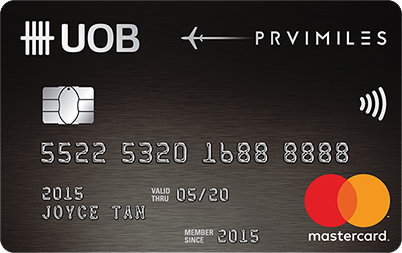
Here’s our review of the UOB PRVI Miles credit cards issued in Singapore. It forms part of our series of credit card reviews, which are all summarised on our dedicated Credit Cards page.
Dollar amounts refer to SGD, and ‘miles’ refer to KrisFlyer miles, except where stated. This review was updated on 9th October 2026.
| UOB PRVI Miles | |||
 |
1.4 mpd local |
2.4 mpd FCY |
4 lounge visits |
| APPLY HERE | |||
| UOB PRVI Miles | ||
|
||
|
1.4 mpd local |
2.4 mpd FCY |
4 lounge visits |
| APPLY HERE | ||
Mainly Miles Says
The UOB PRVI Miles cards still sit near the top of the table for uncapped general spend, earning 1.4 mpd locally, 2.4 mpd overseas and 3 mpd in four regional currencies, and they now include the airport lounge access we flagged as a major gap in our previous reviews.
UOB’s annoying quirks haven’t gone anywhere though.
S$5 earning blocks, two-year points expiry, only two useful transfer partners and an annual fee settled with your points unless you intervene all chip away at those headline rates. The Amex version still rewards big spenders most, but has had a mixed 2026.
| Pros | Cons |
|
|
Three versions
There are three versions of the UOB PRVI Miles card, one on each of the major networks: Visa, Mastercard and American Express.
All three share the same income requirement, annual fee, core earn rates, lounge access and transfer partner options. The differences between them have widened since our 2020 review though, so they matter more than ever when deciding which one to apply for.
| UOB PRVI Miles: which version? | |||
 Visa Visa |
Mastercard |
 Amex Amex |
|
| Card tier | Visa Signature | World Mastercard | American Express |
| Lounge entry | App or card | App or card | App only |
| UOB$ merchants | UNI$ + UOB$ | UNI$ + UOB$ | UNI$ only |
| SPC petrol | No UNI$ | No UNI$ | Earns UNI$ |
| SimplyGo UNI$ | Monthly total | Every 5 days or S$15 |
Monthly total |
| SGD charges processed overseas |
1% fee | 1% fee | No fee |
| Annual fee waiver | On request | On request | Automatic at S$50,000 spend |
| Loyalty bonus | – | – | 20,000 miles at S$80,000 spend* |
| Quarterly bonus | – | – | 5,000 miles per S$8,000 in-person FCY |
| Acceptance | Widest | Widest | Narrower |
* S$50,000 for cards approved before 1st August 2026, until their first membership year starting on or after 1st October 2026.
|
UOB PRVI Miles |

For most readers, the choice comes down to two questions.
- Will you spend enough to use the Amex bonuses?
- Are you happy with a card that won’t be accepted everywhere?
If the answer to either is no, go for the Visa or Mastercard. There’s little to separate those two, though the Visa has a slight edge for regular bus and MRT users, since SimplyGo fares are totalled across the whole month before UNI$ are calculated, so less is typically lost to rounding.
You can also hold more than one version. Your UNI$ pool together, but the four lounge visits don’t stack, and UOB’s promotional bonuses are usually capped once across all your PRVI Miles cards.
Eligibility
- Minimum Age: 21
- Minimum Income (Singaporean / PR, aged 21-55): S$30,000/yr
- Minimum Income (Singaporean / PR, aged 56+): S$15,000/yr
- Minimum Income (foreigners): S$40,000/yr
The PRVI Miles cards sit firmly in the entry-level bracket. UOB cut the income requirement from S$50,000 (S$80,000 for the Visa) back in 2018, and it’s stayed at S$30,000 for most Singaporeans and PRs ever since, with an even lower bar of S$15,000 for those aged 56 and over.
Applicants below those thresholds can still get the card secured against a fixed deposit of S$10,000 or more, though that route is only available at a UOB branch.
Annual Fees & Interest Rates
- Annual Fee (principal): S$261.60 (first year free)
- Annual Fee (supplementary): first card free, then S$130.80 each
- Fee waiver: automatic at S$50,000 spend (Amex only), on request otherwise
The first year is free on all three versions, after which the fee is S$261.60. That’s up slightly in recent years, but only because GST has risen from 7% to 9% – the underlying S$240 fee hasn’t moved.
It’s around S$65 more than its closest rivals, with the Citi PremierMiles and DBS Altitude both charging S$196.20, and unlike those two cards, paying the PRVI Miles fee doesn’t earn you any miles in return.
When we last reviewed the card, the first two supplementary cards were always free. Since 1st January 2023 only the first one is, with S$130.80 a year charged for each additional supplementary card from the second onwards.
PRVI Miles Amex cardholders who spend at least S$50,000 in a membership year, including supplementary card spend, have the following year’s fee waived automatically. Visa and Mastercard holders need to ask, though UOB is generally accommodating with waiver requests on this card, based on reader reports.
Other fees and interest rates for the card:
- Interest rate: 27.8% p.a.
- Minimum payment: 3% or S$50, whichever is greater
- Late payment fee: S$100
- Cash advance fee: 8% (minimum S$15), plus 28.5% p.a. interest
- Overlimit fee: S$40
Watch out: UOB takes your points!
When your annual fee falls due, UOB doesn’t simply bill it. If your pooled UNI$ balance is large enough, the bank quietly deducts UNI$ to cover the fee instead, on the first day of the month after it falls due. For the PRVI Miles, you’ll be charged:
- UNI$6,500 (13,000 miles) for a full waiver, if your balance covers it
- UNI$3,250 (6,500 miles) plus S$130.80 in cash for a half waiver, if it doesn’t
- the full S$261.60 in cash, only if you hold less than UNI$3,250
Once the deduction shows as posted, you can request a waiver in the UOB TMRW app, or call UOB if that fails. If it’s granted, the UNI$ come back with their two-year expiry clock reset, however close the originals were to lapsing.
What if UOB says no? A full deduction prices your miles at 2.01 cents each (S$261.60 ÷ 13,000), slightly above the 1.8 cents we typically value a KrisFlyer mile at. So if you’ve decided to keep the card anyway and a waiver isn’t forthcoming, letting UOB keep the UNI$ is marginally better value than paying in cash.
Either way, diarise your card anniversary and check that statement, because 13,000 miles is a lot to lose to inattention.
Sign-up bonus
There’s no miles sign-up bonus for the UOB PRVI Miles cards at the time of writing.
That’s a shame, because UOB had transformed its approach since our 2020 review. Back then, its offers were usually limited to the first few thousand applicants who met the spend, so you could put thousands of dollars through the card and still walk away with nothing.
From 2023, UOB switched to uncapped offers, culminating in a 46,000 bonus miles deal for new-to-UOB cardholders who paid the first year’s fee and met a two-month spend target. That was the equivalent of buying miles at 0.57 cents each, and it last ran until 31st March 2025.
Affiliate platforms occasionally attach cash or gift offers to new PRVI Miles applications, so it’s worth checking before you apply. If a proper miles offer returns, we’ll cover it, and you’ll find current deals across all cards on our Sign-Up Bonuses page.
Regular earn rates
The UOB PRVI Miles cards earn:
- 1.4 mpd on local spend in SGD (UNI$3.5 per S$5)
- 2.4 mpd on FCY spend processed overseas (UNI$6 per S$5)
- 3 mpd on FCY spend in Indonesian Rupiah, Malaysian Ringgit, Thai Baht and Vietnamese Dong, processed in the matching country (UNI$7.5 per S$5)
There’s no minimum spend and no cap on any of these rates.
UOB markets the PRVI Miles as Singapore’s highest-earning ‘limitless’ miles card. Read the footnote though, and that claim only covers local spend and the four regional currencies, and even then the BOC Elite Miles card matches it at 1.4 mpd locally, then beats it on all other overseas spend at 2.8 mpd.
That still leaves the PRVI Miles comfortably in second place among general spend cards.
Earn rates (general spend cards)
(Best to worst, October 2026)
| Card | Local Spend | FCY Spend |
 BOC EM BOC EM |
1.4 mpd | 2.8 mpd |
 UOB PRVI Miles UOB PRVI Miles |
1.4 mpd | 2.4 mpd |
 DBS Altitude DBS Altitude |
1.3 mpd | 2.2 mpd |
 OCBC 90oN OCBC 90oN |
1.3 mpd | 2.1 mpd |
 HSBC T1 HSBC T1 |
1.2 mpd | 2.4 mpd |
 Citi PM Citi PM |
1.2 mpd | 2.2 mpd |
 SC Journey SC Journey |
1.2 mpd | 2 mpd |
 KF Ascend KF Ascend |
1.2 mpd | 1.2 mpd |
 KF UOB KF UOB |
1.2 mpd | 1.2 mpd |
 KF Blue KF Blue |
1.1 mpd | 1.1 mpd |
If you spend S$1,500 a month in SGD and S$500 a month in FCY outside the regional currencies, you’ll finish the year with 39,600 miles.
The same spend earns 34,800 miles on the Citi PremierMiles, 36,600 miles on the DBS Altitude and 42,000 miles on the BOC Elite Miles.
Those figures ignore rounding though, which costs PRVI Miles cardholders more than most, as we’ll cover later.
Overseas, but processed in Singapore
The 2.4 mpd and 3 mpd rates depend on where your payment is processed, not just the currency you pay in.
- A foreign currency charge put through a payment gateway in Singapore earns just 1.4 mpd, which happens more often than you’d think with online merchants and travel sites billing in USD and other currencies
- For the 3 mpd rate, the gateway must be in the matching country, so a Thai Baht charge has to be processed in Thailand
- Any overseas transaction charged in SGD earns 1.4 mpd too
That last point is critical for anyone travelling. Dynamic currency conversion, where a shop or hotel converts your bill to SGD at the terminal, costs you three ways: a poor exchange rate, the local earn rate instead of 2.4 or 3 mpd and, on the Visa and Mastercard, UOB’s 1% international processing fee. Always pay in the local currency.
It isn’t always obvious where a merchant processes your payment. If you’ll be making repeat purchases from an online merchant charging in foreign currency, a small first transaction is the easiest test. Once it posts, check whether you received UNI$6 or UNI$3.5 per S$5.
The 3 mpd regional rate
The regional hike arrived with UOB’s October 2024 refresh, lifting the earn rate in Indonesia, Malaysia, Thailand and Vietnam by 25%, and it applies to online and in-person spend alike.
Those four countries account for a lot of short trips for Singapore-based travellers, from weekends in Bangkok and Bali to day trips across the Causeway. At 3 mpd, the PRVI Miles is the joint-cheapest uncapped way to earn miles there, level with BOC Elite Miles on cost per mile.
Amex acceptance at smaller merchants in these markets is patchy, so the Visa and Mastercard are the more practical choice if you’re maximising this regional FCY benefit.
Agoda and Expedia
PRVI Miles cardholders also earn boosted rates on bookings through UOB’s dedicated Agoda and Expedia pages.

| UOB PRVI Miles Travel partner rates |
||
| Booking | Earn rate | Book by |
| Agoda hotels (charged as overseas spend) |
8 mpd | 15 Aug 2027* |
| Agoda hotels (charged as local spend) |
7 mpd | 15 Aug 2027* |
| Expedia hotels, activities & car rentals |
8 mpd | 31 Mar 2027 |
| Expedia flights (participating airlines) |
3 mpd | 31 Mar 2027 |
* Stays must be completed by 15th November 2027. Hotels in Japan are excluded.
Agoda: book at agoda.com/prvimiles, choosing a room showing UOB’s “up to 8 miles” banner and prepaying, and enter the principal cardholder’s UOB-registered mobile number when you pay.
A few less obvious conditions apply:
- Hotels in Japan don’t qualify at all
- Bonus miles are only earned on the room itself, not on extras charged to it
- Bonus UNI$ are credited within three months of check-out, not when you book
- The full 8 mpd needs the charge to be treated as overseas spend. If it’s processed as a local SGD transaction, you’ll earn 7 mpd instead
Expedia: book at expedia.com.sg/prvimiles, paying Expedia in full upfront. Hotels, activities and car rentals earn 8 mpd, but flights earn only 3 mpd, and only on 17 participating airlines. These include Qatar Airways, Thai Airways, Turkish Airlines, EVA Air and Korean Air, but not Singapore Airlines or Cathay Pacific. Expedia’s bonus UNI$ credit when the transaction posts.
Is it worth it? Prices on these dedicated pages aren’t always the best available, so compare before you book. If you value each mile at 1.8 cents, the 8 mpd rate only beats paying on a 4 mpd card if the room costs no more than about 7% extra. Against the PRVI Miles’ own 2.4 mpd rate, the margin stretches to around 10%.
What’s changed since 2020?
Our last review of these cards dates from 2020 (with a 2021 update), and a lot has moved since. Here’s how they compare today:
| UOB PRVI Miles: then and now | ||
| Our 2020 review | Today | |
| Annual fee | S$256.80 (first year free) |
S$261.60 (first year free) |
| Supplementary cards | First two free | First one free, then S$130.80 |
| Local earn | 1.4 mpd | 1.4 mpd |
| FCY earn | 2.4 mpd | 2.4 mpd (3 mpd regional) |
| Agoda hotels | 6 mpd | Up to 8 mpd |
| Expedia | 6 mpd | 8 mpd hotels, 3 mpd flights |
| UOB Travel | 6 mpd | Discontinued |
| UOB$ (SMART$) merchants (Visa / MC) |
Cashback instead of UNI$ |
UNI$ and UOB$ |
| Lounge access | None | 4 Priority Pass visits a year |
| Amex loyalty bonus | 20,000 miles at S$50,000 |
20,000 miles at S$80,000 |
| Amex quarterly FCY bonus | None | 5,000 miles per S$8,000 |
| Amex airport limo | Up to 8 rides a year |
Discontinued |
| UNI$ transfer fee | S$25 | S$27 |
| KrisFlyer auto-conversion | S$50 a year | Discontinued |
| Payment Facility fee (standard) |
2% | 2.3% |
Visa and Mastercard holders have come out ahead. Lounge access has fixed the biggest gap in the 2020 card, the regional rate adds a very useful 3 mpd, and the old SMART$ trap, where in-store spend at the likes of Cold Storage earned cashback instead of miles, has gone.
Against that, transfers cost more, UOB has scrapped KrisFlyer auto-conversion, buying miles through the Payment Facility is pricier at the standard rate, and Expedia flights now earn half what they did.
The Amex version has had a more mixed time. It gained a quarterly overseas bonus in July 2026, but lost the complimentary airport limo rides we highlighted in 2020, and the spend needed for its 20,000 miles loyalty bonus has risen by 60%.
Eligible transactions
UNI$ aren’t awarded for the usual exclusions, such as NETS transactions, 0% instalment plans, UOB SmartPay, cash advances, balance transfers, fees and interest charges.
Beyond those, the PRVI Miles exclusion list is long. The main categories that earn nothing are:
- Bills, top-ups and wallets: bill payments, payments to payment service providers, AXS, SingPost SAM, ipaymy, RazerPay, EZ-Link and FlashPay top-ups, and funds loaded to prepaid accounts or digital wallets such as GrabPay and YouTrip
- Insurance and utilities: insurance premiums of all kinds, plus electricity, gas and water bills
- Healthcare and education: hospitals, plus schools, colleges, universities and vocational courses
- Government: tax payments, fines, court costs and other government services
- Property and parking: rent paid through real estate agents, property management fees, and car parks
- Financial: wire transfers, brokerages, forex and crypto platforms, and other quasi-cash transactions
- Organisations: charities, religious, political and membership organisations, and professional services not classified elsewhere
- Other: gambling, cigar shops, Amaze transactions, and Shell and SPC service stations
The PRVI Miles Amex is the one exception at SPC, where it still earns UNI$.
The list has grown noticeably since 2020. Hospitals and car parks were added in 2021, utilities and ipaymy in 2022, and Amaze, membership organisations and professional services in late 2024.
CardUp payments do currently earn UNI$, making the PRVI Miles one of the better-earning options for bills paid that way.
The full list is in section 1(ii) of the card’s terms and conditions.
UOB$ merchants
In 2020, we warned PRVI Miles Visa and Mastercard holders to steer clear of in-store purchases at SMART$ merchants (since renamed UOB$), where you’d earn cashback instead of UNI$.
That’s no longer a problem. Since 1st November 2024, the Visa and Mastercard earn UNI$ and UOB$ together at these merchants, so in-store spend there now earns the full UNI$ rate, with a little UOB$ cashback as an extra.
The Amex doesn’t take part in the UOB$ programme at all, so it simply earns UNI$ as normal.
SimplyGo
Bus and MRT fares paid by tapping your card earn the standard 1.4 mpd, but how they’re totalled depends on which version you hold:
- Visa and Amex: fares are added up across the calendar month, with UNI$ credited on the 7th of the following month
- Mastercard: fares are batched every five days, or once they reach S$15, whichever comes first
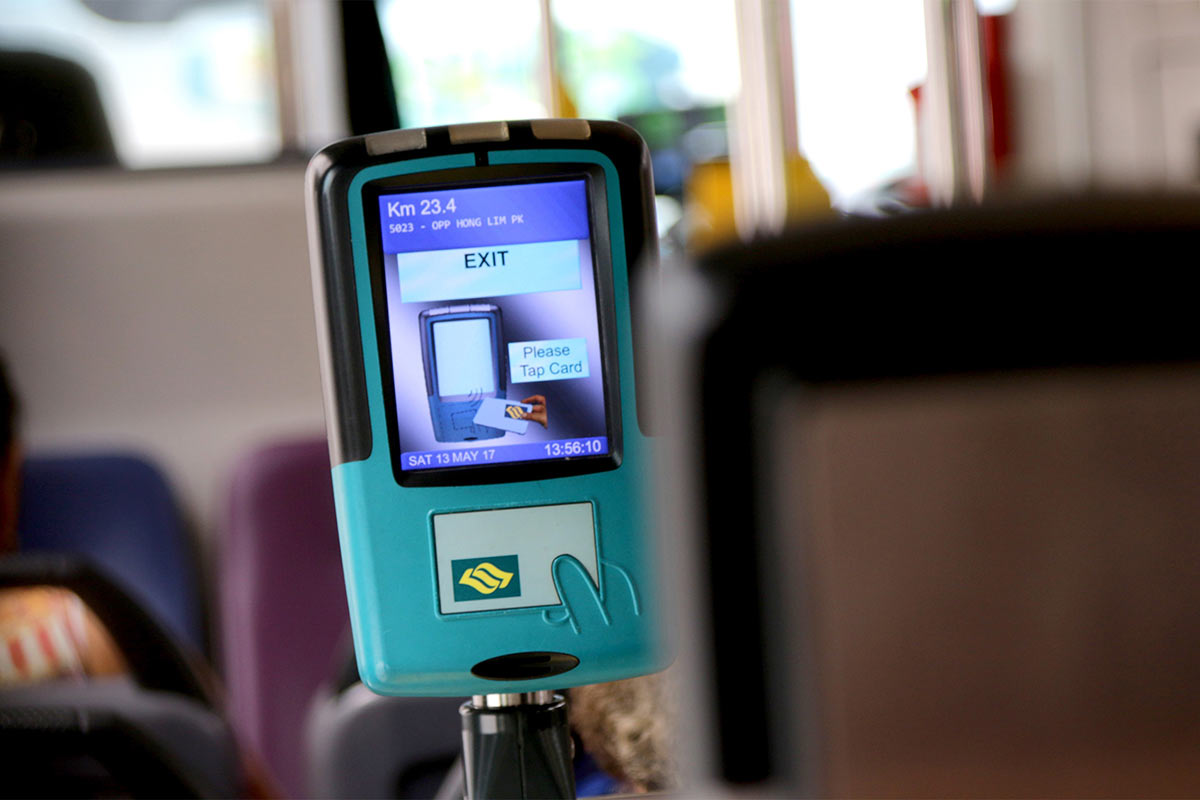
(Photo: Joshua Lee)
UNI$ are calculated on each posted amount, so the Visa and Amex’s monthly total loses less to rounding than the Mastercard’s smaller batches. Either way, individual fares well below S$5 still earn miles on all three cards, provided you clock enough of them.
Posting date, not transaction date
UOB counts your spend by the date it posts to your account, typically one to three days after you make it, not the transaction date itself.
That’s important for anything with a deadline, whether it’s a promotion period, the Amex quarterly bonus or its membership year spend threshold. A purchase on the last day of a quarter can easily fall into the next one, so leave yourself a few days’ margin.
When do UNI$ credit?
UNI$ are credited as each transaction posts, so they’re usually in your account within a few working days, with no need to wait for your statement.
The exceptions are SimplyGo fares on the Visa and Amex (credited monthly), Agoda bonus UNI$ (within three months of check-out), and promotional bonuses, which typically arrive a couple of months after the promotion or qualifying period ends.
Do UNI$ expire?
Yes. UNI$ expire two years after the end of the calendar quarter in which you earn them, so UNI$ earned in May 2027 will expire on 30th June 2029.
That remains one of the card’s main weaknesses. Citi Miles on the PremierMiles card and DBS Points on the Altitude card don’t expire at all.
Once transferred, KrisFlyer miles are valid for three years, while Asia Miles won’t expire as long as your account has qualifying activity at least once every 18 months.
UNI$ pool between cards
UNI$ from all your UOB cards are combined into a single balance, so if you hold the PRVI Miles alongside a 4 mpd card like the UOB Preferred Visa, you can transfer them together and pay one conversion fee.
You can also cancel a UOB card without losing your UNI$, provided you still hold at least one other UOB card that earns them. If the PRVI Miles is your last one, transfer or use your UNI$ before cancelling, because they’re forfeited when the account closes.
Which loyalty schemes can I transfer into?
UNI$ transfer to three frequent flyer programmes, though in practice only two are worth considering.
| Frequent Flyer Programme | Transfer Blocks (UNI$ Miles) |
|
 |
Singapore Airlines KrisFlyer |
5,000 10,000 |
 |
Cathay Pacific Asia Miles |
5,000 10,000 |
 |
AirAsia Rewards |
2,500 4,500 |
AirAsia points transfer at a poorer ratio but, most critically, are worth only a fraction of a KrisFlyer mile or Asia Mile, so we’d ignore that option entirely.
Two useful partners is thin by Singapore standards. Citi PremierMiles cardholders can choose from ten frequent flyer programmes plus IHG, for example. That said, KrisFlyer and Asia Miles between them open up Star Alliance and oneworld, which is enough for many readers.


What is the transfer cost to miles?
Each transfer costs S$27, up from S$25 when UOB raised the fee in December 2025.
However, transfers are free on all your pooled UNI$ if you also hold a UOB Visa Infinite, Visa Infinite Metal, Privilege Banking or Reserve card.
The KrisFlyer auto-conversion programme we covered in our last review, which moved UNI$ across monthly for S$50 a year, was discontinued on 20th May 2026. It was rarely worth it anyway, since it locked you out of Asia Miles and required a UNI$15,000 balance to be left untouched.
↥ Is there a minimum transfer amount?
Transfers to KrisFlyer and Asia Miles start at UNI$5,000 (10,000 miles), and must be made in blocks of that size.
How long do transfers take?
UOB quotes up to five working days for KrisFlyer and up to 14 working days for Asia Miles.
In our experience, KrisFlyer transfers usually complete within one to two days. Asia Miles transfers really do take most of UOB’s quoted window though, and there are occasional reports of them taking even longer, so they’re not one to leave until the last minute.
Instant transfers to KrisFlyer via Kris+
If you need KrisFlyer miles immediately, you can link UOB Rewards to the Kris+ app, convert as little as UNI$1,000 into KrisPay miles at a ratio of 1:1.7, then move those 1:1 into KrisFlyer straight away.
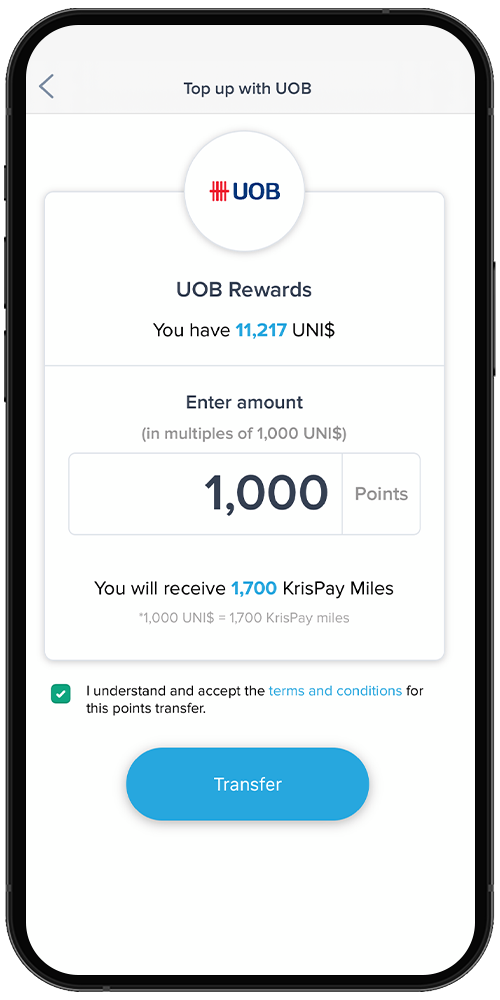
The catch is a 15% haircut compared with a normal transfer, which effectively cuts the card’s earn rates to 1.19 mpd locally, 2.04 mpd overseas and 2.55 mpd on regional spend.
Two rules to remember:
- Move the KrisPay miles into KrisFlyer within 21 days
- Don’t spend any of them in Kris+ first, or the whole batch gets stuck there and then expires six months later if unused
It’s best kept for topping up a balance for a specific redemption, or clearing out a small leftover balance you won’t add to.
What else can UNI$ be used for?
UNI$ can also be redeemed for cash rebates and vouchers through Rewards+ in the UOB TMRW app, but these typically value each UNI$ at around 1 cent.
Transferred to KrisFlyer or Asia Miles, the same UNI$ is worth two miles, or around 3.6 cents at typical valuations, so miles are the better choice by a wide margin.
Visa and Mastercard holders can also use UNI$ to pay on the spot at participating merchants, though at similarly poor value, and that option isn’t available on the Amex.
Points rounding
This is where the PRVI Miles cards lose some of their headline appeal.
UOB awards UNI$ per complete S$5 of each transaction, then rounds any fraction of a UNI$ down. A S$9.99 charge therefore earns UNI$ on S$5 only, and because the local rate is UNI$3.5 per S$5, an odd number of S$5 blocks loses its half UNI$ too.
Here’s how that looks in practice:
| UNI$ awarded | |||
| SGD Charge |
Local (1.4 mpd) |
FCY (2.4 mpd) |
Regional (3 mpd) |
| S$4.99 | 0 (0 mpd) |
0 (0 mpd) |
0 (0 mpd) |
| S$5.00 | 3 (1.2 mpd) |
6 (2.4 mpd) |
7 (2.8 mpd) |
| S$9.99 | 3 (0.6 mpd) |
6 (1.2 mpd) |
7 (1.4 mpd) |
| S$10.00 | 7 (1.4 mpd) |
12 (2.4 mpd) |
15 (3.0 mpd) |
| S$14.99 | 7 (0.93 mpd) |
12 (1.6 mpd) |
15 (2.0 mpd) |
| S$15.00 | 10 (1.33 mpd) |
18 (2.4 mpd) |
22 (2.93 mpd) |
| S$20.00 | 14 (1.4 mpd) |
24 (2.4 mpd) |
30 (3.0 mpd) |
On local spend, S$10 blocks are the sweet spot. FCY spend at 2.4 mpd avoids the issue, since UNI$6 per S$5 is already a whole number, but the regional rate (UNI$7.5) loses its half UNI$ on odd blocks too.
At higher values the effect fades. S$249.99 of local spend earns UNI$171 (342 miles, 1.37 mpd), against UNI$175 (350 miles, 1.4 mpd) for S$250.
So what does this mean for the card’s real earn rate? If your local transactions range randomly between S$20 and S$100, the PRVI Miles earns closer to 1.33 mpd than 1.4 mpd. On smaller transactions between S$5 and S$30, it drops to around 1.17 mpd, below even the Citi PremierMiles’ headline local rate.
Try to use the PRVI Miles for larger transactions, where rounding barely matters, and put small everyday purchases on a card with more forgiving rounding.
↥ Minimum spend to earn UNI$
With S$5 blocks, S$5.00 is the smallest transaction that earns anything, including foreign currency purchases that convert to less than S$5.
SimplyGo fares are the exception, as explained above.
For comparison, the Citi PremierMiles earns from S$1.00, and the DBS Altitude from S$1.54.
FCY fee / cpm overseas
UOB charges a 3.25% foreign currency fee on all three PRVI Miles cards, unchanged since 2020.
At 2.4 mpd, that’s an effective cost of 1.43 cents per mile on overseas spend. At the 3 mpd regional rate it’s 1.14 cents each, level with the BOC Elite Miles at the top of our table.
| Cost per mile on overseas transactions (general spend cards) (Best to worst, October 2026) |
|||
| Card | Fee | Mpd | Cost per mile |
| BOC EM |
3% | 2.8 | 1.14¢ |
| UOB PRVI Miles (IDR, MYR, THB, VND) |
3.25% | 3.0 | 1.14¢ |
 Maybank HVS Maybank HVS |
3.25% | 2.8* | 1.22¢* |
 SCVI SCVI |
3.5% | 3.0** | 1.22¢** |
| HSBC T1 |
3.25% | 2.4 | 1.43¢ |
| UOB PRVI Miles (other currencies) |
3.25% | 2.4 | 1.43¢ |
| Citi PM |
3.25% | 2.2 | 1.56¢ |
| DBS Altitude |
3.25% | 2.2 | 1.56¢ |
 OCBC Voyage OCBC Voyage |
3.25% | 2.2 | 1.56¢ |
 OCBC 90oN OCBC 90oN |
3.25% | 2.1 | 1.63¢ |
 HSBC VI HSBC VI |
3.25% | 2.0 | 1.71¢ |
| SC Journey |
3.5% | 2.0 | 1.83¢ |
| KF UOB |
3.25% | 1.2 | 2.86¢ |
| KF Ascend |
3.25% | 1.2 | 2.86¢ |
| KF Blue |
3.25% | 1.1 | 3.12¢ |
* Maybank Horizon Visa Signature: minimum S$800 spend per calendar month required.
** Standard Chartered Visa Infinite: minimum S$2,000 spend per statement period required.
Cost per mile accounts for an additional 0.30% ‘spread’ over money changer currency rates, and reflects miles earned on the billed amount inclusive of the fee. This doesn’t apply to all banks and all foreign currencies, so it’s a worst-case scenario.
Back in 2020, the PRVI Miles ranked fourth in this table. Today, its regional rate puts it joint top, and its standard 2.4 mpd rate sits level with the HSBC TravelOne just below the leading pack.
The Amex extras
Some of the key benefits of the PRVI Miles card only apply to the American Express version, so here’s a rundown of those perks.

Quarterly overseas spend bonus
Since 1st July 2026, the PRVI Miles Amex has earned 5,000 bonus miles (UNI$2,500) for any calendar quarter in which you spend at least S$8,000 overseas in person. Supplementary card spend counts towards the target, and the bonus is credited within two months of the quarter ending.
Online purchases, phone and mail orders don’t count, and nor do QR, mobile wallet or in-app payments, even if you’re standing in the shop at the time, as we explained when the bonus launched.
Here’s what the bonus does to the card’s overseas earning, using the same cost per mile method as above.
| PRVI Miles Amex: overseas earn with the quarterly bonus (5,000 bonus miles, all spend in one category) |
||||
| In-person FCY spend (quarter) |
Other FCY mpd |
Other FCY cost per mile |
Regional mpd |
Regional cost per mile |
| S$7,999 | 2.4 | 1.43¢ | 3.0 | 1.14¢ |
| S$8,000 | 3.03 | 1.13¢ | 3.63 | 0.95¢ |
| S$10,000 | 2.9 | 1.18¢ | 3.5 | 0.98¢ |
| S$12,000 | 2.82 | 1.22¢ | 3.42 | 1.00¢ |
| S$16,000 | 2.71 | 1.26¢ | 3.31 | 1.04¢ |
At exactly S$8,000 of non-regional spend, the Amex edges past the BOC Elite Miles to become the cheapest way to earn miles overseas in our table, and in the four regional currencies it drops below one cent per mile. Beyond S$8,000 the benefit tapers off, and of course at S$7,999 there’s no bump at all.
The obvious problem is volume.
S$8,000 of in-person spend in one quarter is a lot for most readers, and in Indonesia, Malaysia, Thailand and Vietnam, where the bonus is worth the most, Amex acceptance is at its weakest.
20,000 miles loyalty bonus
The PRVI Miles Amex also awards 20,000 bonus miles (UNI$10,000) when you spend enough in a membership year, credited within two statement periods of your card anniversary. Principal and supplementary spend both count, but excluded transactions don’t.
That threshold was S$50,000 when we reviewed the card in 2020, but UOB raised it to S$80,000 in July 2026:
- Cards approved from 1st August 2026 need S$80,000 from the start
- Older cards keep the S$50,000 threshold until their first membership year starting with a statement dated on or after 1st October 2026
The automatic fee waiver hasn’t moved, which leaves a band where you keep one benefit but not the other:
| PRVI Miles Amex What your annual spend unlocks |
||
| Membership year spend |
Annual fee waiver |
20,000 loyalty miles |
| Below S$50,000 | On request | No |
| S$50,000 – S$79,999 | Automatic | No* |
| S$80,000+ | Automatic | Yes |
* Yes, for cards still on the S$50,000 threshold (see above).
At S$80,000, the bonus is worth an extra 0.25 mpd, down from 0.4 mpd at S$50,000, lifting local spend to an effective 1.65 mpd. Fall S$1 short, and you get nothing.
For a very high spender who maxes out both Amex bonuses, with S$8,000 of in-person overseas spend every quarter (outside Indonesia, Malaysia, Thailand and Vietnam) plus S$48,000 locally, the total comes to 184,000 miles, or 2.3 mpd across the full S$80,000. That’s an impressive return for an uncapped card, but realistic for very few readers.
Recurring promotions
UOB regularly runs bonus promotions for PRVI Miles cardholders, and since November 2022 they’ve settled into a predictable pattern – 5 mpd on overseas dining and shopping for all three versions of the card, usually from May to June and again from November to December.
Registration is required, only in-person spend counts, and the bonus is capped.
Here’s a summary of every edition we’ve covered.
| UOB PRVI Miles 5 mpd overseas promotions | |||
| Promotion period |
Min. spend |
Bonus miles cap |
Bonus categories |
| Nov – Dec 2022 | S$1,000 | 10,400 | Dining, groceries, shopping |
| May – Jun 2023 | S$1,000 | 10,400 | Dining, groceries, shopping |
| May – Jun 2024 | S$1,500 | 10,400 | Dining, groceries, shopping |
| Nov – Dec 2024 | S$1,500 | 13,000 | Dining, shopping |
| May – Jun 2025 | S$1,500 | 8,000 | Dining, shopping |
| Nov – Dec 2025 | S$1,500 | 8,000 | Dining, shopping |
| May – Jun 2026 | S$1,500 | 8,000 | Dining, shopping |
Since the regional rate arrived, the bonus in those four currencies is smaller (2 mpd on top of 3 mpd, rather than 2.6 mpd on top of 2.4 mpd), and the cap has shrunk to 8,000 bonus miles. That’s reached with around S$3,080 of spend elsewhere, or S$4,000 regionally.
If the pattern holds, expect the next round in November. It’s always worth registering anyway, even if you’re not sure you’ll travel, since there’s no limit on participants.
In 2020, UOB’s promotions were more varied, with bonuses on online spend, groceries, Klook, and bus and MRT rides, but overseas spend has been the focus for several years now.
UOB Payment Facility
Formerly known as PRVI Pay, the UOB Payment Facility lets you charge any amount to your card, up to 95% of your credit limit, and have UOB transfer it to your bank account, no questions asked.
You pay an administrative fee and earn 1 mpd (UNI$2.5 per S$5) on the amount. On the PRVI Miles, the standard fee is now 2.3%, so you’re effectively buying miles at 2.3 cents each, up from 2% when we reviewed the card in 2020.
That’s above what we’d pay for miles, but UOB discounts the fee regularly, and the current promotion runs at 1.8% until 31st October 2026.

Its value is for topping up. Since UNI$ only transfer in UNI$5,000 blocks, a small Payment Facility request can push your balance over the next threshold, rather than leaving miles stranded. Request amounts in S$10 multiples, since UNI$2.5 per S$5 is rounded down on odd blocks.
KrisFlyer UOB Account
UOB also pitches bonus miles for pairing the card with a KrisFlyer UOB Account, but with the bonus capped at 5% of your monthly average balance, it’s small change for most readers – avoid.
Airport lounge access
The biggest improvement since our 2020 review is lounge access. PRVI Miles principal cardholders now receive four complimentary Priority Pass visits per calendar year, added in October 2024.
The terms are tighter than most:
- Visits are for the principal cardholder only, with guests charged US$35 each
- The four visits are shared across all your PRVI Miles cards, so holding two versions doesn’t double them
- Supplementary cardholders get no free visits
- Any visits beyond four are charged at US$35
You’ll need a new Priority Pass account, set up at prioritypass.com/prvisg, as UOB can’t attach the benefit to an existing membership. Then use the digital membership card in the Priority Pass app. Visa and Mastercard holders can also use the physical card from 12 hours after registering, but Amex holders need the app.
Because the allowance resets every 1st January, a card approved late in the year can let you benefit from up to eight visits in its first 12 months, if you time your trips well.

(Photo: MainlyMiles)
Priority Pass also covers non-lounge options such as restaurants and spas at many airports, including Changi.
Here’s how that compares with other entry-level cards:
- UOB PRVI Miles: 4 Priority Pass visits per year
- HSBC TravelOne: 4 Dragon Pass visits per year
- Citi PremierMiles: 2 Priority Pass visits per year
- DBS Altitude Visa: 2 Priority Pass visits per year
- Standard Chartered Journey: 2 Priority Pass visits per year
On numbers alone, the PRVI Miles is joint top. If you usually travel with a partner though, remember that every PRVI Miles visit still comes with a US$35 guest charge, whereas the visit allowance on most rival cards can be used for a companion.
See our guide to cards with free airport lounge access for the full list.

Travel insurance
Charge the full fare for your trip to the card and register online before departure, and you’ll receive complimentary travel cover from United Overseas Insurance, extending to your spouse and children:
- Accidental death or permanent disablement: up to S$500,000 on public transport (S$30,000 for children)
- Emergency medical evacuation and repatriation: up to S$50,000
- Travel delay: S$100 for the first six hours and S$50 for the next six, up to S$200 per person
- Missed connections and overbooking: up to S$100 per person, for delays over six hours
- Credit card liability: up to S$5,000
The registration step is easily forgotten, and without it you’re not covered. Trip cancellation, baggage and overseas medical bills all fall outside the policy, so treat this as a top-up to proper travel insurance, never a replacement for it.
Merchant acceptance
As with any American Express card, the PRVI Miles Amex is widely accepted at larger merchants in Singapore, but less so at smaller independents, and the gap widens overseas, particularly in the four regional markets where the card’s best rates apply.
If you choose the Amex, it’s worth carrying a Visa or Mastercard as a backup.
How it compares
The PRVI Miles’ closest rivals are the Citi PremierMiles and DBS Altitude, both entry-level general spend cards with lounge access:
| UOB PRVI Miles vs. Citi PremierMiles vs. DBS Altitude | |||
| UOB PRVI Miles |
Citi PremierMiles |
DBS Altitude |
|
| Annual fee | S$261.60 (first year free) |
S$196.20 (first year free) |
S$196.20 (first year free) |
| Miles for paying the annual fee |
None | 10,000 | 10,000 |
| Local spend | 1.4 mpd | 1.2 mpd | 1.3 mpd |
| FCY spend | 2.4 mpd (3 mpd regional) |
2.2 mpd | 2.2 mpd |
| Cost per mile overseas |
1.43¢ (1.14¢ regional) |
1.56¢ | 1.56¢ |
| Points expiry | 2 years | Never | Never |
| Useful transfer partners |
2 | 10 airlines + IHG |
2 |
| Transfer fee | S$27 | S$27.25 | S$27.25 |
| Smallest charge earning miles |
S$5.00 | S$1.00 | S$1.54 |
| Lounge visits | 4 Priority Pass (no guests) |
2 Priority Pass | 2 Priority Pass (Visa only) |
| Annual miles (our example)* |
39,600 | 34,800 | 36,600 |
* S$1,500 local and S$500 non-regional FCY spend per month, before rounding.
The PRVI Miles out-earns both on every type of spend, and offers double their lounge visits.
In return, Citi’s miles never expire and transfer to far more partners, which is very important if your redemptions go beyond KrisFlyer and Asia Miles, and both rivals reward fee payment with 10,000 miles, where the PRVI Miles offers nothing. Citi is also more forgiving on small transactions.
They aren’t mutually exclusive though. For general spend that doesn’t fit a 4 mpd card, the PRVI Miles’ earn rates make it the stronger card for most transactions over S$10, particularly overseas.
Terms and conditions
Here are links to the full terms and conditions applicable to the UOB PRVI Miles cards and the UOB Rewards Programme.
Our Summary
Six years on from our last review, the UOB PRVI Miles cards are better than they were, at least in Visa and Mastercard form.
The 1.4 mpd local rate is still joint-best among uncapped cards, 2.4 mpd overseas remains competitive, and the 3 mpd regional rate makes this one of the cheapest ways to earn miles in Malaysia, Indonesia, Thailand and Vietnam. Four Priority Pass visits a year have filled the most obvious gap in the 2020 card, while the twice-yearly 5 mpd promotions and 8 mpd Agoda and Expedia hotel rates add occasional boosts.
What hasn’t changed is UOB’s fine print. S$5 earning blocks with fractions rounded down mean the real local rate is closer to 1.33 mpd on typical spend, UNI$ still expire after two years, transfers now cost S$27 to just two useful partners, and the annual fee is quietly taken from your points unless you step in.
The Amex remains the strongest of the three for very high spenders, especially those with large in-person spend overseas, but losing its limo rides and the 60% jump in its loyalty bonus threshold mean it’s no longer the automatic pick it was in 2020. For most readers, the Visa or Mastercard is the better choice.
If you want one card for spend that doesn’t fit a 4 mpd category, the PRVI Miles remains one of the better options available, provided you use it for larger transactions and keep an eye on your UNI$ expiry dates.
| Our Rating | ||||||||||||||||||||
| 3.5 / 5 among general spend cards |
||||||||||||||||||||
|
UOB PRVI Miles |
||||||||||||||||||||
How we rate credit cards
|
||||||||||||||||||||
(Cover Photo: Shutterstock)