


Here’s our review of the OCBC 90°N credit card issued in Singapore. It forms part of our series of credit card reviews, which are all summarised on our dedicated Credit Cards page.
Dollar amounts refer to SGD, and ‘miles’ refer to KrisFlyer miles, except where stated. This review was updated on 31st August 2026.
| OCBC 90°N Card | |||
 |
1.3 mpd local |
2.1 mpd FCY |
9 transfer partners |
| APPLY HERE | |||
| OCBC 90°N Card | ||
|
||
|
1.3 mpd local |
2.1 mpd FCY |
9 transfer partners |
| APPLY HERE | ||
Mainly Miles Says
The OCBC 90°N card has come a long way since we last reviewed it, and in fairness most of the movement has been in the right direction. A single KrisFlyer transfer link became nine partners, the local earn rate crept up to 1.3 mpd, and miles now pool across the Visa and Mastercard versions.
But OCBC has taken almost as much as it has given.
Free transfers to KrisFlyer are gone, replaced by a S$25 fee, the annual fee has more than tripled, and most of those new partners convert at ratios poor enough that there’s little reason to use them.
Add the S$5 earning blocks and the absence of any complimentary lounge access, and this is a card that really only works if you transfer to KrisFlyer alone.
| Pros | Cons |
|
|
Two versions?
The OCBC 90°N card is available on both the Mastercard and Visa networks, and you can hold both at once.
The Mastercard came first, launching in August 2019 with a headline-grabbing set of introductory rates, and the Visa followed in October 2021. For their first couple of years the two were different products, the Visa earned less on general spend but carried a small bonus category, while the Mastercard earned more but had no bonus rate at all.
That distinction disappeared in early 2023, when OCBC brought both cards onto a single earn structure. Mastercard holders saw the new rates from 15th February 2023, and Visa holders from 17th March 2023.
Today the two are the same product, just operating on two different networks.
Both accrue 90°N Miles at the same rate, and those miles also pool together, so 15,000 90°N Miles on your Visa and 20,000 miles on your Mastercard gives you 35,000 miles to redeem in a single transfer.
What still differs is a few of the perks, which we cover later in this review. Broadly, the Mastercard version has the more useful set.
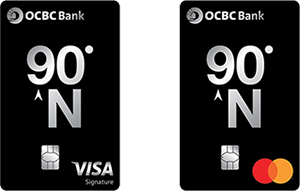
Both versions have since moved to the portrait-style card stock that’s become the norm with several cards in Singapore, and both carry an LED embedded in the degree symbol, which lights up when you make a contactless payment. It serves no purpose whatsoever, but we rather like it.
Eligibility
- Minimum Age: 21
- Minimum Income (Singaporean / PR): S$30,000/yr (age 21-54)
- Minimum Income (Singaporean / PR): S$15,000/yr (age 55+)
- Minimum Income (Non-Singaporean / PR): S$45,000/yr
The OCBC 90°N card sits at the entry-level S$30,000 annual income threshold for most Singaporeans and Permanent Residents, the mandated minimum for a credit card in Singapore, making it widely accessible.
Foreigners will need to hold an Employment Pass or S-Pass in addition to meeting the higher S$45,000 requirement.
Annual Fees & Interest Rates
- Annual Fee (principal): S$196.20 (first year free)
- Annual Fee (supplementary): S$98.10 (first year free)
The annual fee for the OCBC 90°N card is S$196.20, waived for the first year. Supplementary cards cost S$98.10 each per year, again waived in year one.
The fee has risen quite sharply. Until the end of 2023 it was S$54, then from 1st January 2024 OCBC raised it to its current level, a jump of well over 250%.
From the second year onwards, the fee is automatically waived if you charge at least S$10,000 to the card in a membership year – that’s every 12-month period running from your card anniversary date, not the calendar year.
Other fees and interest rates for the OCBC 90°N card include:
- EIR: 27.8%
- Interest-free period: 23 days
- Minimum payment: 3% (or S$50, whichever is greater)
- Late payment fee: S$100
- Cash advance fee: 8% (min. S$15)
- Overlimit fee: S$50
- FCY Fee: 3.25%
Renewal bonus
If the annual service fee is charged to your account, you’ll receive a renewal bonus of 10,000 90°N Miles.
Since the fee is waived in year one, this doesn’t apply until your second membership year at the earliest.
At S$196.20 for 10,000 miles, that’s the equivalent of buying them at 1.96 cents each, above the level we would be comfortable to buy at.
Do also note that the bonus is conditional in both directions. OCBC’s terms are explicit that if the fee is subsequently waived after the bonus has been credited, the 10,000 miles are clawed back – and if your balance is insufficient at that point, the bank reserves the right to charge you the cash equivalent.
Regular earn rates
The OCBC 90°N card earns:
- 1.3 mpd for local spend (i.e. transacted in SGD)
- 2.1 mpd for overseas spend (i.e. transacted in foreign currency)
There’s no cap on the number of 90°N Miles you can earn in a month.
Here’s how those rates compare to other general spend cards with similar income requirements on the market in Singapore.
Earn rates (general spend cards)
(Best to worst, August 2026)
| Card | Local Spend | FCY Spend |
 BOC EM BOC EM |
1.4 mpd | 2.8 mpd |
 UOB PRVI Miles UOB PRVI Miles |
1.4 mpd | 2.4 mpd |
 DBS Altitude DBS Altitude |
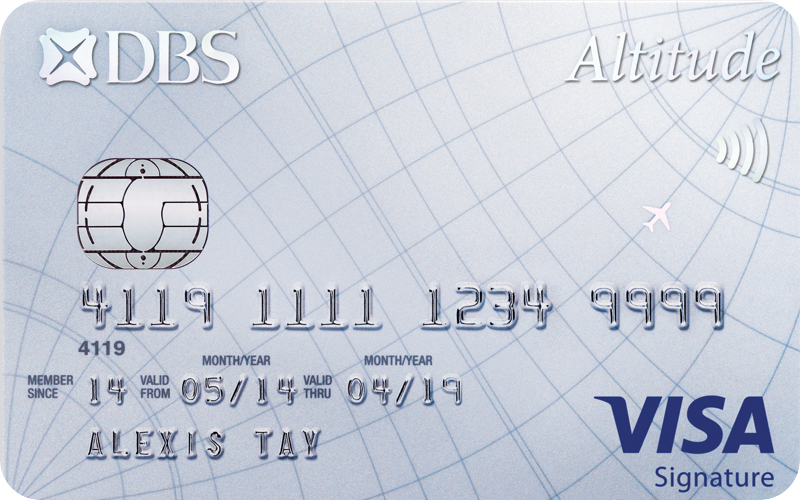
1.3 mpd | 2.2 mpd |
| OCBC 90°N |
1.3 mpd | 2.1 mpd |
 HSBC T1 HSBC T1 |
1.2 mpd | 2.4 mpd |
 Citi PM Citi PM |
1.2 mpd | 2.2 mpd |
 SC Journey SC Journey |
1.2 mpd | 2 mpd |
 KF Ascend KF Ascend |
1.2 mpd | 1.2 mpd |
 KrisFlyer UOB KrisFlyer UOB |
1.2 mpd | 1.2 mpd |
 KF Blue KF Blue |
1.1 mpd | 1.1 mpd |
The 90°N sits mid-table here. Its 1.3 mpd local rate matches the DBS Altitude and beats the Citi PremierMiles, but the BOC Elite Miles and UOB PRVI Miles both do better on either measure.
The 2.1 mpd overseas rate was competitive when this card launched, but it isn’t any more. Six cards on this list now beat it, and one of them – the BOC Elite Miles – does so by a full 0.7 mpd.
Pro Tip: OCBC applies its 2.1 mpd rate to any transaction billed in a foreign currency, even where the payment gateway sits in Singapore.Some banks treat those as local spend. If you’re making an online purchase and aren’t certain how it will be processed, this is a reasonable card to reach for.
You’ll also earn 1 mpd on AXS Pay+Earn transactions, though with the admin fee involved this is an expensive way to accumulate miles and not something we’d recommend.
Bonus earn rates
There’s only one bonus earning opportunity on this card, and it’s with Agoda. Booking through the dedicated link at www.agoda.com/90n earns:
- 7 mpd on bookings made in foreign currency
- 6 mpd on bookings made in SGD

The current cycle of the offer covers bookings made through to 10th October 2026, for stays completed by 31st December 2026.
You’ll initially earn at the standard 1.3 mpd or 2.1 mpd rate when payment is taken, with the bonus element credited within two months of checking out of the hotel. Only prepaid bookings qualify, and the offer can’t be stacked with other promotions, discounts or cashback portals.
As always with bank and OTA tie-ups, do the maths before booking. A rate that’s S$40 more expensive than you’d find elsewhere isn’t a bargain just because it comes with a few thousand extra miles attached. Shop around first, then decide.
When this card launched in 2019 it offered 4 mpd on uncapped overseas spend and up to 8 mpd on some hotel booking sites – rates that made it briefly the most talked-about card in Singapore.
Those terms expired at the end of February 2020 and nothing comparable has replaced them since.
Eligible transactions
OCBC’s exclusion list for the 90°N card is long, and includes several categories that other banks do still reward.
No 90°N Miles are awarded on card fees and charges, annual fees, balance transfers, instalment payment plans, income tax payments, GST, interest, late payment charges, cash advances, or bill payments made via internet banking.
Top-ups to prepaid accounts and payment service providers are also excluded, specifically including EZ-Link, NETS FlashPay, eNETS, SAM, Transit Link, AXS (other than Pay+Earn), GrabPay, YouTrip, ShopeePay and Singtel Dash.
On top of that, OCBC excludes a substantial list of Merchant Category Codes. The ones most likely to catch our readers out are:
- Utilities (MCC 4900)
- Insurance (MCC 5960, 6300)
- Education, from primary schools to universities (MCC 8211-8299)
- Hospitals (MCC 8062)
- Charitable and religious organisations (MCC 8398, 8661)
- Tax and government payments (MCC 9311, 9399)
- Real estate agents and rentals (MCC 6513)
- Car parks (MCC 7523) and tolls (MCC 4784)
- Cryptocurrency and quasi-cash (MCC 6051)
There’s also a specific carve-out on transport. Transactions under MCC 4111, 4121 and 4131 earn nothing, which rules out SimplyGo bus and train journeys, though Grab Transport, Gojek and licensed taxi operators are explicitly re-included and do still earn.
The full list is in the card terms and conditions, last updated in November 2025.
What about CardUp and ipaymy?
The OCBC 90°N card earns its full 1.3 mpd local rate on both CardUp and ipaymy transactions, letting you accrue miles on rent, school fees, insurance premiums, income tax and other payments that would otherwise earn nothing on this card.
That’s sometimes useful, given how much of OCBC’s exclusion list those categories cover. Education, insurance, utilities and tax payments all earn zero when charged directly, but go through a payment platform and they earn at the standard rate.
What’s gone are the regular discounts we used to see. OCBC previously negotiated reduced CardUp admin fees for 90°N cardholders, typically 1.55% for new users and 2% for existing ones, accessed through dedicated promo codes. Those promotions have now all lapsed.
Without them you’re paying the prevailing rate, which for CardUp is currently 2.6%.
At the card’s 1.3 mpd local earn rate that works out at 1.95 cents per mile, above the typical 1.8 cent valuation, and no longer a sensible way to generate miles with this card. ipaymy’s fees vary by payment type, so the figure will differ there, but those were also recently hiked.
Always check the cost per mile against the prevailing fee for your specific transaction type before committing. These platforms are only worth using when the maths works out, and with this card’s earn rate the margin is now thin.
Keep an eye out for the OCBC codes returning, since the bank has offered them repeatedly in the past, but don’t factor them into your decision to hold the card.
Are KrisFlyer miles credited directly?
No. Rather than crediting miles directly, this card accrues 90°N Miles, a rewards currency unique to the 90°N product.
These convert to KrisFlyer miles at a 1:1 ratio, so S$10,000 of local spending gives you 13,000 90°N Miles, which becomes 13,000 KrisFlyer miles.
Confusingly, 90°N Miles were called Travel$ until 2023. If you come across older coverage of this card, including our own, that’s the same currency under its previous name.
When do 90°N Miles credit?
90°N Miles are credited when the transaction posts to your account, which typically takes between one and three days.
You won’t need to wait for your monthly statement, so if you’re making a purchase specifically to reach a redemption threshold, the miles should be available to transfer within a few days.
Do 90°N Miles expire?
No. 90°N Miles have no expiry date for as long as your card account remains open. Once transferred into KrisFlyer they’re subject to the usual three-year KrisFlyer validity, so there’s every reason to leave them on the OCBC side until you actually need them.
That advantage is amplified by the card’s 1,000-mile transfer blocks. If you’re 800 miles short of a redemption, you’ll transfer 1,000 and overshoot by 200.
On a card working in 10,000-mile blocks, the same shortfall means moving 10,000 and stranding 9,200 miles in KrisFlyer with the three-year clock running. Small blocks mean less of your balance gets dragged into expiry territory before you need it.
Note: Don’t confuse 90°N Miles with OCBC$, earned on cards like the OCBC Rewards card. Those do expire, two years from the month of accrual.90°N Miles pool, but only with each other
Since the two versions of this card share a rewards currency, 90°N Miles earned on your Visa and your Mastercard combine into a single balance for redemption purposes, which is great if you hold both cards.
What they won’t pool with is anything else. OCBC operates three separate and non-combinable rewards currencies across its miles-earning cards:
| OCBC’s three rewards currencies | |||
| 90°N Miles | OCBC$ | Voyage Miles | |
| Earned on | 90°N Card | Rewards Card | Voyage Cards |
| KrisFlyer ratio | 1:1 | 2.5:1 | 1:1 |
| Min. transfer (KrisFlyer) |
1,000 | 25,000 | 1 |
| Expiry | Never | 2 years | Never |
It’s annoying that the bank runs three parallel schemes that can’t talk to one another. Hold points in all three currencies and you can’t combine them in a single redemption, so topping up one KrisFlyer balance from an OCBC$, a 90°N and a Voyage Miles pot means paying the S$25 conversion fee three times over.
It remains one of the most frustrating things about collecting miles with OCBC across different card products.
Which loyalty schemes can I transfer into?
For most of this card’s life, it was only Singapore Airlines KrisFlyer.
That finally changed in July 2023, when OCBC added eight new partners – around seven months later than promised – taking the total to nine.
On paper that’s a strong list. In practice, the conversion ratios do a lot of damage.
| OCBC 90°N Transfer Partners (August 2026) |
||
| Programme | 90°N Miles : Miles | vs. KrisFlyer |
 Singapore Airlines KrisFlyer Singapore Airlines KrisFlyer |
1,000 : 1,000 | — |
 Air France-KLM Flying Blue Air France-KLM Flying Blue |
1,000 : 1,000 | No loss |
 IHG One Rewards IHG One Rewards |
1,000 : 1,000 | No loss |
 Marriott Bonvoy Marriott Bonvoy |
1,000 : 1,000 | No loss |
 The British Airways Club The British Airways Club |
1,000 : 900 | – 10% |
 Etihad Guest Etihad Guest |
1,000 : 900 | – 10% |
 Cathay Asia Miles Cathay Asia Miles |
1,000 : 750 | – 25% |
 United MileagePlus United MileagePlus |
1,000 : 700 | – 30% |
 Accor Live Limitless Accor Live Limitless |
1,000 : 500 | – 50% |
Only three of the eight new partners – Flying Blue, IHG and Marriott Bonvoy – convert at the same full ratio as a KrisFlyer transfer.
Of those, Flying Blue is the only one most of our readers will have much use for, since sacrificing a KrisFlyer mile worth around 1.8 cents to gain a single IHG or Bonvoy point is rarely a trade worth making.
British Airways Avios and Etihad Guest both take a 10% haircut. Avios transfers double as de facto Qatar Airways Privilege Club transfers, since the two programmes share the Avios currency and move points between linked accounts freely, but you’re still handing over a tenth of your balance for the privilege.
Accor is a pure cashback scheme offering a fixed 2,000 points per EUR40 (~S$60), only worth considering if you value KrisFlyer miles at under 1.5 cents.
The Asia Miles problem
And then there’s Asia Miles, which remains the single most baffling thing about this card.
OCBC expects you to accept a 25% haircut to move your points into the Cathay programme rather than KrisFlyer. Transfer enough 90°N Miles to generate 10,000 KrisFlyer miles and you’d get just 7,500 Asia Miles instead.
That penalty has sat there untouched since the partnership launched in July 2023, so it’s fair to treat it as permanent.
No other bank in Singapore treats Asia Miles this way. Everywhere else, points convert into the Cathay programme at the same ratio as they do into KrisFlyer, and at HSBC the Asia Miles ratio is now the better of the two, though that’s a consequence of HSBC devaluing its KrisFlyer transfers rather than any generosity towards Cathay.
Sadly it means Asia Miles simply isn’t a good transfer option for OCBC cards.
Transfer bonuses: don’t hold your breath
To OCBC’s credit, the bank did for a time run periodic transfer bonuses that took some of the sting out of these poor ratios:
- November 2024: 35% bonus to Asia Miles, plus a further 20% for transfers of 100,000+ miles
- November 2024: 75% bonus to IHG One Rewards
- June 2024: 15% bonus to British Airways Avios
- October 2023: 15% bonus to Asia Miles (capped at 2,500 bonus miles)
- October 2023: 50% bonus to IHG One Rewards
- October 2023: 20% bonus to Flying Blue
Even at their best though, these offers rarely did more than restore parity.
The 35% Asia Miles bonus, the most generous of the lot, took a 10,000-mile KrisFlyer equivalent up to 10,130 Asia Miles, which is to say it repaired OCBC’s own damage.
More importantly, the well has apparently run dry. We haven’t seen an OCBC transfer bonus of any kind since November 2024, a gap now approaching two years.
↥ Is there a minimum transfer amount?
The minimum transfer from your 90°N Miles balance is 1,000 miles across all nine partners.
For KrisFlyer, subsequent transfers must be in blocks of 1,000. For the other eight programmes, subsequent transfers can be made in blocks of just 100 miles, so 1,200 or 5,900 for example are both possible.
This is one area where the 90°N beats most of its rivals.
The Citi PremierMiles imposes a 10,000-mile minimum with 10,000-mile blocks thereafter, and OCBC’s own Rewards card is just as restrictive. Being able to move in 1,000-mile increments, rather than dragging an entire 10,000-mile block into KrisFlyer every time you top up, can be a useful advantage.
What is the transfer cost?
S$25 per transfer, applied identically across all nine partners.
Previously, the 90°N card offered free, unlimited transfers to KrisFlyer until OCBC introduced the fee in February 2023, and at the time it was one of the best reasons to hold it. Being able to move 1,000 miles at a time at no cost, whenever you happened to need them, was a great benefit.
With a S$25 fee attached, that flexibility loses much of its point. Transferring the 1,000-mile minimum now costs 2.5 cents per mile in fees alone, so in practice you’ll want to be moving a decent balance each time – which rather defeats the purpose of the small blocks.
How long do transfers take?
OCBC splits its partners across two platforms, which is as confusing as it sounds.
- KrisFlyer transfers are made through the standard OCBC Rewards portal or the OCBC app, and typically complete within 24 hours.
- The other eight programmes are handled through the separate STACK Rewards portal, under the Points Exchange tab. These are usually near-instant.
The KrisFlyer turnaround is quick enough to make our instant and quick ways to transfer to KrisFlyer rundown, which is useful if you’re chasing an award seat that’s just opened up.
Points rounding
Here’s where the 90°N card quietly takes back some of what its headline rates promise.
Since June 2020, OCBC awards points in S$5 blocks. Every transaction is rounded down to the nearest S$5 before any miles are calculated, and amounts from separate transactions are never combined to make up a block.
Officially, you therefore earn 6.5 90°N Miles per S$5 block on local spend, and 10.5 90°N Miles per S$5 block on foreign currency spend.
The practical effect on smaller transactions is severe:
| 90°N Miles awarded | ||
| Charge | Local Spend | FCY Spend |
| S$4.99 | 0 (0 mpd) |
0 (0 mpd) |
| S$5.00 | 7 (1.4 mpd) |
11 (2.2 mpd) |
| S$9.99 | 7 (0.7 mpd) |
11 (1.1 mpd) |
| S$10.00 | 13 (1.3 mpd) |
21 (2.1 mpd) |
| S$14.99 | 13 (0.87 mpd) |
21 (1.4 mpd) |
| S$15.00 | 20 (1.33 mpd) |
32 (2.13 mpd) |
One cent makes all the difference here. A S$9.99 purchase earns exactly the same as a S$5.00 one, halving your effective earn rate, and a S$4.99 purchase earns nothing whatsoever.
However, because OCBC rounds the resulting miles figure to the nearest whole number, a transaction landing exactly on a S$5 multiple can round up – S$5.00 earns 7 miles rather than 6.5, an effective 1.4 mpd.
The impact of all of this fades as transactions get larger. A S$249.99 local purchase earns 319 miles (1.28 mpd) against 325 miles (1.3 mpd) for a S$250.00 purchase – a minor difference most won’t lose sleep over.
Just plan your smaller spending in S$5 increments where you can, and route anything under S$5 to a different card entirely.
That’s easy enough locally, but close to impossible on foreign currency spend, where rounding is applied after conversion to SGD and can’t realistically be predicted with great accuracy.
↥ Minimum spend to earn points
Because every transaction is rounded down to the next S$5 denomination, S$5.00 is the minimum transaction amount that earns anything at all on this card.
Anything below that – including foreign currency transactions that convert to less than S$5 once billed – earns zero 90°N Miles.
For small transactions, the Citi PremierMiles card earns from S$1.00, and the DBS Altitude from S$1.67. OCBC keeps company here with UOB and Maybank, all of which use the same S$5 method.
FCY fee / cpm overseas
The OCBC 90°N card carries a 3.25% foreign currency transaction fee, in line with most of the market in Singapore.
Combined with the 2.1 mpd overseas earn rate, that works out at 1.63 cents per mile on foreign currency spend, still worth doing for some readers, but a long way from the best available.
| Cost per mile on overseas transactions (general spend cards) (Best to worst, August 2026) |
|||
| Card | Fee | Mpd | Cost per mile |
| BOC EM |
3% | 2.8 | 1.14¢ |
 Maybank HVS Maybank HVS |
3.25% | 2.8* | 1.22¢* |
 SCVI SCVI |
3.5% | 3.0** | 1.22¢** |
 HSBC T1 HSBC T1 |
3.25% | 2.4 | 1.43¢ |
| UOB PRVI Miles |
3.25% | 2.4 | 1.43¢ |
| Citi PM |
3.25% | 2.2 | 1.56¢ |
| DBS Altitude |
3.25% | 2.2 | 1.56¢ |
 OCBC Voyage OCBC Voyage |
3.25% | 2.2 | 1.56¢ |
| OCBC 90°N |
3.25% | 2.1 | 1.63¢ |
 HSBC VI HSBC VI |
3.25% | 2.0 | 1.71¢ |
| SC Journey |
3.5% | 2.0 | 1.83¢ |
| KrisFlyer UOB |
3.25% | 1.2 | 2.86¢ |
* 2.8 mpd earn rate for the Maybank HVS subject to a min. spend of S$800 (any currency) in the same calendar month.
** 3 mpd earn rate for the SCVI card is subject to a min. spend of S$2,000 (any currency) in the same statement cycle.
Cost per mile also accounts for an additional 0.3% ‘spread’ over money changer currency rates, though this doesn’t apply to all banks and all foreign currencies, so is a worst-case scenario.
The 90°N sits fourth from bottom among the general spend cards here. It was a strong overseas option once; it isn’t now, and if foreign currency spend is your priority the BOC Elite Miles beats it on both earn rate and cost per mile by a comfortable margin.
Remember too that the S$5 blocks apply to foreign currency transactions after conversion, so your real-world cost per mile on this card will be slightly worse than the table suggests.
What else can 90°N Miles be used for?
Beyond airline and hotel transfers, 90°N Miles can be redeemed for cash rebates against your card bill at a rate of 1,000 90°N Miles per S$10 – in other words, 1 cent per mile.
OCBC markets this as up to 2.1% cashback, which is technically accurate at the FCY earn rate, but it values your miles at well under the typical 1.8 cent benchmark. If cashback is what you’re after, there are better cashback cards on the market, including OCBC’s own.
Miles can also be exchanged for vouchers, products and experiences through the OCBC app, and used against flight and hotel bookings on the Travel with OCBC portal. Neither route offers value close to a KrisFlyer transfer.
Lounge access
There isn’t any with this card – at least not for free.
The 90°N card includes DragonPass membership, giving access to over 1,300 airport lounges worldwide, but with no complimentary visits included. You’ll pay the prevailing rate each time you use it.

That’s a gap against the competition, with both the Citi PremierMiles and DBS Altitude cards including two free Priority Pass visits per year at a comparable income requirement and annual fee.
OCBC has run acquisition promotions in the past bundling four complimentary DragonPass visits for new Visa cardholders, but these have been time-limited offers, rather than a standing benefit.
Our full rundown of Singapore credit cards with lounge access covers the more generous options if this matters to you.


Other benefits
This is where the Visa and Mastercard versions diverge, and where we’d give the Mastercard the edge.
OCBC 90°N Mastercard:
- Flexiroam global data roaming: three 1GB 5-day data plans per calendar year, covering over 200 countries, plus 15% off subsequent plans. The most tangible perk on either card.
- Mastercard Travel Rewards: cashback offers at 400+ overseas merchants, refreshed quarterly. Offers must be activated through the Mastercard portal before you spend, which is easy to forget.
- Mastercard Priceless experiences and One Dines Free dining offers.
OCBC 90°N Visa Card:
- Travelgoogoo roaming: one year of unlimited messaging on the major apps plus 1GB of global data, with discounted data top-ups.
- Trip.com: up to 8% off hotels and 3% off flights.
- Dine and Save with Visa: up to 20% off at participating restaurants.
Both versions include E-Commerce Protection on online purchases, covering non-delivery, incomplete delivery, wrong items and items damaged in transit.
Bonus interest with the OCBC 360 account
If you hold an OCBC 360 account, charging at least S$500 per month to your 90°N card qualifies you for the Spend component of its bonus interest structure.
That might be worth having if you’re already an OCBC 360 customer, but it probably shouldn’t drive your card choice. Diverting S$500 a month onto a 1.3 mpd card when you could be earning 4 mpd elsewhere costs you around 16,000 miles a year – worth roughly S$290, which is likely more than the extra interest is worth.
Terms and conditions
Here are links to the full terms and conditions applicable to the OCBC 90°N card.
Our Summary
When we last reviewed the OCBC 90°N card, its problem was that it had one transfer partner and free transfers. Today it has nine transfer partners and a S$25 fee – and it’s not obvious the trade has worked out in the cardholder’s favour.
The local earn rate is up to 1.3 mpd, miles now pool across the Visa and Mastercard versions, there’s no monthly earning cap, and 90°N Miles still never expire – which, combined with a 1,000-mile transfer blocks, remains the most genuinely useful thing about this product.
But only four of those nine transfer partners are worth using, one of which is KrisFlyer.
Asia Miles, which ought to be the headline addition for anyone chasing Cathay Pacific redemptions, comes with a 25% penalty that no other bank in Singapore imposes, and which OCBC has left untouched for three years.
The transfer bonuses that occasionally patched over these ratios ran dry nearly two years ago.
Meanwhile there are S$5 earning blocks to contend with, there’s still no complimentary lounge access, the annual fee has more than tripled since 2023, and OCBC persists with three incompatible rewards currencies for reasons known only to itself.
For most of our readers, the Citi PremierMiles offers eleven transfer partners at full ratio plus two lounge visits, and the BOC Elite Miles simply earns more on both local and overseas spend for KrisFlyer addicts. Neither asks you to accept a haircut on your own points.
The LED is still great, though.
| Our Rating | ||||||||||||||||||||
| 2.5 / 5 among general spend cards |
||||||||||||||||||||
|
OCBC 90°N Card |
||||||||||||||||||||
How we rate credit cards
|
||||||||||||||||||||
Links on Mainly Miles may pay us an affiliate commission.
I think there is another plus point is that as long is FCY spend it will be award as 2.1 miles even the payment gateway is in Singapore. So is a card that i have in doubts about the payment gateway i will use this card for the purchase.
Good point David, will add that in!
Travel$ aren’t earned for many short term overseas holiday rentals. The MCC is excluded. I used this card for several rentals and got 0 travel$ but large FCY fees. Never again – now I only use my OCBC cards for very specific 4mpd purchases that they can’t exclude.