

There hasn’t been much good news for the users of bill payment platforms this year, with CardUp and ipaymy both repricing upwards in June, taking their headline rates to 2.9% and 2.95% respectively, and Citi’s PayAll promotions becoming progressively less generous over the year.
The one facility that had held its price since 2020, and which quietly offered the cheapest miles in Singapore for some customers, was Standard Chartered’s EasyBill.
Unfortunately, that’s now changed too.
From 31st August 2026, the SC EasyBill processing fee has increased from 1.9% to 2.5%, a 32% jump, and the first increase since the service launched at a 2% fee back in mid-2019.
What is SC EasyBill?
EasyBill is Standard Chartered’s bill payment facility, allowing its own credit card customers to earn the usual 360° Rewards Points (or cashback, or Bonus$aver bonus interest) on outgoings that don’t normally accept a credit card, in exchange for a processing fee.
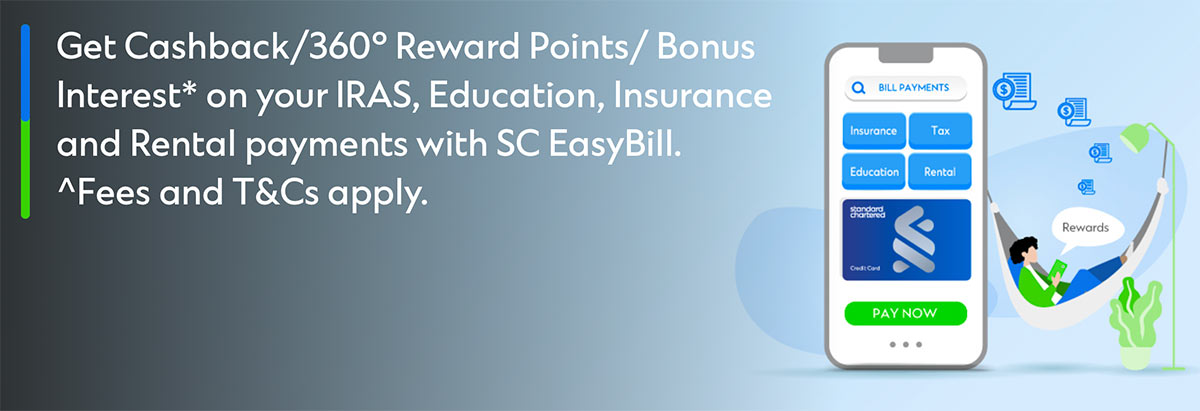
There are four eligible payment categories, each with its own restrictions.
| SC EasyBill Payment Categories | ||
| Category | What’s covered | Cap |
| IRAS | Personal and business income tax, property tax, GST and other taxes | None stated |
| Rent | Monthly rental specified in a tenancy agreement | S$10,000 |
| Education | School, university and polytechnic fees, training institutes, enrichment centres, day care, tuition, plus fees for hobbies, sports instruction and extracurricular activities | S$30,000 |
| Insurance | Health, motor, life, travel and foreign domestic worker premiums | None stated |
The terms also limit you to one EasyBill application per payment type every calendar month. That can be an annoyance, for example a motor insurance renewal and a travel policy falling due in the same month means only one of them can go through the facility.
Payments take up to seven business days to reach the recipient, there’s still no recurring payment option almost seven years on, and the facility remains open to principal cardholders only. You’ll need an active physical card too.
The new rate
Here’s how the EasyBill fee has moved since launch.
| SC EasyBill Fee History | ||
| Effective | Fee | Change |
| Mid-2019 | 2.0% | Launch |
| May 2020 | 1.9% | – 0.1 ppt |
| 31st August 2026 | 2.5% | + 0.6 ppt |
After six years of stability, the fee has jumped by almost a third in one hit.
Because Standard Chartered awards points on the payment amount rather than the fee, the cost per mile is simply the fee divided by your card’s local earn rate. Here’s what that looks like across the Standard Chartered range.
| SC EasyBill Cost Per Mile | |||
| Card | Local earn rate |
Before (1.9% fee) |
Now (2.5% fee) |
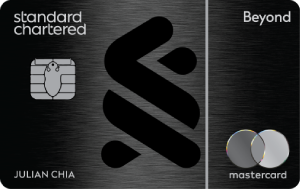 Beyond BeyondPriority Banking Priority Private |
2 mpd | 0.95¢ | 1.25¢ |
| Beyond Regular |
1.5 mpd | 1.27¢ | 1.67¢ |
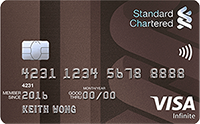 Visa Infinite Visa InfiniteS$2,000+ statement spend |
1.4 mpd* | 1.36¢* | 1.79¢* |
 Journey Journey |
1.2 mpd | 1.58¢ | 2.08¢ |
| Visa Infinite < S$2,000 statement spend  Priority Banking Priority BankingVisa Infinite |
1 mpd | 1.90¢ | 2.50¢ |
* The Visa Infinite’s 1.4 mpd local earn rate requires at least S$2,000 of spend in the same statement cycle. EasyBill payments do count towards that total. Below the threshold you’ll earn 1 mpd.
Standard Chartered’s remaining cards sit in the bank’s “Tier 2” pool, earning well under 1 mpd and converting at a much poorer 34,500 points to 10,000 miles ratio, rather than 25,000 to 10,000.
They were never worth using with EasyBill before, and they certainly aren’t now.
For cashback cardholders the maths is relatively simple: the best rate in the range is 1.5% with the Simply Cash card, against a 2.5% fee.
What it now costs
On a S$10,000 payment, the fee has moved from S$190 to S$250.
A Beyond cardholder with Priority Banking or Priority Private status still walks away with 20,000 miles for that S$250, which is decent buying. A Journey cardholder gets 12,000 miles for the same S$250 – miles typically valued at no more than 1.8 cents each, at a cost of 2.08 cents each.
For anyone using EasyBill regularly the increase adds up. Put S$5,000 of rent through the facility every month and your annual fee bill climbs from S$1,140 to S$1,500.
Set against a 1.8 cents valuation, only two Standard Chartered cards now buy miles at a price worth paying through EasyBill – the Beyond, and the Visa Infinite (if you’re reliably clearing S$2,000 of spend each statement cycle on the latter).
Everything else is now buying miles for more than they’re worth.
Use the Tax Facility instead
Here’s the important part, and it’s the same conclusion we reached in 2020 when the fee went the other way.
If you hold a Beyond or Visa Infinite card, do not use EasyBill for your personal income tax.
Standard Chartered’s separate Credit Card Income Tax Payment Facility remains at 1.90%, untouched by this increase. That’s a materially better deal, and it works differently: rather than paying IRAS directly, Standard Chartered credits the approved amount to a bank account of your choosing, and settling the bill is then up to you.
The full terms for that facility are here.
| EasyBill vs. the Tax Facility | ||
| SC EasyBill | Income Tax Payment Facility |
|
| Fee | 2.5% | 1.9% |
| Eligible cards | All SC credit cards | Beyond and Visa Infinite only |
| Supplementary cards | No | Yes |
| Payments covered | IRAS, rent, education, insurance | Personal income tax only |
| How often | Once per category per month | Once per calendar year |
| Documents needed | None upfront | Current year IRAS NOA |
| Who pays IRAS | The bank | You do |
| Cost per mile (Beyond, PB/PP) |
1.25¢ | 0.95¢ |
The catch is that the Tax Facility only applies once per calendar year per cardholder – though principal and supplementary cardholders each get their own application, which could be a useful for some. Property tax, GST and corporate tax still have to go through EasyBill.
Journey cardholders, and anyone else outside the Beyond and Visa Infinite line-up, can’t use the Tax Facility at all.
Is 2.5% for everyone?
Yes – it appears to apply to all four payment types across IRAS, rent, education and insurance.
Standard Chartered’s own page describes the charge as an “up to 2.5%” processing fee, and clause 14 of the terms still maintains that the fee varies according to the facility chosen.
That’s the same clause the bank has used since 2019, and it has never actually meant anything in practice – the rate has always been identical across the four categories.
Standard Chartered does display your applicable rate in the application flow once you’ve selected a payment type and card, before you commit, so you’ll see the figure for yourself.
Targeted discounts have appeared periodically in the past, including a fee-free promotion in 2023, so it’s good to keep an eye on your SMS and app notifications. If you’re offered anything below 2.5%, let us know in the comments.
How does it compare?
EasyBill has gone from one of the cheapest options in Singapore to one of the more expensive ones, in a single move.
| Bill Payment Facilities Compared | ||
| Facility | Fee | Notes |
| UOB Payment Facility | 1.6% – 1.8%* | UOB cards only, but pay anything at all with no documentation |
| SC Income Tax Payment Facility | 1.9% | Beyond and Visa Infinite only, personal income tax only |
| ipaymy | From 1.99% (2.4% – 2.95% standard) |
1.99% is for Mastercard tax payments; standard rates are lowest on Amex and UnionPay at 2.4% |
| CardUp | From 2.25% (2.9% standard) |
Cheapest codes need Visa or UnionPay; Mastercard and Amex from 2.59% |
| SC EasyBill | 2.5% | Four categories, one payment per category per month |
| Citi PayAll | 2.6% | Widest range of payment categories, periodic fee rebate promotions |
* Promotional rate for one-time payments, applicable to applications approved by 31st October 2026.
Rates shown are the lowest publicly available at the time of writing. Promotional codes, card networks and eligible payment types vary by provider.
The UOB Payment Facility needs a special mention here, because it sets the effective ceiling on what anyone should be paying for miles, as we noted when the current promotion launched in May.
UOB transfers the money straight to your bank account for any reason at all, so you don’t need a bill, an invoice or a tenancy agreement, and every card earns a flat 1 mpd, so the cost per mile matches the fee exactly.
That’s currently 1.6 cents with the Reserve card and 1.8 cents with everything else, including the widely-held PRVI Miles and KrisFlyer UOB cards.
Which means that if you also hold a UOB card, EasyBill is now the more expensive option for every Standard Chartered card, except the Beyond.
Citi PayAll’s standard fee is 2.6%, and its most recent rebate promotion ran to 31st July 2026. Based on the pattern of previous years we wouldn’t expect the next one before November, so there’s no near-term relief there either.
CardUp’s cheapest promo code is now 2.25%, for recurring income tax payments on a Visa or UnionPay card, against a 2.9% standard fee. Mastercard and American Express holders can do no better than 2.59%.
ipaymy’s standard fee ranges from 2.4% on American Express and UnionPay cards to 2.85% on Mastercard and 2.95% on Visa, so the entry point is already below what EasyBill now charges.
It also has the cheapest publicly available rate of any third-party platform – 1.99% on tax payments made with a Mastercard, using a reusable promo code. Recurring UnionPay payments come in lower still at 1.85%, though recurring payments aren’t offered on Mastercard or American Express at all.
Almost every operator in this space has repriced upwards over the past few years.
Citi lifted PayAll from 2% to 2.2% in April 2023 and again to 2.6% twelve months later, CardUp and ipaymy both went up this June with CardUp publicly blaming rising card processing costs, and Standard Chartered has now followed. UOB is the one outlier, having spent 2026 mostly discounting its Payment Facility, rather than raising it.
Terms and conditions
The full EasyBill terms and conditions still don’t state a fee figure anywhere, which is presumably deliberate given clause 23 reserves the bank’s right to change it at any time without notice.
Several clauses are key to the facility:
- Clause 21 confirms EasyBill payments earn 360° Rewards Points or cashback in the normal way, and are not treated as excluded transactions. For Bonus$aver cardholders they also count as qualifying retail spend for bonus interest.
- Clause 22 is important – if you convert your EasyBill payment into instalments within the same application, no 360° Rewards Points, cashback or Bonus$aver bonus interest will be awarded at all.
- Clause 4 allows the bank to demand documentation proving the payment was eligible, and to claw back points if you can’t produce it. Nothing is requested upfront, but keep things like your tenancy agreement or payment invoice to hand.
- Clause 16 reduces your available credit limit by the payment amount plus the fee before the transaction posts, so make sure you’ve got necessary headroom there.
Applications can’t be cancelled once submitted, and the fee is non-refundable.
Summary
Standard Chartered’s EasyBill fee has gone from 1.9% to 2.5% with effect from 31st August 2026, the first increase in the facility’s history and a 32% jump in one go.
For most Standard Chartered cardholders that spells the end of EasyBill as a sensible way to buy miles. At 2.08 cents with the Journey card and 2.50 cents with a 1 mpd card, you’re now paying more for miles than we think they’re worth – and more than a UOB cardholder pays for miles with no bill to show at all.
The exception is the Beyond Card, where Priority Banking and Priority Private clients still pick up miles at 1.25 cents each. That’s no longer the market-leading rate it was at an excellent 0.95 cents, but it remains one of the better deals available in Singapore – and since you’re paying S$1,635 a year for the privilege, you’d hope so.
The obvious move for Beyond and Visa Infinite holders is to shift income tax payments across to the Income Tax Payment Facility, which is still offered at 1.9%. It’s only good once a year, but that’s a S$60 saving for every S$10,000 you put through it.
Whether that 1.9% rate survives into the 2027 tax season is of course another question.