
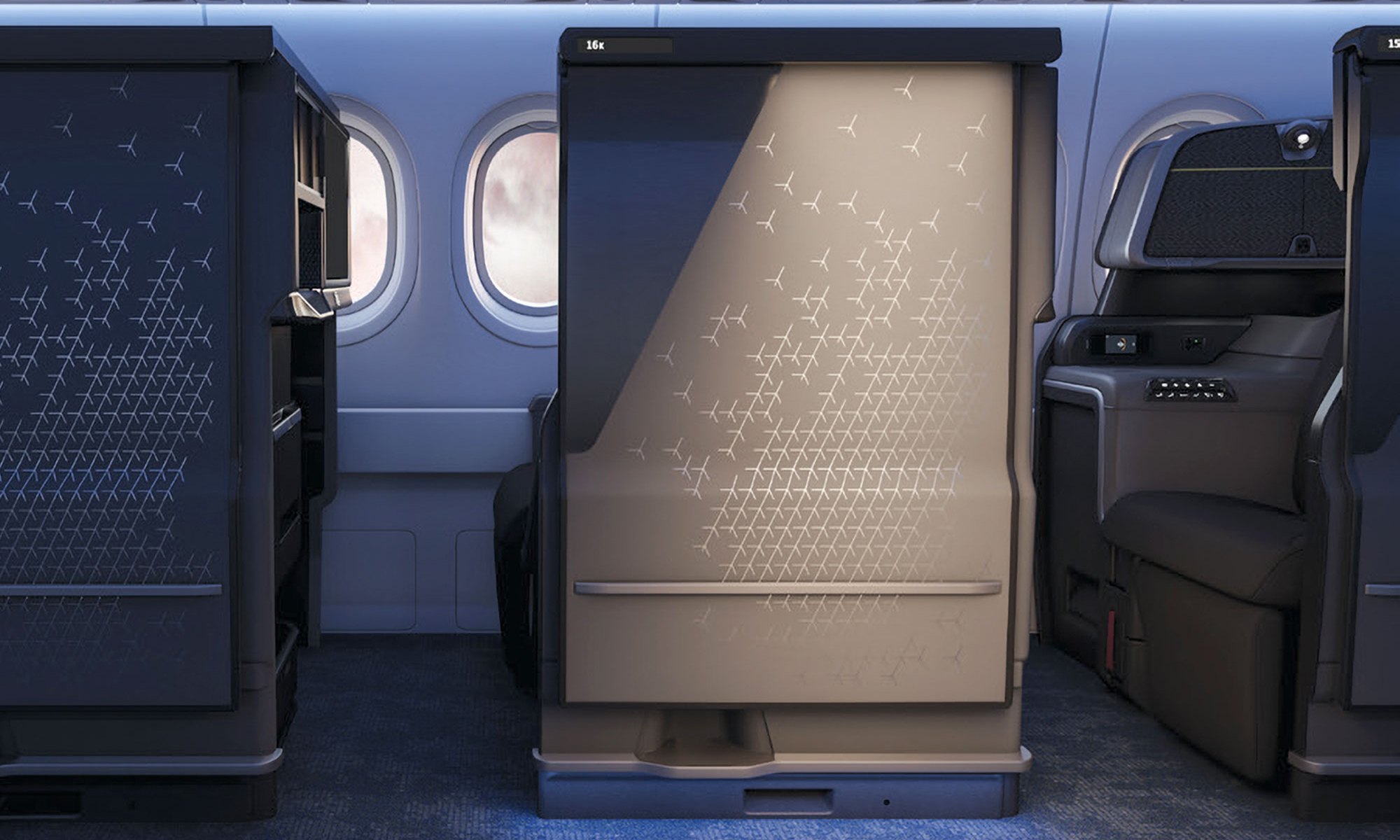

In the coming months, Singapore Airlines’ long-awaited next-generation long-haul Business Class product will start to appear on retrofitted Airbus A350 Long Haul aircraft as part of the carrier’s S$1.1 billion cabin refresh programme, announced back in November 2024.
It will now inevitably become known as “2027 J” rather than the “2026 J” we first predicted, after the airline confirmed in May that supply chain constraints, along with a certification delay on one of the new seats, had pushed the first rollout into next year.
The airline has, true to form, kept its cards close to its chest.
Beyond a handful of carefully cropped renders, a short teaser video and a few chosen words at the November 2024 announcement, there’s been little substantive information on the seats themselves.
That said, two new teaser videos released alongside SIA’s recent dining and amenity announcements do offer some fleeting glimpses, which we’ll take a look at below.
The official line is that the seats are “designed from the ground up”, with SIA adding that the same designs will also appear on its upcoming, but also much delayed, Boeing 777-9s.
SIA has committed to a full reveal in Singapore in November, followed by a Q1 2027 service entry for the first retrofitted aircraft. Until then, the exact specification and the launch routes remain firmly under wraps.
What the teasers actually confirm
SIA’s own teaser materials have confirmed a handful of things concretely.

(Image: Singapore Airlines)
A 1-2-1 staggered layout, fuselage-aligned. This continues the direct aisle access standard SIA has boasted in long-haul Business Class since the 2006 J seat, and rules out any move to a reverse herringbone or similar angled configuration.
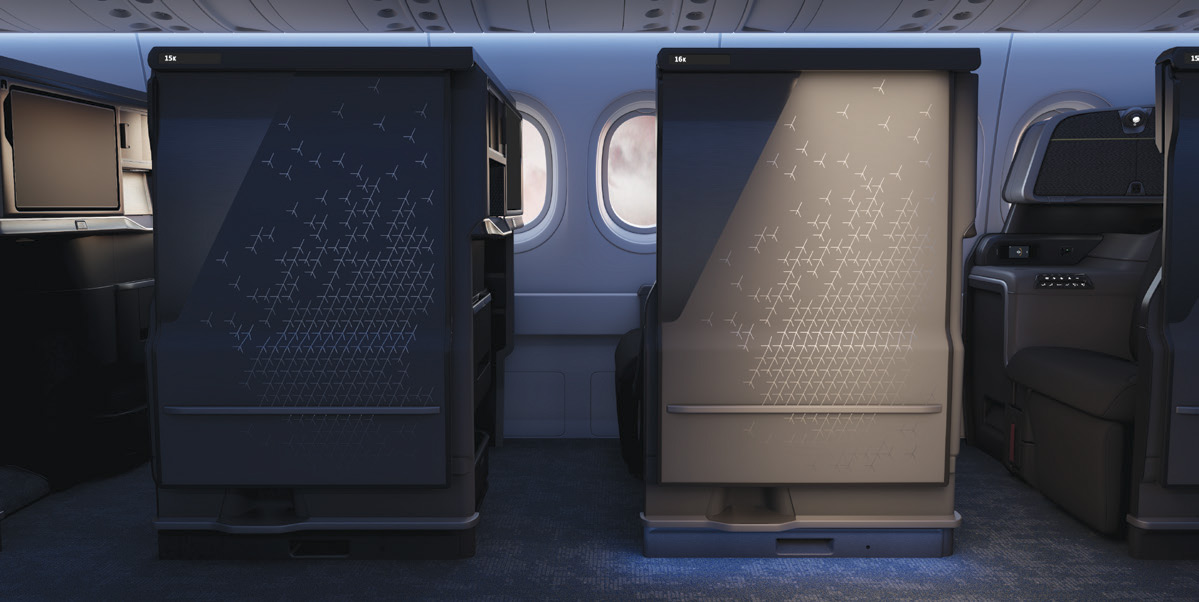
Alternating window-aligned and aisle-aligned seats at the window positions. The widest render released so far shows consecutive seat rows with visibly different seat / IFE screen and console positions relative to the window line, confirming this. It follows exactly the same layout principle as SIA’s 2018 Regional Business Class on the Airbus A350 Medium Haul and Boeing 787-10.
(Image: Singapore Airlines)
At window-aligned rows, the console sits between the seat and the aisle, giving solo travellers maximum privacy, but slightly more restricted access space. At aisle-aligned rows, the console sits between the seat and the window, pushing the seat closer to the aisle – but making it easier to get in and out of.
Closing privacy doors at every seat. This is the headline change and brings SIA into line with the current industry standard. It’s also about time – doors have been more or less expected in Business Class for the best part of five years now. Even Malaysia Airlines has been flying them since November 2024, more than two years before SIA will.
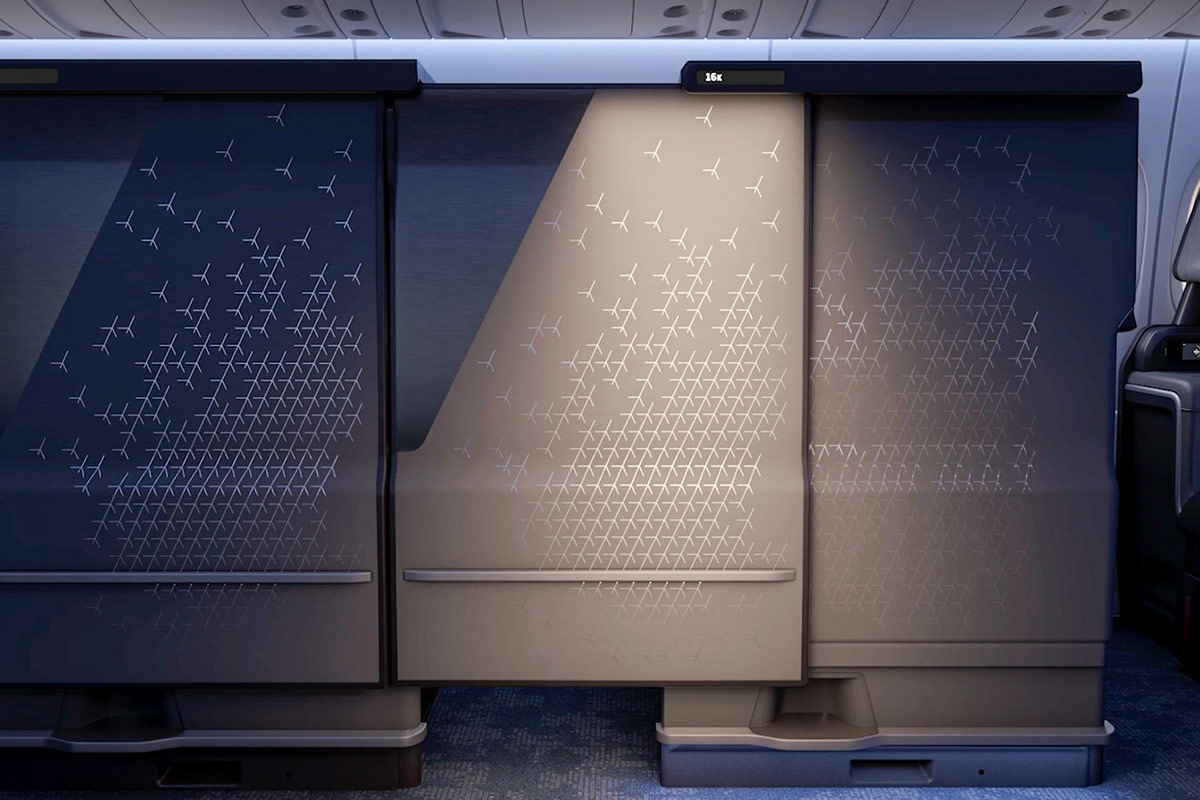
Externally sliding doors. In the renders, each door slides across the outside of the fixed shell wall rather than disappearing into a recess. It’s a detail worth noting, though as we’ll come to, it tells us less about the manufacturer of the seat than you might think.
A navy and champagne palette. The renders alternate deep navy and warm champagne finishes on the doors, with a subtle repeating motif, carrying over the signature SIA navy from the airline’s existing premium products.
The cabin isn’t getting smaller. SIA has confirmed the retrofitted A350 Long Haul will retain 42 Business Class seats, with Economy Class actually gaining five.
The latest teaser videos
The new seats won’t arrive alone. Over the past few weeks, SIA has revealed two more parts of what it calls an “elevated end-to-end travel experience”, both rolling out from November:
- Dining: a new SIA Chefs’ Selection menu category, new wines and spirits, and Christofle chinaware in Suites, First and Business Class (our coverage / the video)
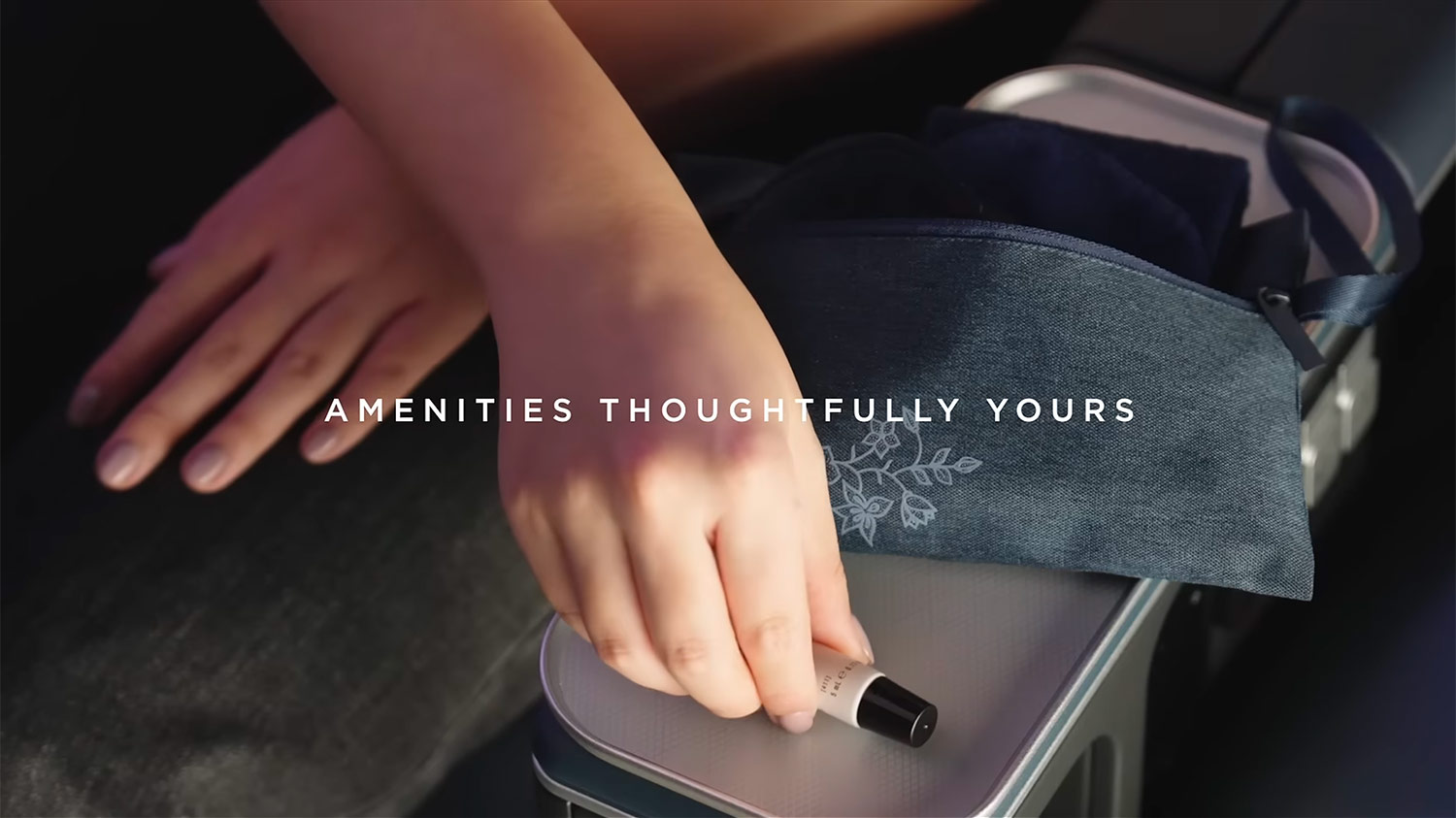
- Amenities: Sisley kits in Suites and First, Byredo kits in Business Class and, for the first time, Business Class pyjamas (our coverage / the video)
Both will reach passengers on today’s aircraft first, so many of us will be trying the new pyjamas in SIA’s current seats for some time yet.
More interesting are the short teaser videos SIA released alongside those announcements. They’re mostly lingering close-ups of sleepwear and skincare products, but a handful of frames offer fleeting glimpses of the new seats behind them.
Business Class
The Business Class video clips are frustratingly tight, but they do confirm a darker palette, in keeping with the renders.

(Image: Singapore Airlines)
The new Byredo kit sits on a matte charcoal side console, with a shallow, curved recess set into the surface, most likely for personal items, a drink or a water bottle.
Another frame shows the new navy pyjamas being handed into a seat with the bed already made up. We think we can make out a console or divider towards the head end, with no obvious partition towards the feet.

(Image: Singapore Airlines)
That would fit a centre honeymoon pair (see below) with the divider down, but in truth the shot is far too tightly focused to say for sure – and of course that’s quite deliberate on the airline’s part.
The new amenities span every cabin, though, and so do the videos, so here’s what they show elsewhere on board.
First Class
Ironically, the First Class frames are the most revealing of all. They point to a warm, almost residential palette of champagne and greige surfaces, warm brown leather and vertically grained wood-effect panelling. That’s a noticeable contrast to the navy-heavy Business Class renders.

(Image: Singapore Airlines)
Running along the front edge of the side console is a row of physical, backlit buttons. From left to right, there’s a dedicated table release, then one-touch presets for dining, take-off and landing, a relaxed recline and bed mode.
After those come what look like fine adjustment controls, a Do Not Disturb button and a crew call button.
Proper buttons for the functions you use most is a welcome approach, particularly when you’re fumbling for them in a darkened cabin. The dedicated table release also suggests the dining table may stow away inside the console itself.

(Image: Singapore Airlines)
Another frame shows the bed made up in crisp white bedding, with the console beyond. There’s an amenity kit sitting on top, and what look like storage nooks below.

(Image: Singapore Airlines)
There’s also an illuminated vanity mirror, which appears to fold up from at least one of the consoles.
It’s squarer than the one in the A380 Suites, with nothing alongside it on the right, whereas the Suites mirror is flanked by storage on both sides, so we can be pretty confident we are looking at the 2027 First Class here.
Beyond these glimpses, we already know a little more about the new First Class. Each suite gets angled closing doors and business jet-style electric window blinds.

(Image: Singapore Airlines)
Selected seats will also convert into a shared space for “companion dining”, so two passengers travelling together can eat face-to-face, for the first time since the original A380 Suites were retired.
Premium Economy and Economy
SIA has said its Airbus A350 Long Haul Premium Economy and Economy cabins will only be “refreshed” in the retrofit, rather than getting all-new seats. Nonetheless, there are a few clips of these updated designs in the latest teaser videos.
(Image: Singapore Airlines)
The Premium Economy shot shows the new pouch on a light grey centre console with a fine textured finish and polished metal trim. Ahead of it is a recess like the one used for water bottles on today’s seats. On the right are what look like chunky push-button controls for the recline and leg rest, which would make them mechanical rather than electric.
In Economy, the new drawstring pouch is shown over a narrow, charcoal tray table with a lighter rim and a cup recess, possibly deployed in its half-folded position.

(Image: Singapore Airlines)
None of this tells us who’s building the seats, of course. It is, though, our first real look at some of the finishes and controls passengers will actually touch.
On the evidence so far, SIA is drawing a clear line between a warmer First Class and a darker, sleeker Business Class.
So what can we reasonably expect in Business Class?
This is the part that will actually matter to passengers, and there’s more to go on than the sparse teasers suggest.
Honeymoon pairs, and quite possibly a true double bed
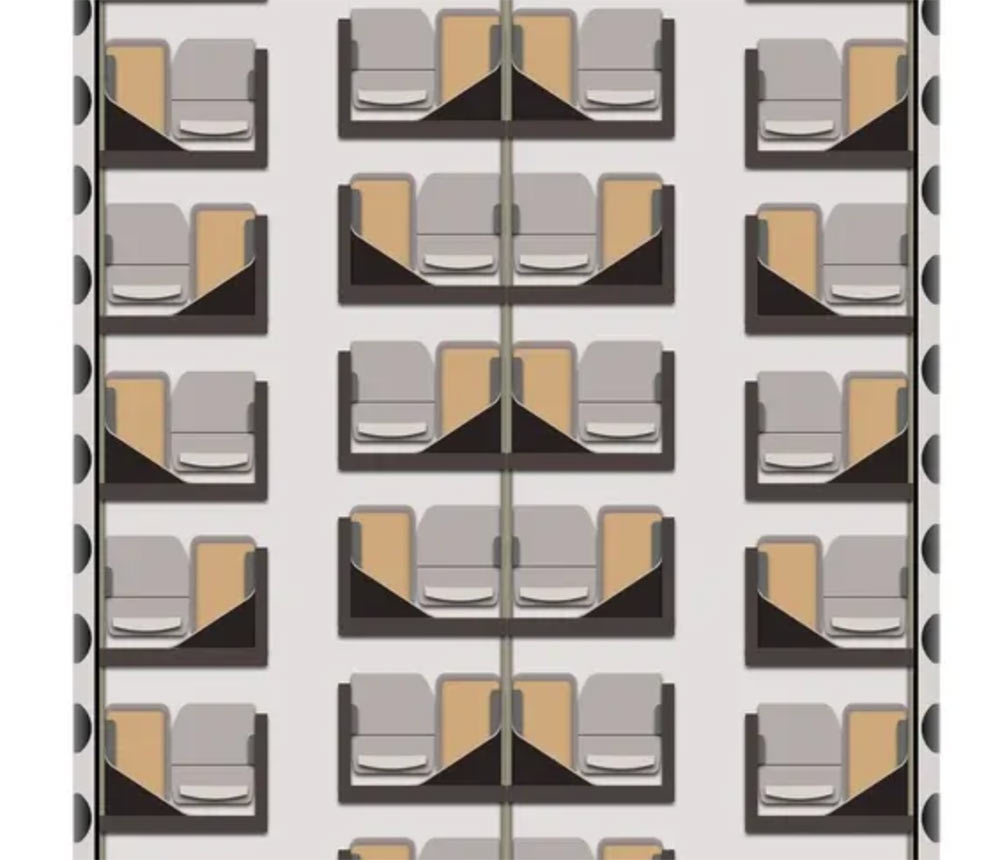
The 2018 Regional seat already offers paired centre seats at alternate rows. Given the 2027 J teasers show the same alternating layout logic at the window seats, it would be genuinely strange not to replicate the alternating apart-together middle pair arrangement too.
(Image: aeroLOPA)
The centre seats at aisle-aligned rows will therefore sit together, we believe, and very likely have a retractable partition between them, potentially converting – with the bedding deployed – into something close to a double bed arrangement.

(Photo: MainlyMiles)
This would bring the long-haul product into line with what SIA’s Airbus A380 has offered on the upper deck since 2017 at selected bulkhead rows – but at every other row instead. It’s a format that’s apparently proved very popular with couples, but is notoriously difficult to secure.

(Photo: MainlyMiles)
Powered bed conversion, at last
The 2013 seat’s manual flip-over cushion system is almost universally flagged as its one genuinely dated feature.
A proper powered lie-flat conversion is long overdue, already features on the regional fleet, and was addressed with the 2017 J seats fitted to the A380s – though those have limited deployment across the network.
There is essentially no chance, in our view, that the 2027 J launches without it. Press a button – get a bed.
Seat width: the awkward question
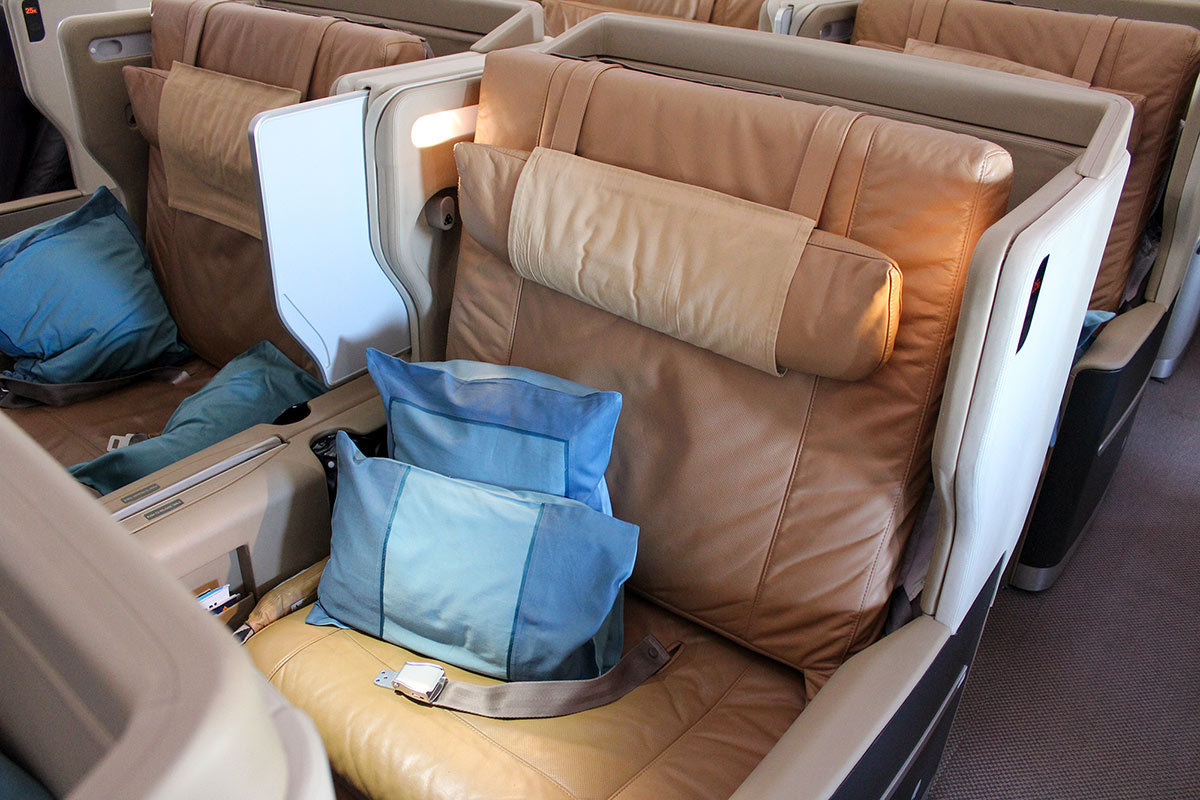
SIA’s current 2013 seat is 28 inches wide, one of the widest Business Class seats flying, and the airline probably won’t want to go backwards on that metric.
But here’s the tension. If the seat count stays at 42 and Economy is gaining five seats, the new Business Class cabin is working within broadly the same footprint as the current one, maybe even slightly less. Adding doors, higher shell walls and more enclosed storage all consume width that currently goes to the passenger.
In other words – something has to give.
Our expectation is a seat that’s marginally narrower than today’s but feels considerably more private and better organised, with the bed length possibly increasing, rather than the width. Expect at least 78 inches of bed length, quite possibly more.
(Photo: Shutterstock)
The narrower A350 cabin is the bigger constraint here. The Boeing 777-9, when it eventually arrives, could accommodate a wider seat far more comfortably, but spare parts commonality for seats and their complex mechanisms usually means the seat pan itself is the same width across different aircraft types.
On the current 2013 J product, there is more side space on the Boeing 777-300ER compared to the A350 Long Haul, but the seats themselves are the same and we understand can be interchanged as identical parts across both types, a very useful ongoing maintenance benefit in terms of both practicality and cost.
Technology SIA can’t credibly omit
By 2027, the following are simply table stakes, and their absence would be a story in itself:
- USB-C fast charging at every seat, alongside universal AC power
- Wireless charging pads integrated into the side console surface
- Bluetooth audio pairing, letting passengers use their own headphones with the IFE
- An all-new KrisWorld entertainment system, which SIA has confirmed will arrive with the refitted aircraft, along with new screens in First and Business Class
- A 4K screen, likely in the 22 – 24 inch range to match the best of its rivals, such as Cathay Pacific’s 24-inch Aria Suite. That would be a big step up from the 18-inch screen in today’s 2013 J seat
- High-speed Starlink Wi-Fi connectivity, more on that below
One more to watch, but not necessarily to expect.
Safran offers headphone-free audio built into the headrest, called Euphony, which is already flying in Japan Airlines’ A350-1000 Business Class. If SIA includes it, that would be a genuine talking point. It doesn’t strike us as very SIA, though.
Starlink arrives at the same time
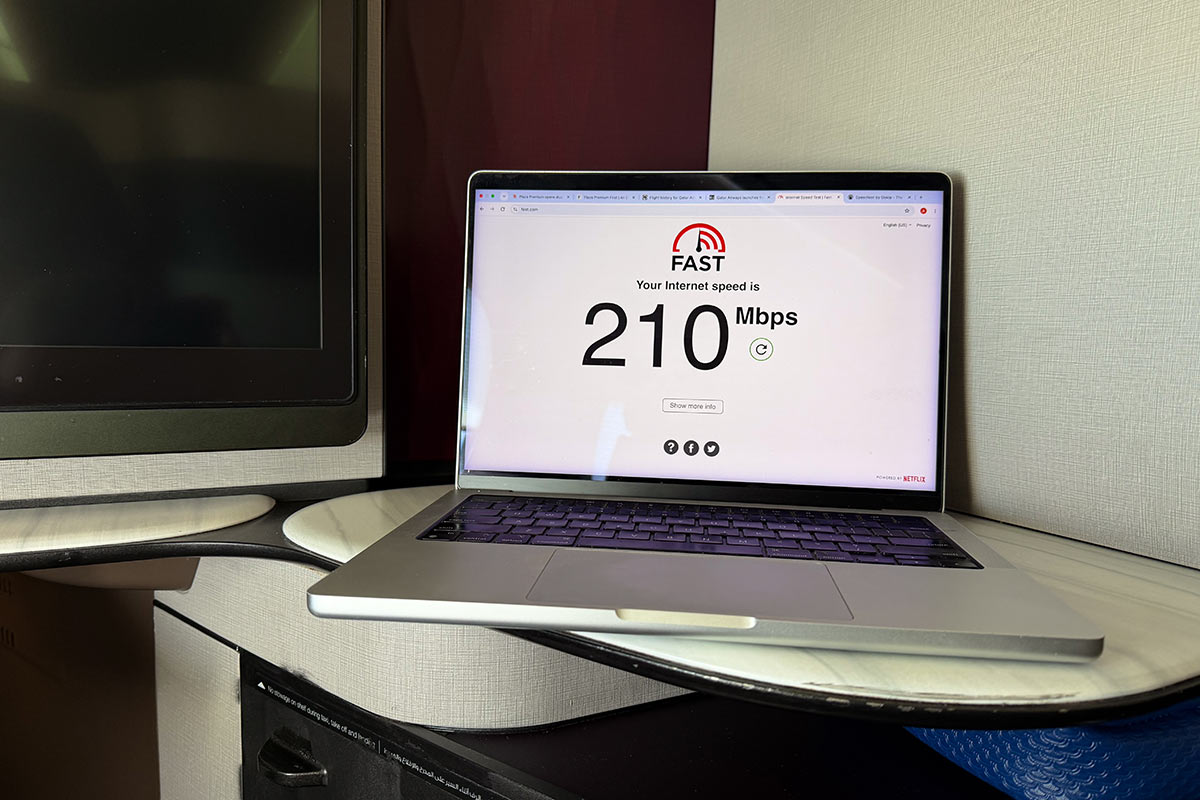
One thing we can say with more confidence than most of the above – the new cabins will come with new Wi-Fi.
SIA confirmed Starlink as its incoming connectivity provider in May 2026, and we understand the A350 fleet’s Starlink retrofits will be carried out in tandem with the cabin refits, rather than as a separate programme.


That makes obvious sense – the aircraft is already out of service, and doing both at once avoids two rounds of downtime (plus Starlink can be strapped on and fired up in a matter of hours, according to Qatar Airways at least).
SIA hasn’t actually confirmed that its Boeing 777-9s will arrive with Starlink installed, but it would look utterly ridiculous if they didn’t!
(Photo: MainlyMiles)
The Airbus A380s are the outlier. SIA says Starlink will reach that fleet from Q1 2027 too, but with no new Business Class seat coming to the superjumbo, there’s no cabin retrofit programme to piggyback on, so those installations will need some downtime of their own.
For passengers, it means the first retrofitted Airbus A350 LH won’t just have new seats – it should have significantly better connectivity too.
Given how much of the current in-flight experience gap across the industry has become about Wi-Fi rather than hardware, that may end up mattering as much as the Business Class door!
Storage
The 2013 seat’s storage is famously inadequate for a long-haul product, because there’s nowhere sensible to put a laptop during meal service, and the side stowage is too small.
The renders show a substantially larger console structure alongside each seat, and what appears to be an enclosed stowage compartment. Expect a dedicated device nook with charging, a larger literature pocket, and somewhere to put your shoes.
Who’s actually building it?
“Designed from the ground up” might suggest SIA created the seat itself, but in practice airlines can’t design their own seats – they choose one, then customise it heavily.
Taking a wide-body Business Class seat from drawing board to certification takes five to seven years, thousands of hours of crash testing, a global supply chain and approvals from Airbus, Boeing and regulators.
That’s a job for a handful of specialist seat manufacturers, not airlines.
Even the seats you’d assume were airline creations come off someone else’s production line:
- Qatar Airways’ Qsuite is a Collins Aerospace product
- Delta One Suites and Etihad’s new A330neo Business Class are both Thompson Vantage XL
- JAL’s new A350-1000 Business Class is Safran Unity, as is Qantas’ upcoming A350-1000 seat
Airlines specify the seat in detail, negotiate exclusivity and apply their own trim, branding and entertainment systems. The structure, mechanics and certification remain the manufacturer’s.
SIA is of course no exception. Its much-loved (but kind of illegal) 2006 J seat was built by Koito, with JAMCO stepping in to sort out the certification mess, while today’s 2013 J and 2017 J are both JAMCO seats.
They’re heavily customised and unique to SIA, but JAMCO underneath.
So here, “designed from the ground up” means heavily customised and exclusive to SIA, which is how every premium airline does it.
Follow the timeline
The most useful clue isn’t what the renders look like – it’s when the seat was first chosen.
SIA’s new Business Class was originally meant to debut on the Boeing 777-9 back in 2021. CEO Goh Choon Phong also said at the November 2024 announcement that SIA had spent six years on the design, putting the programme’s start at around 2018.
Unless SIA switched seats midway, which the 777-9’s delays certainly gave it time to do, the chosen product needed to exist by around 2018 to 2020, at least on the drawing board.
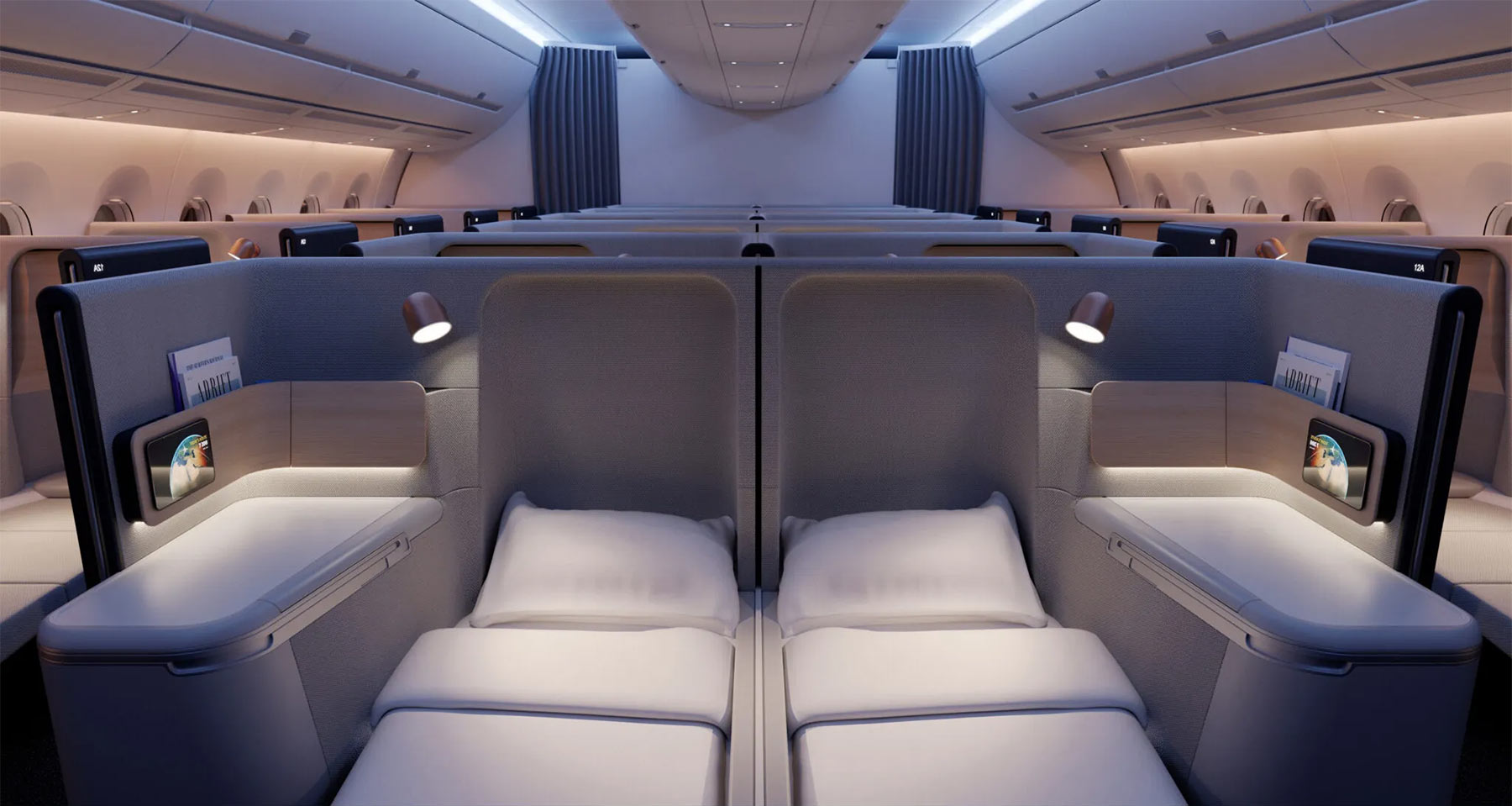
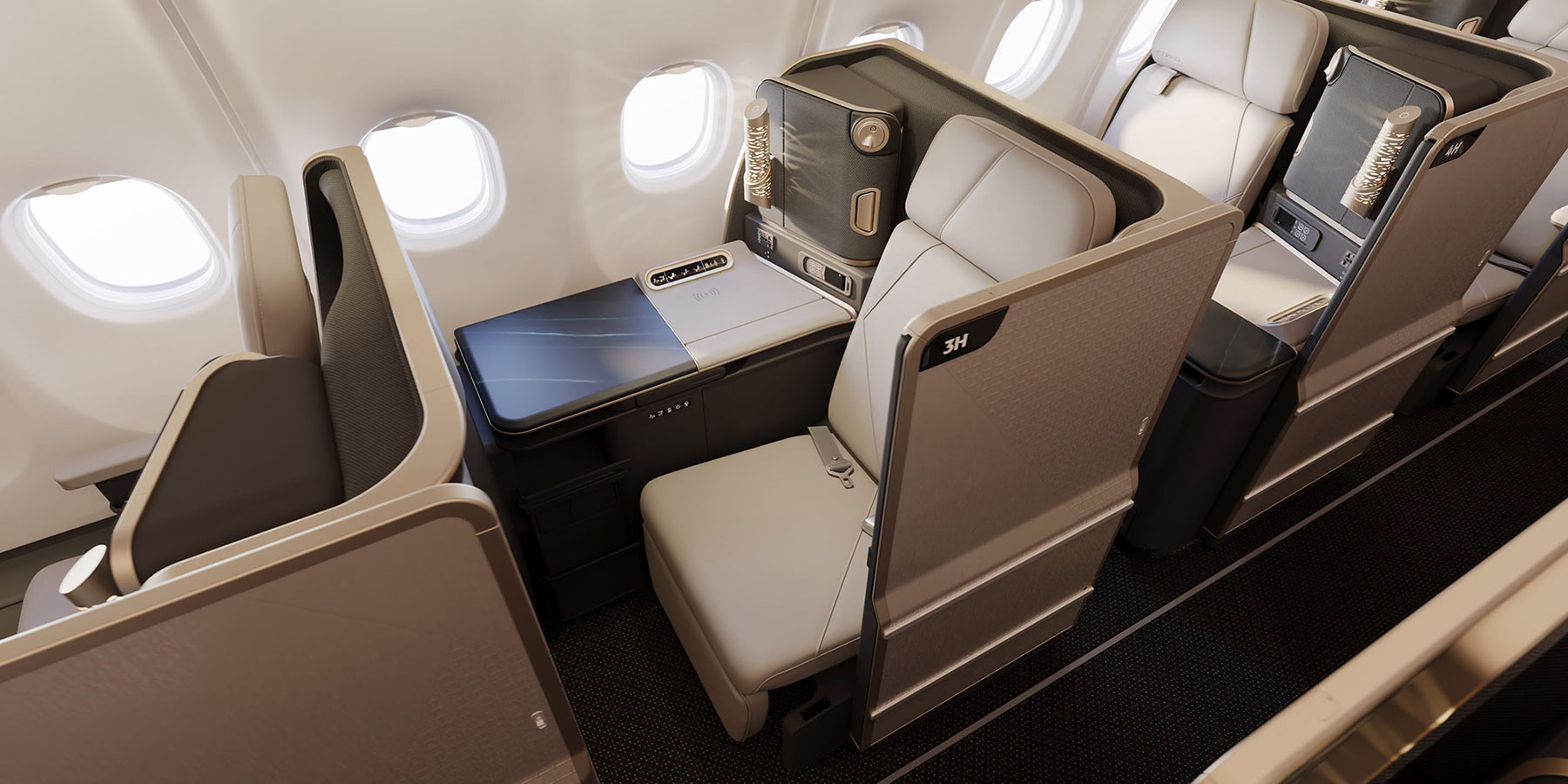
Given that we know it’s a forward-facing, staggered arrangement with privacy doors, here’s a list of the realistic contenders.
| Who could be building SIA’s 2027 J? | |
| Stelia Rendez-Vous |
|
 (Image: Stelia Aerospace) (Image: Stelia Aerospace) |
|
| In favour | Against |
|
|
| Thompson Vantage XL / XL+ |
|
 (Image: Etihad Airways) (Image: Etihad Airways) |
|
| In favour | Against |
|
|
| JAMCO Quest for Elegance |
|
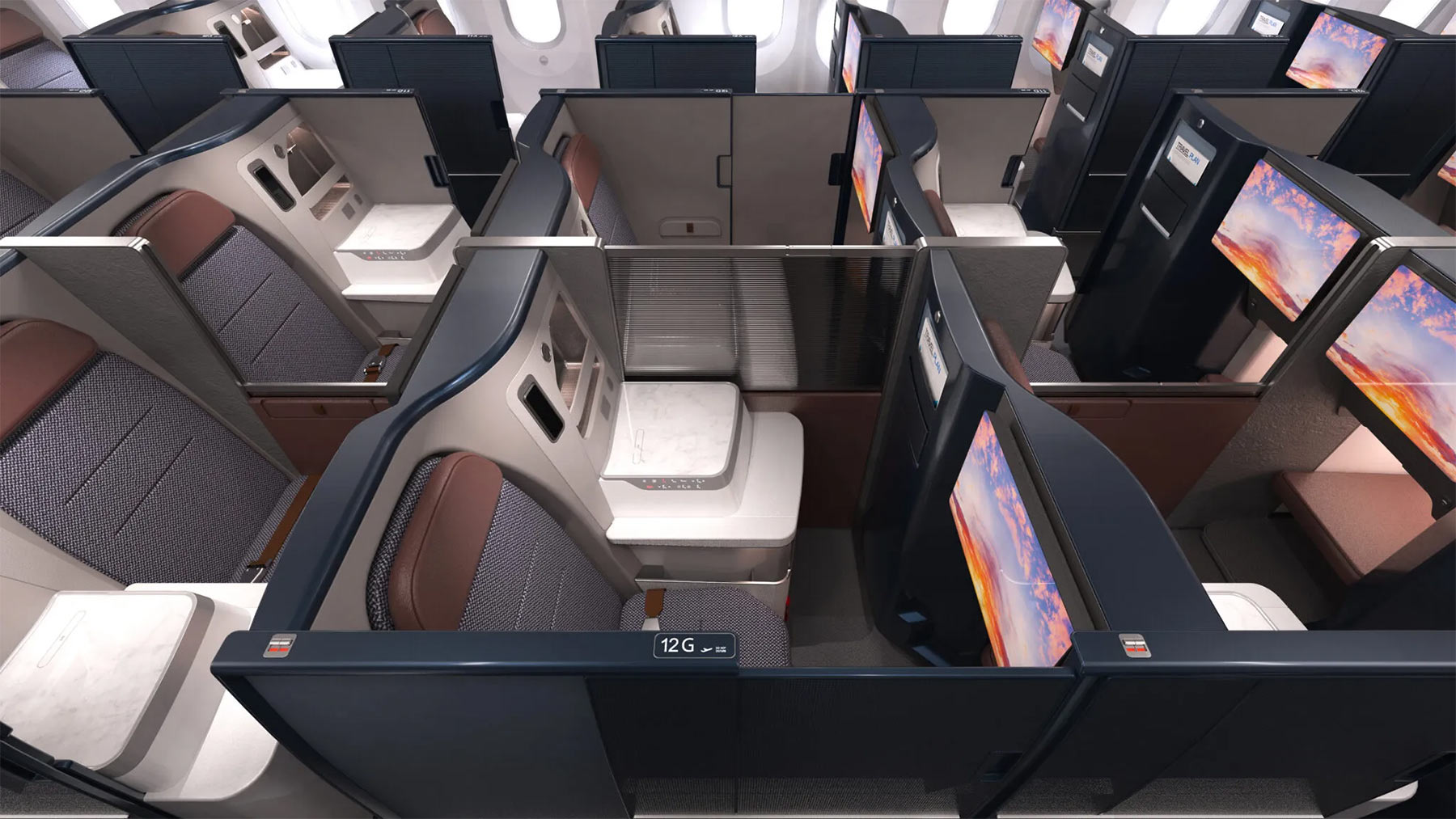 (Image: JAMCO) (Image: JAMCO) |
|
| In favour | Against |
|
|
| Safran Unity |
|
 (Image: Qantas) (Image: Qantas) |
|
| In favour | Against |
|
|
| Collins Aerospace Horizon |
|
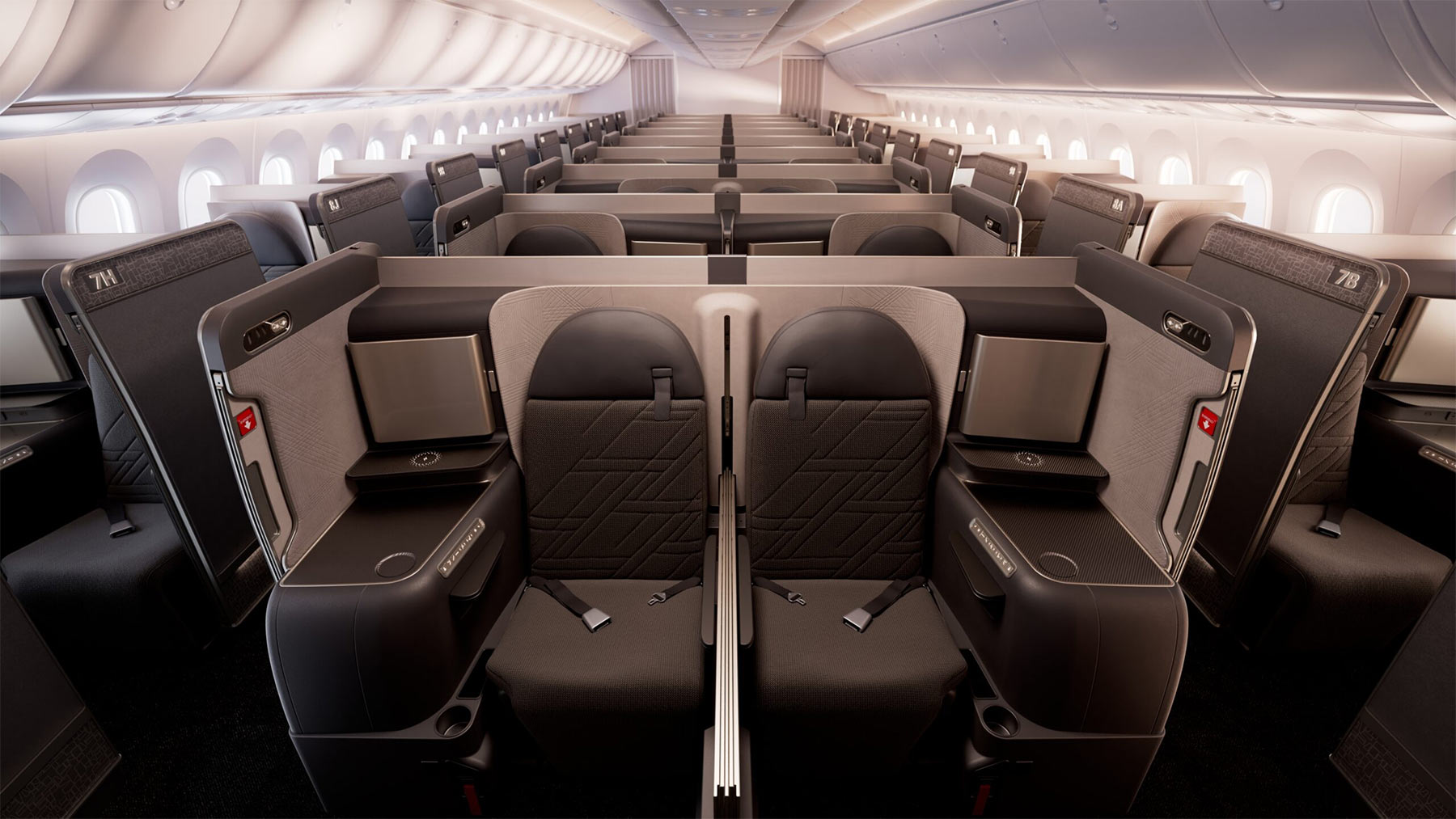 (Image: Korean Air) (Image: Korean Air) |
|
| In favour | Against |
|
|
| Recaro R7 (ex-CL6720) |
|
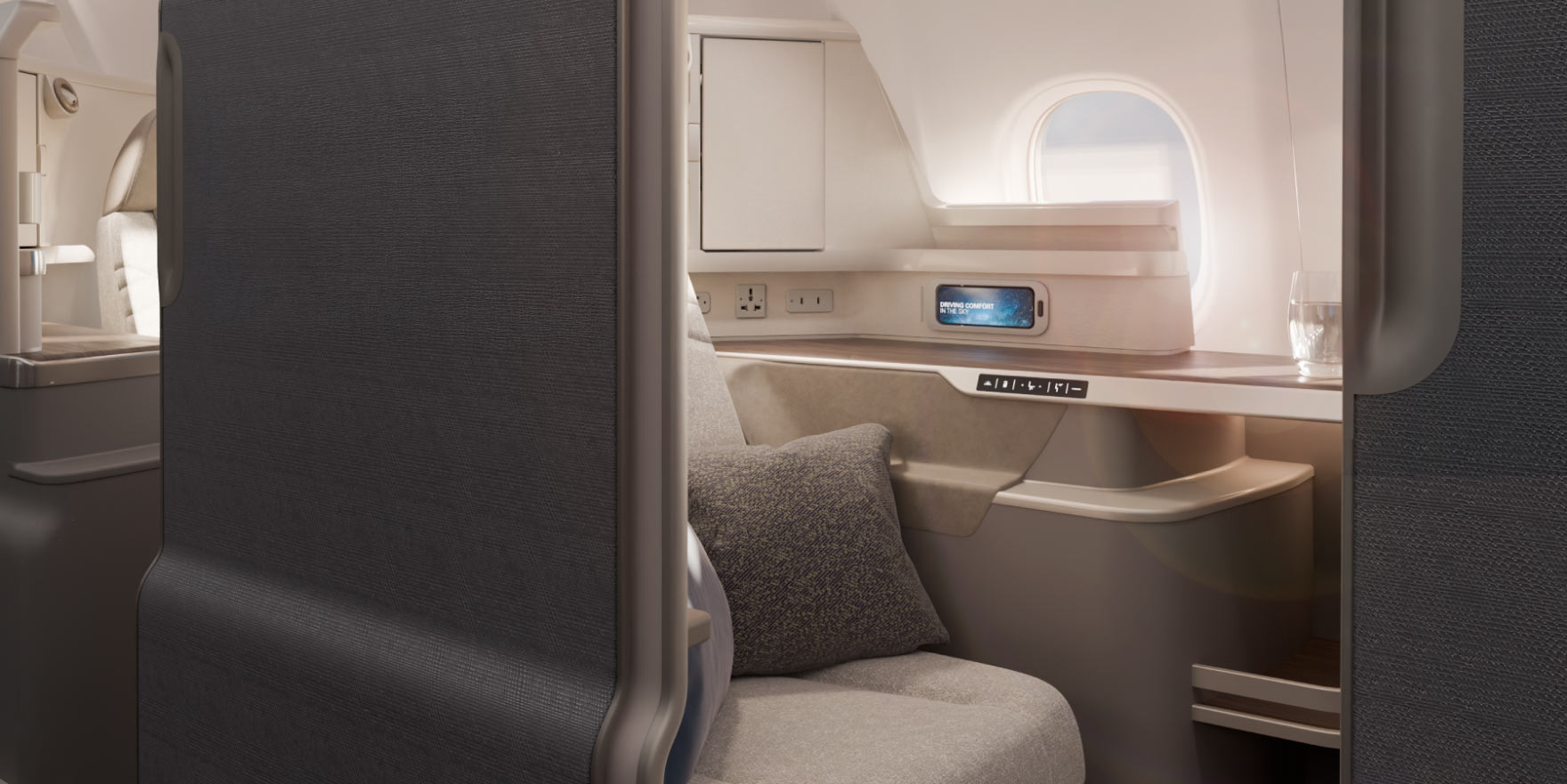 (Image: Recaro Aircraft Seating) (Image: Recaro Aircraft Seating) |
|
| In favour | Against |
|
|
Elevate’s new Summit seat also fits the brief on paper, but it only debuted in April 2026 – far too late to be in the running.
Why the door won’t settle it
It’s tempting to identify the seat from its door, but that doesn’t work. Door panels are among the most customisable parts of any seat, and Japan Airlines’ and Qantas’ Unity doors look nothing alike, despite being the same product.
Even how the door moves varies. Etihad’s new A330neo seat is a Thompson Vantage XL, the same platform as Delta One Suites, whose doors recess into the shell. Etihad’s, however, look strikingly similar to SIA’s renders.
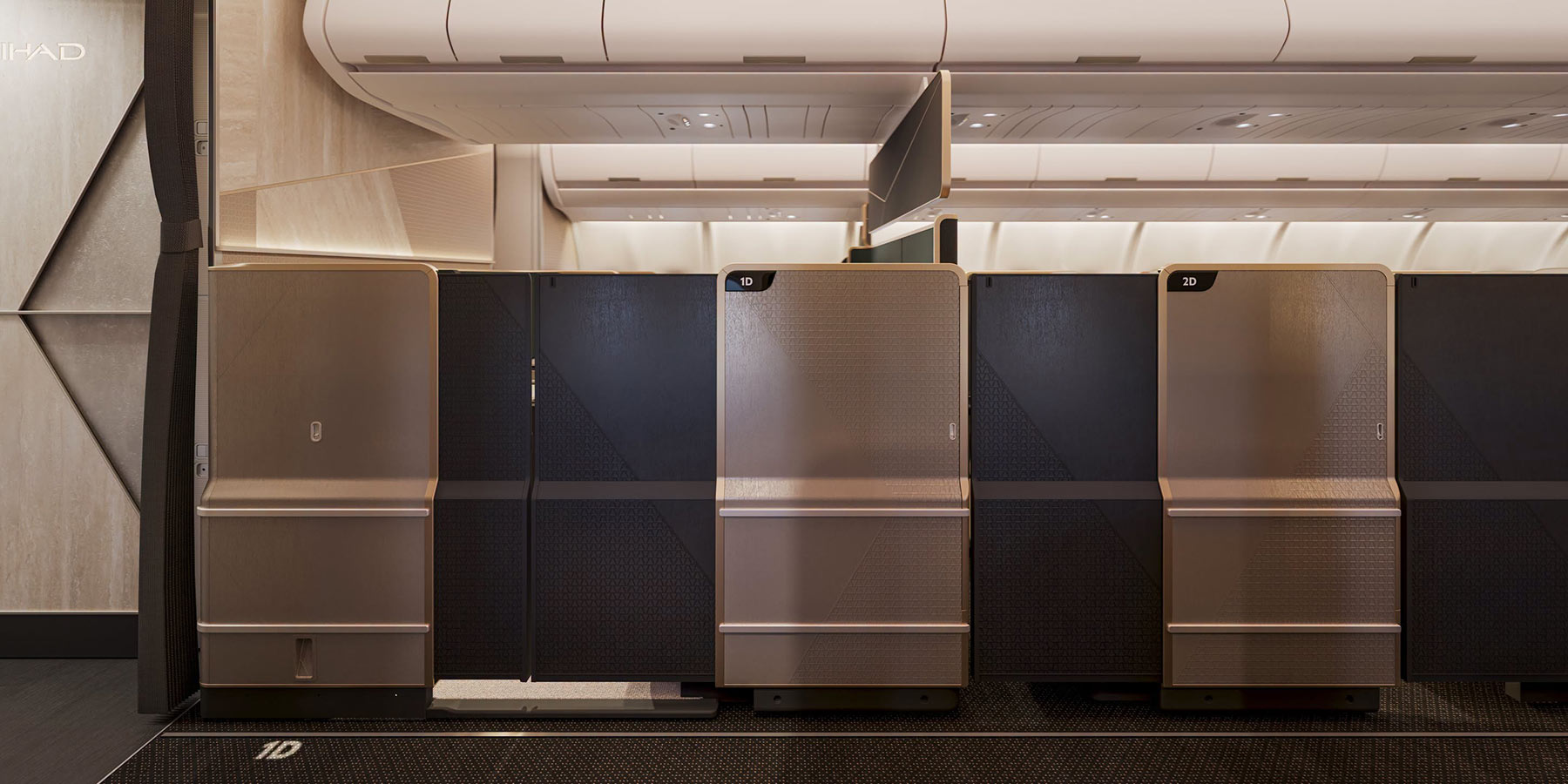
(Image: Etihad Airways)
(Image: Singapore Airlines)
Our prediction
JAMCO has supplied every SIA long-haul Business Class seat since 2007, but SIA is clearly happy to shop around. It picked Stelia for its 2018 Regional Business Class, and Thompson for the 737-8 MAX (technically that was SilkAir, but we all know what was planned in the background!).
On balance, we’d put Stelia and Thompson marginally ahead of JAMCO. Safran’s Unity looks closest in the renders, but is the hardest to square with the timeline, unless SIA was originally destined to be the launch customer on the 777-9.
In truth, we’re guessing – and so is everyone else. It also matters less than the speculation suggests. Whoever builds it, passengers will judge the seat on its width, bed, storage, screen and door, and on most of those we already have a fair idea what’s coming.
The timeline question
SIA has stated the retrofit programme covers all 34 Airbus A350 Long Haul and 7 Airbus A350 Ultra Long Range aircraft by the end of 2030, with the LH fleet first from Q1 2027 and the ULR fleet to follow at a date the airline has not yet specified.
Completing 41 aircraft from a Q1 2027 start works out at roughly one aircraft every five weeks.
On paper, that’s doable. In practice, retrofit programmes almost always slip.
Singapore Airlines has very recent form here. The airline’s last comparable programme, the retrofit of its Boeing 777-300ER fleet with the 2013 J seat, was originally targeted for completion by September 2016. The final aircraft actually emerged from refit in 2019, more than two years late.
The original plan to refit 19 aircraft in 20 months was always ambitious, but operational misfortunes didn’t help. A wing fire grounded one 777-300ER for five months in June 2016, and a tow truck fire in November 2017 wrote off a 777-200 outright – both forcing the airline to keep aircraft in service longer than planned before refit work could start.
But even without those setbacks, the original pace was optimistic.
The 2027 J programme is considerably larger in scope, at 41 aircraft versus 19. And we already have direct evidence that things are biting. SIA’s own explanation for the current delay cited industry-wide supply chain constraints, plus a certification delay on one of the new seats.
That’s not a promising start for a programme that hasn’t yet fitted a single seat.
In our view, a more realistic end-date is probably 2031 or 2032 for the full A350 LH fleet – and with the ULR fleet’s refit schedule now open-ended, even that may prove generous.
By that time the Boeing 777-9 fleet should be established and growing, fitted factory-fresh with the same seats, giving the carrier a much larger total number of the new seats in service than the 41-aircraft A350 refit alone will deliver.
Though given Boeing’s track record with the 777X certification programme, we wouldn’t stake our house on how many 777-9s will be in service by the early 2030s either.
Which aircraft get refitted first
As we cover in our SIA A350 fleet guide, the LH fleet is itself split into sub-variants.
The older A350-900 LH aircraft (registrations starting at 9V-SMA, now ten years old) are the likely first candidates for retrofit. The newer LH+ sub-fleet, which SIA uses on practically all of its US West Coast routes to Seattle, San Francisco and Los Angeles thanks to its additional range, is significantly younger and we’d expect it to be refitted later.
The implication of that order is that the new Business Class will likely first appear on European routes and selected Asia-Pacific sectors, well before it reaches the US West Coast. Seattle, San Francisco and Los Angeles passengers look set to wait.
The seven ULR aircraft refits start later, and they’re a rather more complicated story.
The ULR fleet is a separate problem
The seven A350-900 ULRs were always going to start being refitted after the Long Haul fleet got underway, but their position in the queue has become considerably less certain.
The new four-seat First Class cabin destined for the ULR fleet had been pencilled in for a Q1 2027 debut, but as we reported in May, that has been pushed back to an unspecified later date, taking the ULR’s Business Class refit with it.

(Photo: Dillon Chong)
SIA has also cited a certification delay on one of the new seats, without saying which. With Business Class now holding a firm date and First Class still without one, we’d hazard a guess.
So while the LH fleet now has a firm Q1 2027 target, the ULR fleet has no confirmed launch quarter at all.
The schedule offers a clue
SIA’s tried-and-tested method of freeing up a ULR airframe for hangar downtime is to pull the type from daily San Francisco (SQ34/33) and shift it onto the 3x weekly Los Angeles rotation (SQ36/35).
That swap was originally loaded into the schedule from 1st November 2026. It has since been pushed back to 28th March 2027 – the start of the NS27 season.
A month later, from May 2027, those 3x weekly SQ36/35 Los Angeles flights lose the ULR too, leaving the sub-fleet operating only on daily Newark and JFK services until at least the end of the published schedule in early October 2027.
If that holds, the first ULR might enter the hangar around early April 2027, with a second one potentially joining it a month later, since the pair of New York flights can be operated by four ULR aircraft, with a fifth standing by as a spare, meaning two can be out of action concurrently.
And the “first one always takes longer” rule applies here, perhaps with even greater force. The ULR conversion is a substantially bigger job than the LH refit, since it introduces an entirely new four-seat First Class cabin at the front and rebalances Business and Premium Economy capacity behind it. That’s a structural cabin reconfiguration, not just a seat swap.
Realistically, then, we’d expect mid-2027 at the earliest before the ULR fleet sees 2027 J – and, more interestingly, 2027 F.
That also means SIA’s headline ultra-long-haul services to New York JFK and Newark will continue with the 2013 J seat well into next year and quite possibly beyond. Not ideal optics for a carrier that likes to showcase its newest products on its flagship routes.
Could the 777-9 beat the ULR to it?
There’s an intriguing possibility here.
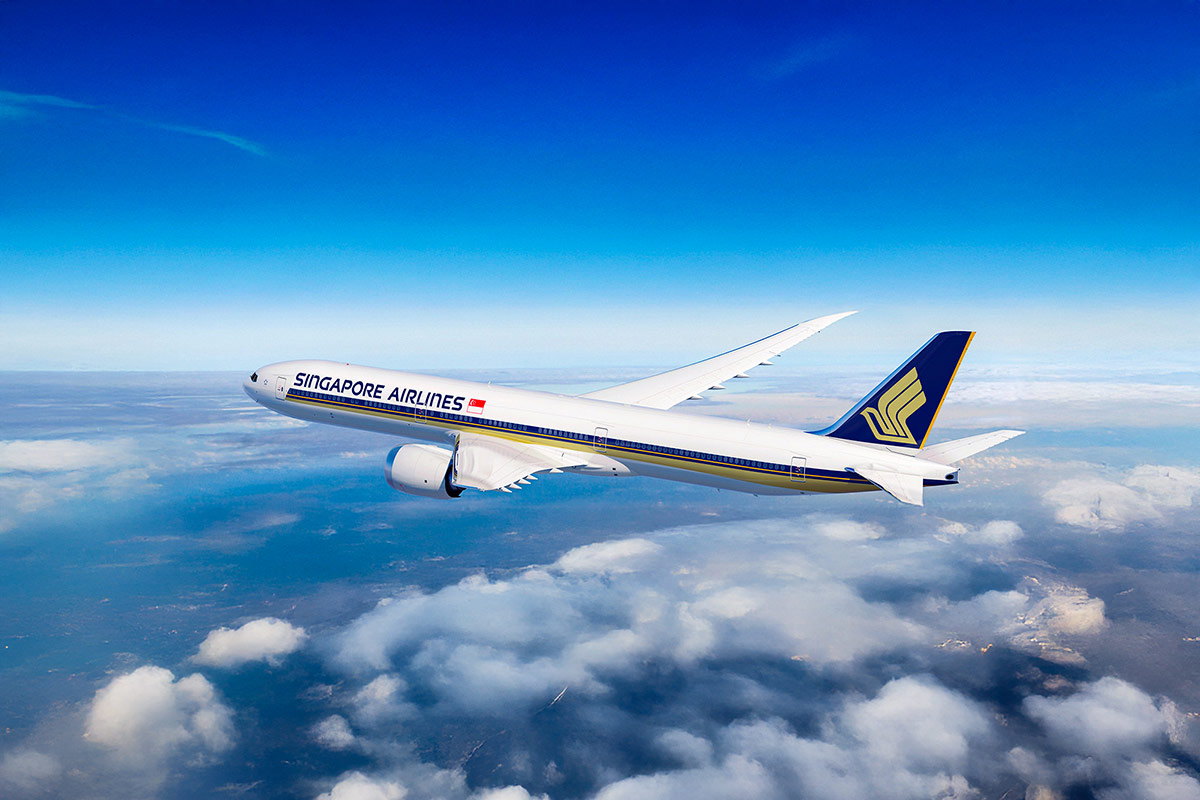
Depending on when the first Boeing 777-9 actually turns up next year, the new First Class could conceivably debut on that aircraft rather than on a retrofitted Airbus A350 ULR. The 777-9s will arrive factory-fresh with the latest cabin products already fitted.
(Image: Boeing)
As we covered in January, Los Angeles had looked like the frontrunner for the new First Class debut on the ULR, alongside New York. That remains a likely outcome, but with the ULR programme now looking a little open-ended and the Boeing 777-9 inching closer, it’s no longer the only outcome.
Whether Boeing can deliver on its side of that equation is, of course, an entirely separate question.
Which route will launch the new Business Class?
Several strong candidates are in play, and SIA has form for pulling surprises.
London Heathrow looks a strong bet.

(Photo: Heathrow Airport Limited)
As we first revealed in August 2025, SIA swapped one of its daily Boeing 777-300ER London Heathrow flights (SQ306/305) to an A350-900 Long Haul aircraft from 1st July 2026.
On the face of it, that was an unusual move. Heathrow slots are premium real estate where you’d normally deploy your largest aircraft, particularly in peak summer. At the time, the only explanation that genuinely made sense was a deliberate deployment of the new Business Class cabin on a high-visibility flagship route.
That theory has since taken a knock.
The retrofit programme slipped, but SIA persisted with the A350 LH on the SQ306/305 pairing anyway, and the four-class 777-300ER it displaced went to a daily Amsterdam rotation rather than back to London. It’s entirely possible the swap was simply about First Class demand out of Amsterdam that the A350 LH couldn’t serve, and had nothing to do with the new cabin at all.
So we’d file that one under “still interesting, but no longer conclusive”. The historical precedent, however, hasn’t changed – it also points to London.
SIA launched its original SpaceBed product on London, its 2013 Long Haul seat on London, and its 2017 A380 seat across Sydney, Hong Kong and London (though Sydney was first). Only the 2006 Long Haul seat broke the pattern, launching on Paris (and even then, London followed quickly).
That’s London as either the launch or an early-launch route for three of the last four long-haul Business Class debuts, a hit rate that’s hard to ignore.
Sydney remains a credible alternative. It’s the airline’s largest long-haul market after London, and operationally simpler to launch with – because a daily return service with one aircraft works neatly.
But the A350 LH fleet now operates to 25 SIA destinations, and recent reshuffles have put the type onto routes that aren’t the usual suspects, including Bangkok and Manila, potentially nice slot-ins between longer trips.
We may find out at November’s reveal, or SIA might keep that card up its sleeve until the first retrofitted aircraft is able to be loaded into the schedule.
What happens next
SIA has confirmed it will unveil the new products in Singapore in November, ahead of the Q1 2027 service entry. That covers the new First and Business Class seats, the next-generation KrisWorld system and Starlink Wi-Fi.
Enhancements like dine-on-demand and rumoured caviar service in Business Class, while not mentioned in the recent announcements, might also be held back for the launch event itself – but sadly no guarantees on either of those.
That’s when we’ll be getting media access, cabin and seat tours and, hopefully, a full specification sheet and maybe even a first destination or two.
Summary
After years of delays, Singapore Airlines’ new long-haul Business Class finally makes its public debut in November, with the first retrofitted Airbus A350 Long Haul due to enter service in Q1 2027.
The headline change is closing doors at every seat, in a 1-2-1 staggered layout that alternates between window-aligned and aisle-aligned seats, much like SIA’s 2018 Regional Business Class.
Alongside that, we’d expect alternating honeymoon pairs in the middle, possibly with a proper double bed option. We’d also expect a powered flat bed, a larger 4K screen, more practical storage and Starlink Wi-Fi from day one.
The trade-off could be width. With the same 42 seats in roughly the same space, plus doors and higher walls, don’t be surprised if the new seat is slightly narrower than today’s 28-inch 2013 J, but at least it will feel far more private.
Who’s building it is still an open question. Stelia and Thompson are our marginal picks, but JAMCO and Safran remain firmly in the frame. For most passengers, the door, the bed and the Wi-Fi will matter far more than the name on the seat frame anyway.
Do be patient, though. With 41 aircraft to refit and the ULR fleet still without a firm date, the 2013 J will be around into the early 2030s.
In the meantime, the new Byredo kits, Business Class pyjamas and Christofle chinaware arrive from November, so even passengers in today’s seats will notice something new.
We’ll have full coverage from the grand seat reveal next month.
(Cover Photo: Singapore Airlines)