

Back in July 2020, HSBC joined most other Singapore banks in stripping reward points from education payments, alongside utilities, insurance and a raft of other categories, as we reported at the time.
Now, for one card at least, that’s been partly reversed.
HSBC Premier Mastercard holders can once again earn miles on school, college and university fees, provided the payment is made in a foreign currency, and at the card’s full overseas earn rate.
For families funding a child’s studies abroad, that’s a useful new bonus, and it makes the Premier Mastercard one of only a handful of cards in Singapore still rewarding this category.
For those unfamiliar, the HSBC Premier Mastercard is only available to HSBC Premier customers in Singapore, which unfortunately immediately rules out most people. For those who qualify, it’s one of the stronger general spending cards on the market.
| Fast Facts
Annual fee: S$708.50 (waived for Premier Qualified customers) |
| Up to 58,200 miles + S$200 voucher APPLY HERE |
What’s changed?
HSBC has updated the Premier Mastercard’s terms and conditions with a new clause, effective 23rd July 2026. From that date, cardholders earn 6.9 HSBC Reward points per S$1 spent (up to 2.76 mpd) overseas at merchants coded under the following education MCCs:
- 8211: Elementary and Secondary Schools
- 8220: Colleges, Universities, Professional Schools and Junior Colleges
- 8241: Correspondence Schools
- 8244: Business and Secretarial Schools
- 8249: Vocational and Trade Schools
- 8299: Schools and Educational Services (Not Elsewhere Classified)
That’s the exact set of education codes banks typically exclude, so there are no obvious gaps here that we can see.
The change was only announced this week, when HSBC added the perk for overseas education reward points earning to the card’s product page.

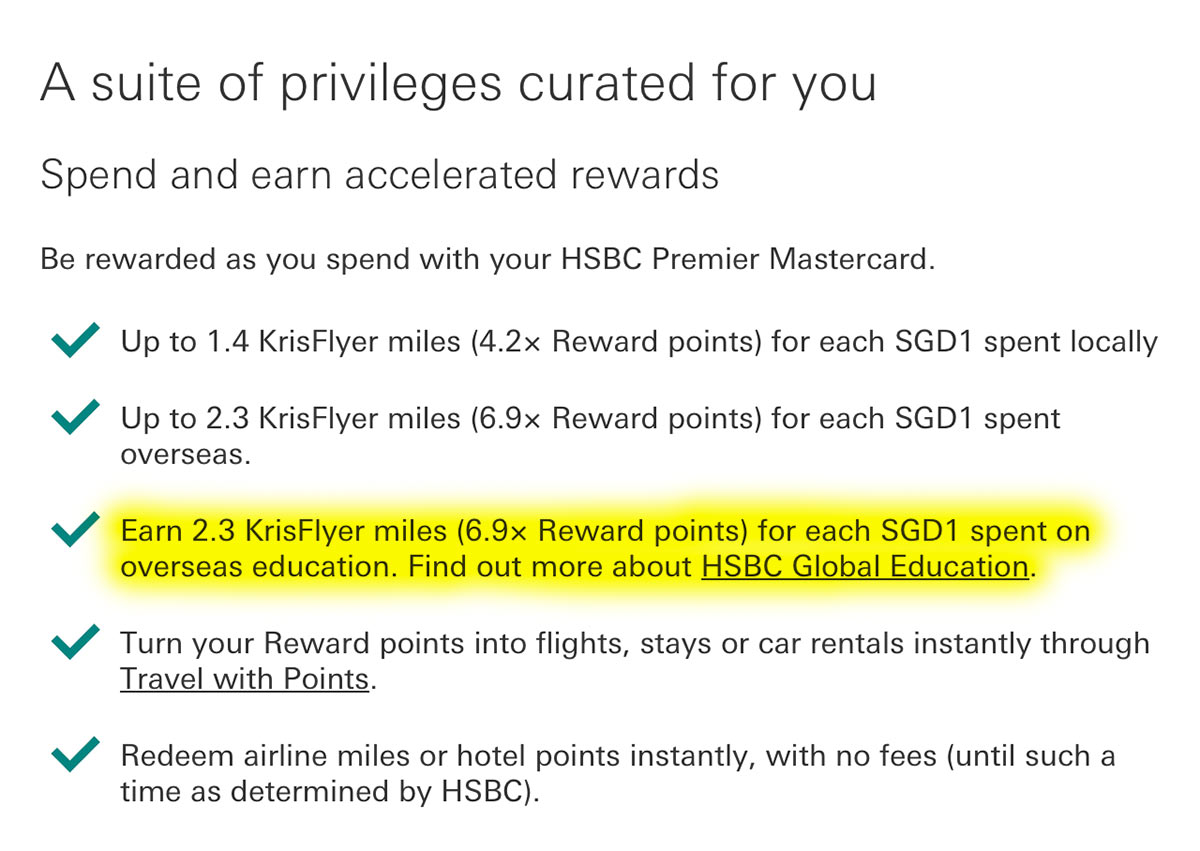
The card T&Cs, however, backdate it to late July 2026, so if you’ve already paid a foreign currency tuition bill with the card since then, it’s worth checking your account – you should find a stash of points you weren’t expecting (though you may have rightly avoided using this card anyway).

One oddity is that the card T&Cs document still lists all six education MCCs among its excluded transactions, just a few lines below the new clause that rewards them!
The new clause 2(a) is clearly written as a specific carve-out, so it should logically take precedence over the general exclusion list, but keep your payment receipts and statements in case there are any issues with points crediting for these transactions.
“Overseas” means foreign currency
The T&Cs define overseas spend as any transaction charged in a currency other than Singapore dollars. It’s the billing currency that matters, not where the institution or payment processing is located. HSBC’s Global Education page puts it the same way, describing the benefit as applying to education spend in foreign currency.
Two important points arise here:
- Pay in the local currency. An overseas university that charges you in Singapore dollars will earn you nothing.
- Local fees still earn nothing. Local school and university fees charged in Singapore dollars remain fully excluded from reward points earning – don’t make the mistake of thinking all Education spend has had points earning restored for this card – it hasn’t.
Here’s how it translates into miles rates.

| HSBC Premier Mastercard Education Earn Rates |
||
| Education spend charged in | 2.5:1 partners* | KrisFlyer (3:1) |
| Foreign currency | 2.76 mpd | 2.3 mpd |
| Singapore dollars | None | None |
| * Asia Miles, BA Avios, Etihad Guest, EVA Air, AF-KLM Flying Blue, Qantas, Vietnam Airlines | ||
The 2.3 mpd figure HSBC advertises assumes you convert to KrisFlyer, which sits on HSBC’s less favourable 3:1 transfer ratio list.
We’d generally suggest using one of HSBC’s 2.5:1 partners instead, such as Asia Miles or British Airways Club Avios (the latter is also then transferable to Qatar Airways Avios), where the same spend works out to 2.76 mpd.
Other points to note:
- No cap and no minimum spend. The T&Cs have no monthly cap nor minimum spend for this benefit, so a large tuition bill will earn points in full.
- Supplementary cards count. Spend on supplementary cards is pooled into the principal account as usual.
Check the MCC and currency before you pay
This benefit hinges on the merchant’s category code (MCC), and the currency you’re charged in.
- Dynamic Currency Conversion. Some universities may offer to charge you in Singapore dollars. Always choose the institution’s local currency, and check the MCC in advance if possible before paying a large bill.
- Card surcharges. Some overseas institutions add their own fee for credit card payments, often in the 2 – 3% range. On top of the 3.25% FCY fee, that can quickly make earning miles on tuition an expensive exercise, so factor it in before committing.
How does it compare?
Only a small group of credit cards in Singapore still reward education spend, most of them from Maybank, plus a few premium UOB options.
Here’s how the Premier Mastercard stacks up on cost per mile for education paid in foreign currency.
| Cost per mile on education spend in FCY (Best to worst, September 2026) |
||||
| Card | FCY Fee |
Mpd | Cost per mile |
Conditions |
 Maybank XL Rewards Maybank XL Rewards |
3.25% | 4.0 | 0.86¢ | S$500 min. spend S$1,000 monthly cap |
 Maybank Visa Infinite Maybank Visa Infinite |
3.25% | 3.2 | 1.07¢ | S$4,000 min. monthly spend (otherwise 2 mpd) Uncapped |
 Maybank World Mastercard Maybank World Mastercard |
3.25% | 3.2 | 1.07¢ | S$4,000 min. monthly spend (2.8 mpd with S$800 spend) Uncapped |
 Maybank Horizon VS Maybank Horizon VS |
3.25% | 2.8 | 1.22¢ | S$800 min. monthly spend Uncapped |
| HSBC Premier MC (2.5:1 partners) |
3.25% | 2.76 | 1.24¢ | No min. spend Uncapped |
 UOB Reserve UOB Reserve |
3.25% | 2.4 | 1.43¢ | No min. spend Uncapped |
 UOB VI Metal UOB VI Metal |
3.25% | 2.4 | 1.43¢ | No min. spend Uncapped |
| HSBC Premier MC (KrisFlyer) |
3.25% | 2.3 | 1.49¢ | No min. spend Uncapped |
Cost per mile also accounts for an additional 0.3% ‘spread’ over money changer currency rates, though this doesn’t apply to all banks and all foreign currencies, so is a worst-case scenario.
On pure cost per mile, the Premier Mastercard doesn’t lead. That’s especially true for KrisFlyer miles – at 1.49 cents each, you’d be paying noticeably more than with the Maybank Horizon Visa Signature, which earns an uncapped 2.8 mpd on foreign currency education spend at 1.22 cents per mile, with no Premier banking relationship required.
The Maybank XL Rewards Card is cheaper still at 0.86 cents per mile, but its S$1,000 monthly cap won’t make much of a dent in a typical overseas university bill, and applications close on your 40th birthday, which rules out many parents.
So why would you use the Premier Mastercard at all? Here are some reasons:
- Simplicity. If you already hold the card but not the others, you don’t need to apply for, qualify for and juggle a separate product just for tuition payments.
- No minimum spend and no cap. Maybank’s Horizon Visa Signature needs S$800 of spend a month, and its Visa Infinite and World Mastercard need S$4,000 to unlock 3.2 mpd. A large tuition bill will usually clear those thresholds anyway, but not always.
- Longer points validity. HSBC Reward points last 37 months, against 12 – 15 months for Maybank TREATS Points, unless you hold Rewards Infinite status.
- Free, fast transfers. HSBC currently charges no fee for miles conversions, and most complete instantly or within one working day. Maybank charges S$27.25 per transfer, unless you hold its World Mastercard.
- Far more transfer partners. HSBC offers 16 airline and four hotel programmes, while Maybank offers only four airline options. UOB is even worse, with only KrisFlyer and Asia Miles on its list.
If you value Asia Miles or Avios as highly as KrisFlyer miles, the gap also narrows. At 2.76 mpd, the Premier Mastercard works out to 1.24 cents per mile, almost level with the Horizon Visa Signature.
Sign-up bonus – education fees may count
HSBC’s current Premier Mastercard sign-up offer runs until 31st October 2026, with up to 58,200 miles (48,500 KrisFlyer miles) plus a S$200 Apple Store reward voucher, for S$5,000 of qualifying spend.
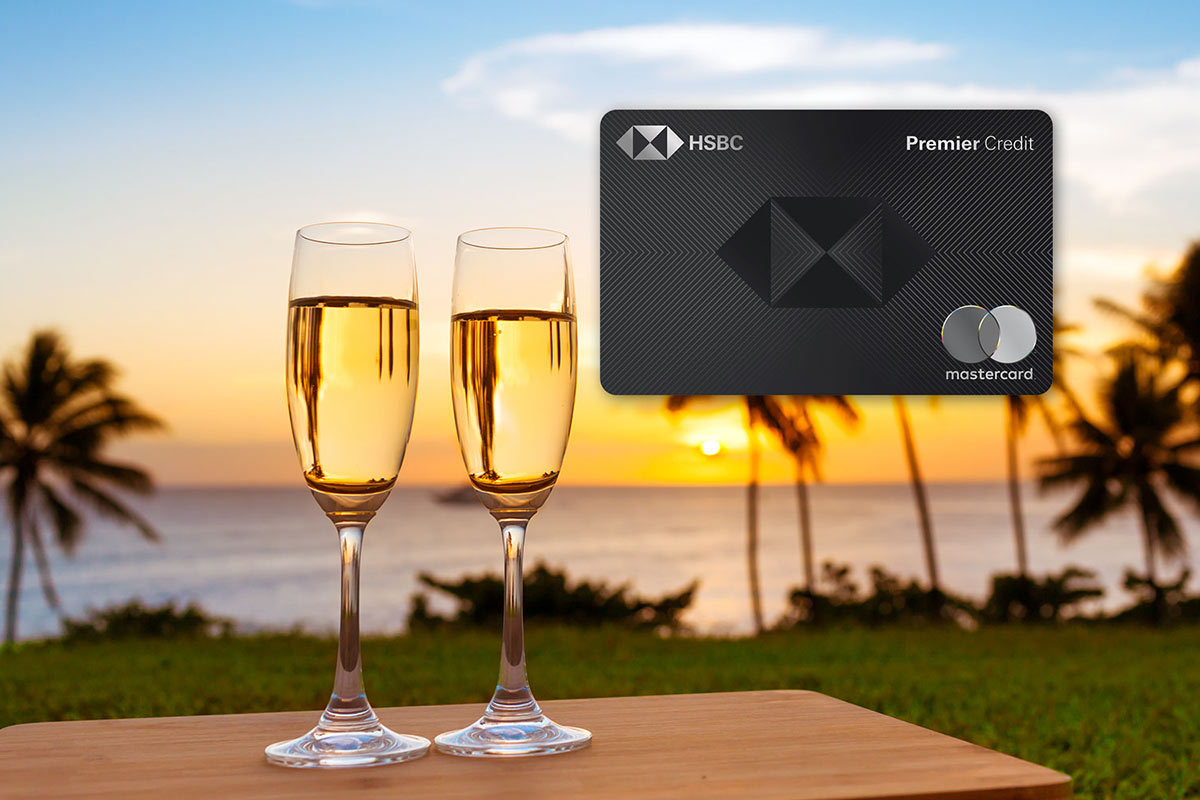

Interestingly, the sign-up promotion’s own exclusion list doesn’t include any education MCCs, nor does it mention education at all. On paper, that means a foreign currency tuition payment should count towards the S$5,000 minimum spend, while also earning 2.76 mpd in its own right.
If you have a large overseas tuition bill falling due in the next couple of months and you’re eligible for the card, this could be a very efficient way to hit the minimum spend for a new application.
Who can get the card?
As a reminder, the HSBC Premier Mastercard is only available to HSBC Premier customers, which rules out most of our readers.
- Minimum income: starts at S$30,000 a year for Singaporeans and PRs with a Total Relationship Balance (TRB) of at least S$50,000, rising to S$65,000 otherwise.
- Annual fee: S$708.50, waived if you maintain a TRB of at least S$200,000 with HSBC Singapore.
According to HSBC’s Global Education page, the same FCY education earning benefit now also applies to the bank’s invitation-only HSBC Privé card.
Summary
Since 23rd July 2026, the HSBC Premier Mastercard has earned 6.9 HSBC Reward points per S$1 on education spend charged in foreign currency. That’s up to 2.76 mpd with Asia Miles, Avios and other 2.5:1 partners, or 2.3 mpd with KrisFlyer, with no cap and no minimum spend.
It’s a welcome exclusion-of-an-exclusion from HSBC, after the bank axed education from rewards earning back in 2020.
On cost per mile, several Maybank cards remain the cheaper way to earn KrisFlyer miles on overseas tuition, particularly the Horizon Visa Signature with its uncapped 2.8 mpd.
For Premier customers who already hold the card and would rather not juggle multiple cards, though, this is now a perfectly sensible home for foreign currency school and university fees spend.
(Cover Photo: Yue Wu)