

Since 1st April 2026 the HSBC Revolution has earned 4 mpd on the first S$1,000 of eligible online and contactless spend, but those who keep an average daily balance of at least S$50,000 in an HSBC Everyday Global Account (EGA) now earn an enhanced 8 mpd instead, on a higher S$1,200 monthly cap.
When HSBC announced the change in March, we noted that the maths would depend heavily on your circumstances, then in our full review of the card in August, we said it probably wasn’t worth moving money for.
However, things have changed since then.
Interest rates have fallen – we assumed you could earn around 2.5% on S$50,000 elsewhere, but today the best realistic rates for parked Singapore dollars, whether locked in or not, top out at about 2%.
Also, HSBC launched a new programme earlier this month, Rewards+, which pays boosted interest on the same EGA balance you’d be holding for the Revolution, and one of its qualifying goals is something many Revolution cardholders are already doing.
| HSBC Revolution | |||
 |
No annual fee |
4 mpd online & contactless |
8 mpd with EGA |
| READ OUR REVIEW | |||
| HSBC Revolution | ||
|
||
|
No annual fee |
4 mpd online & contactless |
8 mpd with EGA |
| READ OUR REVIEW | ||
A quick recap
The two tiers apply to exactly the same bonus spending categories – dining, retail, direct travel bookings, taxis, ride-hailing and memberships, paid online or by contactless. Only the earn rate and the monthly cap differ.

| HSBC Revolution earning tiers | ||
| Standard | Enhanced (S$50,000 ADB in EGA) |
|
| Bonus earn rate | 10x points 4 mpd |
20x points 8 mpd |
| Monthly bonus cap | 9,000 points (S$1,000 spend) |
22,800 points (S$1,200 spend) |
| Max. miles per month (2.5:1 partners) |
4,000 | 9,600 |
| Max. annual miles (2.5:1 partners) |
48,000 miles | 115,200 miles |
| Max. annual miles (KrisFlyer, 3:1 partners) |
40,000 miles | 96,000 miles |
The rules on the S$50,000 deposit are quite strict:
- It must be in a sole EGA – joint accounts aren’t eligible
- It must be cash in the SGD account – investments, insurance policies and fixed deposits don’t count
- It’s assessed as an Average Daily Balance (ADB) for each calendar month, against the month your card transactions post in
That last point means the money needs to be there from the 1st of the month. Deposit S$50,000 on the 15th and your ADB for that month will fall short, unless you top up by a larger amount to compensate.
How much is 8 mpd worth?
Both our March article and our review quoted the headline gain as 13,800 extra bonus points a month, or 66,240 miles a year. That figure compares the two tiers’ bonus caps directly, but it assumes the extra S$200 of spend you can put through at 8 mpd would otherwise earn almost nothing.
For most miles collectors that’s not the case. If you’re spending more than S$1,000 a month in categories like dining and retail, you probably hold at least one other 4 mpd card with room left in its own cap, and that’s where the extra S$200 would go if you didn’t qualify for the enhanced tier.
Put the overflow on another 4 mpd card and the comparison becomes much simpler – the enhanced tier is worth an extra 4 mpd on whatever bonus-category spend you put through the card, up to S$1,200 a month.
| Extra value from the 8 mpd tier (per year) |
|||
Your value per mile: 1.8¢ 1.0¢ Drag to set your own valuation |
|||
| Monthly bonus spend | Extra miles (2.5:1 partners) |
Value | Value if transferring to KrisFlyer (3:1 partner) |
| S$500 | 24,000 | S$432 | S$360 |
| S$1,000 | 48,000 | S$864 | S$720 |
| S$1,200 | 57,600 | S$1,037 | S$864 |
Miles valued at 1.8 cents each by default (adjust using the slider). Without the EGA, spend above the S$1,000 standard cap is assumed to go on another 4 mpd card instead.
So a cardholder maxing out the enhanced cap every month gains around 57,600 miles a year, worth a little over S$1,000 at a 1.8 cents per mile valuation. If you only transfer to KrisFlyer, knock a sixth off those miles, thanks to HSBC's inferior 3:1 transfer ratio for that programme.
If you don't have another 4 mpd card to absorb the overflow, the enhanced tier is worth a bit more, since the S$200 above the standard cap would otherwise earn just 0.4 mpd. That's the 66,240-mile scenario, but it's not the one most of our readers are in.
How much interest are you giving up?
The EGA's prevailing interest rate is just 0.01%, so on its own S$50,000 earns you about S$5 a year there. The real cost of the 8 mpd tier is whatever that money could have earned somewhere else.
If you already put your cash into T-bills, you’ve accepted that it isn’t available on demand, so the EGA’s instant access is a bonus rather than a cost. Then again, money that has to stay at S$50,000 every month to earn 8 mpd isn’t entirely free to move either - take it out and you lose the enhanced rate - so in practice it’s a soft lock-in anyway.
We've left out the bonus-interest accounts that want your salary, a minimum card spend or an investment purchase before paying their headline rate. Those can work out well, but they come with conditions of their own, and you can only credit your salary to one bank.
We'll look at that last point again shortly, because HSBC now has an option of its own.
That leaves four reasonable benchmarks, with and without a lock-in:
| Alternatives for S$50,000 | |||
| Account | Rate (p.a.) | Interest per year | SDIC insured? |
| MariBank Savings Account |
0.88% | S$440 | Yes |
| GXS Saving Pocket |
1.20%* | S$600 | Yes |
| 6-month T-bill SG Government |
1.86% | S$930 | N/A (Government backed) |
| Chocolate Finance |
2.2% (first S$20,000) 1.9% (next S$130,000) (2.02% blended) |
S$1,010 | No |
Rates as of November 2026, excluding new-customer and conditional bonuses.
* Limited-time promotional rate. T-bill rate is the cut-off yield for the issue of 10th November 2026.
MariBank and GXS are both digital banks, with deposits insured up to S$100,000 per depositor by the Singapore Deposit Insurance Corporation (SDIC), exactly as your EGA balance is.
Treasury bills are issued by the Singapore government, so there's no question over safety, but they tie your money up for six months at a time. Rolling them over usually leaves a few days of idle cash between maturity and the next auction, so the real yield ends up a little below the headline.
If you're happy to commit your cash for a set period, GXS's Boost Pockets (1.50% to 2.00% p.a. for three to 18 months) and MariBank's fixed deposits (1.28% to 1.48% p.a. for three to 12 months) all fall within the same range, so the conclusions below apply to them too.
Chocolate Finance pays noticeably more, but it isn't a bank account, it's a managed investment account holding short-term fixed income funds.
That means it isn't covered by SDIC, and note that withdrawals can take up to three working days to process. Its advertised returns are currently backed by a top-up programme that makes good any shortfall on the first S$150,000, but that's a promise from Chocolate Finance itself, with no government backing.
If you're comfortable with that, it's the highest-paying option on the list, though only by a small margin.
HSBC Rewards+ changes the maths
Until 1st July 2026, EGA holders could earn an extra 1% p.a. through HSBC's Everyday+ Rewards programme, though only on increases in their balance - so it did little for a sum that simply sits there month after month.
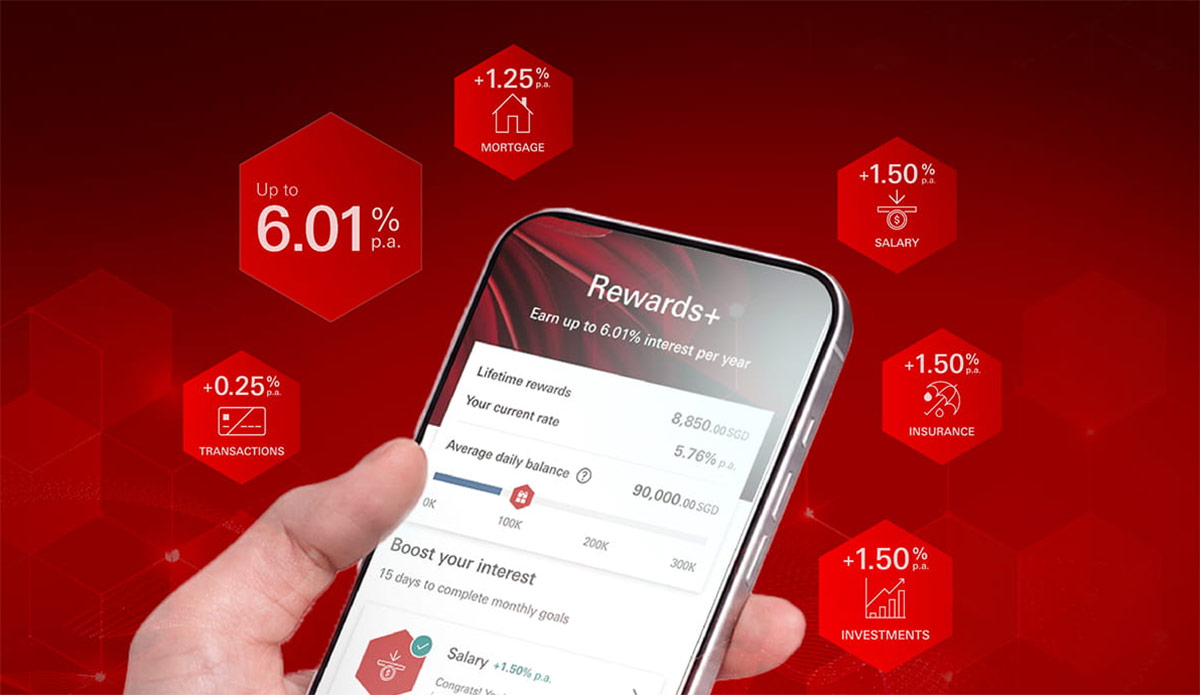
Its successor, HSBC Rewards+, launched on 1st November and works quite differently. It pays boosted interest on your whole SGD balance in a sole EGA, up to S$100,000, for each goal you hit:
| HSBC Rewards+ Boosted interest |
||
| Goal | Requirement | Boost |
| Salary | Credit at least S$5,000 salary via GIRO each month | 1.50% p.a. |
| Transactions | Spend S$1,000+ a month on HSBC cards, bill payments or PayNow to UEN | 0.25% p.a. |
| Investments | Invest S$50,000 in eligible products | 1.50% p.a. |
| Insurance | Buy an eligible new policy | 1.50% p.a. |
| Mortgage | Take a new home loan of S$500,000+ | 1.25% p.a. |
The investment, insurance and mortgage goals are big commitments that nobody should make just for the sake of some miles, so we'll ignore them here. The first two, though, are much more relevant.
The transactions goal is almost free for Revolution users. Spending at least S$1,000 a month across your HSBC credit cards earns an extra 0.25% p.a., and if you're putting enough through the Revolution to justify the enhanced tier, you're probably clearing that threshold already. That lifts your S$50,000 from S$5 a year to about S$130 right off the bat.
The salary goal is the big one. Credit at least S$5,000 of salary into your EGA by GIRO each month and you add another 1.50% p.a., taking the balance to 1.76% p.a. in total, or about S$880 a year on S$50,000.
That has to be a genuine salary credit by GIRO, in SGD. The S$5,000 is also what actually lands in your account, so it's after CPF deductions. For a Singaporean under 55, that means a gross salary of around S$6,250 a month is needed.
It's assessed on the date your salary posts, too. If your pay ever slips from the last day of one month to the first day of the next, you'll lose the salary boost for the 'missing' month.
The catch is that your salary can only go to one bank. If it's currently unlocking a higher rate at UOB, OCBC or DBS, moving it to HSBC would cost you there. However, if it's sitting in an account where it isn't earning you anything extra, the EGA is now a much better place for this money than it was a month ago.
A few other points are worth knowing:
- Rates can change: HSBC can revise them with 30 days' notice, and it trimmed the EGA's base rate and scrapped the Everyday+ bonus only this year.
- Only one EGA counts: If you hold more than one sole EGA, Rewards+ only applies to the one with the smallest account number, so that's where your S$50,000 needs to be.
- Stay in good standing: Boosted interest is paid by the 7th of the following month, and you forfeit it if any of your HSBC accounts falls into arrears before then.
Sethisfy has a detailed breakdown of Rewards+ if you want to dig into the investment and insurance goals too.
So... is it worth it?
Here's the overall picture, combining the extra miles from the 8 mpd tier with the interest the S$50,000 earns in the EGA, then subtracting what it would have earned elsewhere. Positive numbers mean the EGA wins.
| Annual gain from keeping S$50,000 in the EGA (salary credited elsewhere) |
|||
Your value per mile: 1.8¢ 1.0¢ Drag to set your own valuation |
|||
| Compared with | S$500 monthly spend |
S$1,000 monthly spend |
S$1,200 monthly spend |
| MariBank | -S$3 | +S$554 | +S$727 |
| GXS | -S$163 | +S$394 | +S$567 |
| 6-month T-bill | -S$493 | +S$64 | +S$237 |
| Chocolate Finance | -S$573 | -S$16 | +S$157 |
EGA earns 0.01% p.a. at S$500 spend, and 0.26% p.a. at S$1,000+ with the Rewards+ transactions goal met.
| Annual gain from keeping S$50,000 in the EGA (salary credited to HSBC) |
|||
Your value per mile: 1.8¢ 1.0¢ Drag to set your own valuation |
|||
| Compared with | S$500 monthly spend |
S$1,000 monthly spend |
S$1,200 monthly spend |
| MariBank | +S$747 | +S$1,304 | +S$1,477 |
| GXS | +S$587 | +S$1,144 | +S$1,317 |
| 6-month T-bill | +S$257 | +S$814 | +S$987 |
| Chocolate Finance | +S$177 | +S$734 | +S$907 |
EGA earns 1.51% p.a. at S$500 spend, and 1.76% p.a. at S$1,000+ with the Rewards+ transactions goal met.
So what does this tell us?
Against a regular bank savings account, the 8 mpd tier starts to pay off once you're spending around S$500 - S$700 a month in the bonus categories, even with your salary credited elsewhere. Put S$1,000 or more through the card and you're several hundred dollars a year better off.
Against T-bills or Chocolate Finance it's much closer. Without the salary boost, you really need to be spending at or near the S$1,200 cap every single month just to come out a little ahead, based on a 1.8 cents per mile valuation, and any month you fall short tips the balance the other way.
Credit your salary to HSBC, and it's a clear win against everything here, at virtually any level of spend.
If you transfer exclusively to KrisFlyer, the miles side shrinks by a sixth. Without the salary boost, that's enough to turn the Chocolate Finance comparison negative and leave T-bills only narrowly behind, but the others are largely the same.
Fresh funds promotions
HSBC regularly runs bonus interest promotions on the EGA, and the current round pays up to 2.00% p.a. on incremental fresh funds below S$500,000 from November 2026 to January 2027, for existing customers who register by 30th November. Details are on the bank's EGA page.
This round suits Revolution users nicely. Customers without HSBC investments only get the full 2.00% if they don't draw the new money down in December or January (otherwise it's 1.80%), which is exactly what the 8 mpd tier asks of you anyway (leave the money where it is!).
The terms also explicitly allow it to be combined with Rewards+, so someone crediting their salary to HSBC could earn around 3.75% p.a. on new money for those three months.
The downside is that these rounds only reward increases in your balance against a reference month, so they suit money moving into the bank rather than money that stays there. Once a promotion ends, you're back to the base rate plus whatever Rewards+ goals you hit.
Eligibility is also restrictive - the current round is only open to existing customers with an EGA opened on or before 31st July 2026, and it excludes anyone already on the September or October rounds, so check the terms carefully before counting on one.
New HSBC banking customers have a separate option, and it's open to existing HSBC cardholders too, as long as they haven't held an HSBC bank account in the 12 months before 1st October 2026.
Open an EGA by 31st December 2026, deposit S$50,000 of fresh funds from another bank in the same calendar month, keep it there for the following five months, and HSBC will award 30,000 Reward points (12,000 miles). That's worth around S$216 at a 1.8 cents per mile valuation, on top of the Revolution's own sign-up bonus if you're new to HSBC credit cards.
You'll need to opt in to HSBC marketing and log on to the HSBC app by the deposit deadline, and the points take around seven months to arrive.
Other things to consider
- Premier customers: If you're HSBC Premier and your EGA balance already sits above S$50,000 most of the time, the maths above doesn't really apply to you. You're not giving anything up, so the Revolution should be your first choice in its bonus categories.
- The income requirement: The same S$50,000 counts towards a Total Relationship Balance (TRB) with HSBC, which reduces the Revolution's minimum income requirement from S$65,000 to S$30,000 for salaried Singaporeans and PRs. If that's what stands between you and the card, it's another point in the EGA's favour.
- Deposit insurance: S$50,000 in the EGA sits well within the S$100,000 SDIC limit, provided you don't hold other large SGD deposits with HSBC, since it's a per-bank protection.
- Joint accounts: Money in a joint EGA counts for neither the 8 mpd tier nor Rewards+. If your household cash sits in a joint account, you'd need to move S$50,000 into a sole one in your name.
- Maintain the ADB: Every month your ADB dips below S$50,000, you lose the enhanced rate for that month's spend. If you regularly draw on this cash for bills or investments, be sure to top up sufficiently to get the ADB for the month north of S$50k again to retain the 8 mpd benefit.
- How you value miles: We've used 1.8 cents per mile throughout the text, but each of the three tables above has its own slider, so you can test using your own valuation.
Summary
Our August verdict was that the Revolution's 8 mpd tier wasn't worth moving money for, unless the money was already at HSBC. With rates elsewhere having fallen since then, and Rewards+ now in the picture, that conclusion might have been wrong for many.
If you'd otherwise leave this cash in a regular savings account, keeping it in the EGA is worth it as long as you're putting at least S$500 - S$700 a month through the Revolution in its bonus categories. Spend S$1,000 or more and the case is strong.
If you'd otherwise use T-bills, Chocolate Finance or similar, it's only worth it if you consistently spend at or near the S$1,200 cap every month, or if you're also crediting your salary to HSBC. Without one of those, the gap is too small to justify the effort.
If your salary can go to HSBC without costing you a better rate elsewhere, the EGA plus 8 mpd combination beats every option we've looked at, at almost any level of spend.
Finally, if none of that applies, the standard 4 mpd tier on S$1,000 monthly spend remains one of the best no-annual-fee earn rates around. There's nothing wrong with just sticking to that.
Full terms and conditions for the Revolution's earning tiers are available here.
(Cover Image: HSBC)