


When the Standard Chartered Journey Card arrived on the Singapore credit card scene in May 2023, it was dispatched as something of a rescue mission.
Its predecessor, the ill-fated X Card, launched to enormous fanfare in 2019, then spent four years searching for a purpose it never found. The Journey rebrand gave the card a proper job description at last, and it has stuck to it ever since with remarkably little change.
That stability is unusual in a market where earn rates, caps and category definitions shift almost quarterly. It’s also a double-edged sword, because while the Journey Card has stood still, its competitors’ haven’t, and that’s not always a good thing.
Here is our full review of the Standard Chartered Journey Credit Card. It forms part of our series of credit card reviews, which are all summarised on our dedicated Credit Cards page.
Dollar amounts refer to SGD, and ‘miles’ refer to KrisFlyer miles, except where stated. This review was updated on 13th September 2026.
| SC Journey Card | |||
 |
2 mpd FCY |
3 mpd bonus spend |
First year free |
| APPLY HERE | |||
| SC Journey Card | ||
|
||
|
2 mpd FCY |
3 mpd bonus spend |
First year free |
| APPLY HERE | ||
Mainly Miles Says
The Standard Chartered Journey Card is an entry-level general spend card that can best be described as having been quietly overtaken.
Its uncapped 1.2 mpd local and 2 mpd foreign currency rates were respectable in 2023, but are now near the bottom of the category, while the 3 mpd bonus for online transport, food delivery and groceries, capped at S$1,000 per statement month, falls 25% below competitors earn rates.
On the plus side, 360° Rewards Points never expire, which takes the pressure off timing your transfers. Add two Priority Pass visits, a S$30,000 income requirement and a first-year fee waiver, and there’s a decent package here, even if it’s far from market leading.
| Pros | Cons |
|
|
From the X Card to the Journey Card
To understand where the Journey Card sits today, it helps to remember what it replaced.
Standard Chartered launched the X Card in July 2019 with a 100,000 miles sign-up bonus, a figure no Singapore credit card had come close to before. The headline offer was pulled after less than a week, over a month early, and was replaced with a less generous 60,000 miles deal.
It rather set the tone for what followed.
The card offered few perks beyond two complimentary lounge visits, and the bank ended up waiving its supposedly “mandatory” S$695.50 annual fee simply to keep members on board. By late 2022 the first-year waiver had become a permanent fixture, which rather gave the game away.
In May 2023 the X Card was rebranded the Journey Card, and repositioned almost entirely.
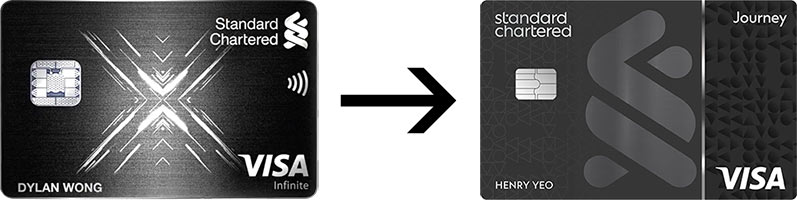
The income requirement dropped from S$80,000 to S$30,000, the annual fee fell to S$194, the card switched from Visa Infinite to Visa Signature, and the metal was replaced with what Standard Chartered described as “carbon neutral plastic”.
Alongside the rebrand came a new 3 mpd bonus category for online transport, food delivery and grocery spend, initially a promotion running only to the end of 2023. That rate was made permanent in December 2023, and remains in place today.
The card’s other significant change came in 2024, and it wasn’t in cardholders’ favour. Standard Chartered axed nine of its ten transfer partners from late March that year, though it did finally add Asia Miles at the same time, leaving two options where there had been ten.
The bank then expanded its list of excluded spend categories from early September 2024, taking utilities and hospital payments off the miles-earning table.
Since then, very little has moved.
Eligibility
- Minimum age (principal): 21
- Maximum age (principal): 65
- Minimum income (Singaporean / PR): S$30,000/yr
- Minimum income (foreigner): S$90,000/yr
For Singapore citizens and permanent residents this is an entry-level product, sitting at the same S$30,000 threshold as cards like the BOC Elite Miles and DBS Altitude.
Foreigners face a S$90,000 income requirement since 29th March 2025, up from S$60,000 previously, and applicants must also hold a valid Singapore Employment Pass.
Note also the upper age limit of 65, which not every card issuer applies.
Annual Fees & Interest Rates
- Annual fee (principal): S$196.20 (first year waivable)
- Annual fee (supplementary): Free (up to 4 cards)
- EIR: 27.9% per annum
- Foreign transaction fee: 3.5%
- Cash advance fee: 8% of amount withdrawn (min S$15)
- Late payment charge: S$100
The first-year annual fee is optional, and whether you opt for it is part of the sign-up bonus decision, which we cover below. Essentially, you choose at the point of application whether to pay it or waive it, and that choice determines how many bonus miles you receive.
From the second year onwards the fee applies as standard, but Standard Chartered attaches a renewal bonus to keep you interested.
The renewal bonus
If you pay the S$196.20 annual fee on renewal, Standard Chartered credits 10,000 miles, typically by the end of the following month.
Taken in isolation that’s buying miles at 1.96 cents each, which is more than we’d be willing to pay. In practice this is the same as on the Citi PremierMiles and DBS Altitude cards, both of which pair a similar annual fee with a 10,000 mile renewal bonus, so the Journey Card is at least no worse than its peers here.
Could you simply ask for a waiver instead? Standard Chartered doesn’t list the Journey among the cards whose annual fee is strictly non-waivable, so the door is formally open, but cardholder reports suggest the bank now takes a firm line and turns down most requests.
Standard Chartered has history here. The X Card was marketed as having a strictly non-waivable fee while the bank quietly handed out “exceptional” waivers in 2020 and 2021 to stop members walking away.
Sign-up bonus
The Journey Card sign-up bonus has moved around considerably over the years, peaking at 45,000 miles in 2023 for a S$3,000 spend. The current bonus is smaller, but the structure makes it far easier to achieve.
At the time of writing the offer is up to 30,000 bonus miles for new-to-bank applicants, requiring a minimum spend of S$800 within 60 days of card approval. Choosing the annual fee waiver at application drops this to 20,000 miles, since the 10,000 mile welcome element is tied to paying the first-year fee.
“New-to-bank” means you don’t currently hold a principal Standard Chartered credit card, and haven’t held one in the past 12 months from your application date.
The terms include a clawback clause if you end your banking relationship with Standard Chartered within six months of the promotion ending.
Credit card sign-up offers change regularly, so check our dedicated article for the current deal and its expiry date.


Earn rates
The Journey Card earns 360° Rewards Points, which convert to miles at a fixed ratio of 2.5 points to 1 mile.
- 3 Rewards Points per S$1 local spend, equivalent to 1.2 mpd
- 5 Rewards Points per S$1 foreign currency spend, equivalent to 2 mpd
- 7.5 Rewards Points per S$1 on selected online categories, equivalent to 3 mpd
The first two rates are uncapped, with no minimum monthly spend to unlock them. The third is capped, which we will come to later.
Here’s how the base earn rates compare against other general spend cards at a similar income requirement.
Earn rates (general spend cards)
(Best to worst, September 2026)
| Card | Local Spend | FCY Spend |
 BOC EM BOC EM |
1.4 mpd | 2.8 mpd |
 UOB PRVI Miles UOB PRVI Miles |
1.4 mpd | 2.4 mpd |
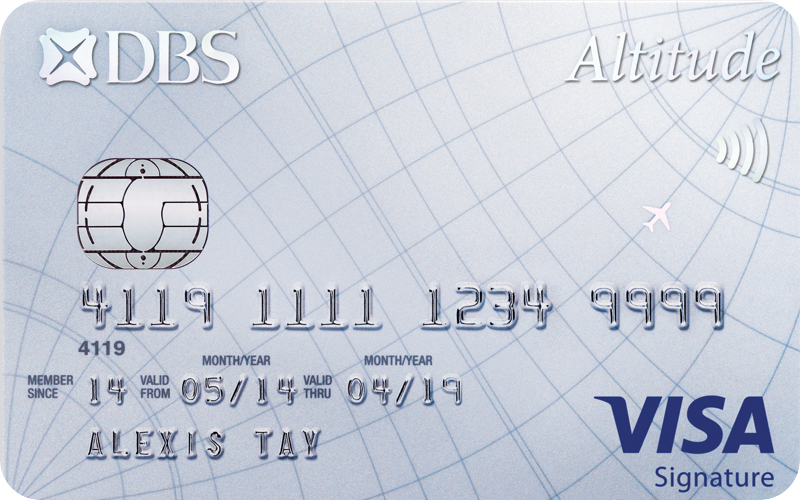 DBS Altitude DBS Altitude |
1.3 mpd | 2.2 mpd |
 OCBC 90oN OCBC 90oN |
1.3 mpd | 2.1 mpd |
 HSBC T1 HSBC T1 |
1.2 mpd | 2.4 mpd |
 Citi PM Citi PM |
1.2 mpd | 2.2 mpd |
 Journey Card Journey Card |
1.2 mpd | 2 mpd |
 KF Ascend KF Ascend |
1.2 mpd | 1.2 mpd |
 KrisFlyer UOB KrisFlyer UOB |
1.2 mpd | 1.2 mpd |
 KF Blue KF Blue |
1.1 mpd | 1.1 mpd |
The Journey Card is a fair way down the list on both local spend and on foreign currency spend.
It isn’t totally embarrassing, but three years ago these rates would have put it higher in the table, because almost all of the rest of the market has moved, while the Journey (somewhat ironically) has stayed still.
The 3 mpd bonus categories
The primary feature the Journey Card has that most of its general spend rivals don’t is a bonus category, available year-round with no registration required.
You’ll earn 3 mpd for online transactions charged in Singapore Dollars with merchants falling under the following categories.
| Journey Card 3 mpd Bonus Categories (Online, SGD transactions only) |
||
| Category | MCCs | Example merchants |
| Transport | 4111 4121 4411 4789 |
Grab, Gojek, Cabcharge Asia, Tada, Ryde, Royal Caribbean Cruises, Easybook.com |
| Grocery and food stores |
5411 5462 5499 5921 |
NTUC FairPrice Online, NTUC FairPrice app, Lazada Redmart, Watson’s Singapore, Nespresso Singapore |
| Food delivery | 5811 5812 5814 |
GrabFood, Foodpanda, Deliveroo, McDonald’s, KFC, Pizza Hut, Domino’s Pizza |
| Capped at the first S$1,000 of eligible spend per statement month | ||
Three conditions must all be met to qualify:
- The merchant’s MCC must appear on the list above.
- The transaction must code as online (card not present).
- The transaction must be charged in Singapore Dollars.
Merchants shown are examples only. As always, the bank doesn’t assign the category, the merchant’s acquiring bank determines the MCC, so occasional (pleasant and unpleasant) surprises are inevitable.
SimplyGo bus and train fares code as MCC 4111, which is on the list, but they aren’t online transactions, so your daily commute earns 1.2 mpd rather than 3 mpd.
However, paying for a dine-in meal through a restaurant’s own app, or by scanning a QR code at the table, should attract the bonus even though nothing is being “delivered” as such. What matters is the merchant category, so if it codes as 5811, 5812 or 5814, you’re good in this example.
Watch the cap, and watch the calendar
Bonus earning is capped at the first S$1,000 of eligible spend per statement month, which yields a maximum 3,000 miles in these categories. Spend beyond that reverts to the standard 1.2 mpd.
Careful here, because your statement month is not a calendar month. It runs from the statement date in your current calendar month to one day before the statement date in the following month. If you’re used to calendar-month caps elsewhere, this is an easy way to lose bonus miles at either end of the cycle.
Note that the cap is tracked by posting date rather than transaction date, so if your statement month ends on the 20th, a purchase made on the 19th that only posts on the 22nd counts against the following month’s allowance.
Spending right up to the end of your statement month is therefore something of a gamble, since you have no way of knowing when a merchant will submit the transaction.
Base points credit when the transaction posts, typically within one to three working days. The bonus element is aggregated and credited on your statement cycle date, so don’t panic when the extra 1.8 mpd isn’t visible immediately.
Mobile wallets don’t count
Standard Chartered confirms that Apple Pay, Google Pay, Samsung Pay and Garmin Pay transactions are not card-not-present transactions, and therefore do not qualify for the 3 mpd bonus.
Is the bonus actually worth much?
Maxing the S$1,000 cap every month at 3 mpd earns 3,000 miles, against the 1,200 miles the same spend would earn at the base local rate. That’s a bonus of 1,800 miles a month, or 21,600 miles a year.
Put the same S$1,000 through a 4 mpd card and you’d earn 4,000 miles. In other words, the Journey Card’s headline bonus category is still a third short of what the better bonus category cards deliver.
Where it does earn its place is as an overflow card. If you’re already maxing the monthly caps on your 4 mpd cards for online spend in these categories, 3 mpd on the next S$1,000 is considerably better than the 1.2 mpd (or similar) you might otherwise drop to.
How your points are calculated
Standard Chartered’s rounding policy is one of the card’s quiet strengths.
Rather than awarding points in S$5 blocks as UOB and Maybank do, or rounding the transaction down to the nearest dollar as BOC now does, Standard Chartered calculates points on the exact transaction amount and rounds the resulting points total to the nearest whole number.
Local spend is a single sum – multiply the transaction by 3, then round.
Foreign currency spend is handled slightly differently, with the base and bonus elements worked out and rounded separately before being added together, so the transaction is multiplied by 3 and rounded, multiplied by 2 and rounded, and the two figures combined.
The minimum spend needed to earn anything at all is S$0.17 either way, at which point 3 points per dollar produces 0.51 points, and that rounds up to 1.
| How Local Spend Earns 360° Rewards Points |
|||
| Local charge | Rewards Points | Miles equivalent | Effective rate |
| S$0.16 | 0 | 0 | 0 mpd |
| S$0.17 | 1 | 0.4 | 2.35 mpd |
| S$1.90 | 6 | 2.4 | 1.26 mpd |
| S$9.99 | 30 | 12 | 1.2 mpd |
| S$68.45 | 205 | 82 | 1.2 mpd |
| 3 Rewards Points per S$1, rounded to the nearest whole point. 2.5 Rewards Points = 1 KrisFlyer mile |
|||
For small transactions this is much better than most of the market. That S$9.99 purchase earns 12 miles here, against 6 miles on a S$5-block card earning 1.2 mpd.
Spend exclusions
As with every miles card in Singapore, a long list of transactions earn nothing at all. Standard Chartered’s list applies across all its credit cards, and grew notably in September 2024.
Broadly, you won’t earn 360° Rewards Points on:
- Government and tax payments, court costs, fines and bail
- Utilities and hospitals (both added 3rd September 2024)
- Education, from primary schools through to universities and vocational schools
- Insurance premiums
- Charitable, political and religious organisations
- Financial institutions, security brokers and money transfer services
- Cryptocurrency, travellers’ cheques and debt repayment
- Real estate agents and managers
- Cleaning, maintenance and janitorial services
- Parking
- Prepaid and stored value top-ups, including EZ-Link, Transit Link, SimplyGo, AXS and SAM
- Cash advances, Credit Card Funds Transfers and EasyPay instalments
- Recurring payments set up as automatic merchant debits, and bill payments made through SC online banking or the mobile app
- Fees and charges, including the annual fee itself
That recurring payments exclusion is broader than most. It captures any arrangement where you’ve given a merchant a one-time authorisation to charge your card at fixed intervals – a definition that potentially covers a good deal of subscription spend.
CardUp and ipaymy are not excluded, so you can still route larger payments like rent, insurance premiums and education fees through those platforms and earn at the local rate of 1.2 mpd.
The full and current list is available on Standard Chartered’s retail transaction exclusions page.
The FCY fee problem
Here is the Journey Card’s single biggest weakness.
All foreign currency transactions attract a 3.5% fee, made up of a 2.5% Standard Chartered charge plus the 1% levied by Visa. That is the highest foreign transaction fee of any credit card in Singapore, where the rest of the market tops out at 3.25%.
Paired with an earn rate of only 2 mpd, it means using the Journey Card overseas is effectively buying miles at around 1.83 cents each.
| Cost per mile on overseas transactions (general spend cards) (Best to worst, September 2026) |
|||
| Card | Fee | Mpd | Cost per mile |
| BOC EM |
3% | 2.8 | 1.14¢ |
 Maybank HVS Maybank HVS |
3.25% | 2.8* | 1.22¢* |
 SCVI SCVI |
3.5% | 3.0** | 1.22¢** |
| HSBC T1 |
3.25% | 2.4 | 1.43¢ |
| UOB PRVI Miles |
3.25% | 2.4 | 1.43¢ |
| Citi PM |
3.25% | 2.2 | 1.56¢ |
| DBS Altitude |
3.25% | 2.2 | 1.56¢ |
 OCBC Voyage OCBC Voyage |
3.25% | 2.2 | 1.56¢ |
 OCBC 90oN OCBC 90oN |
3.25% | 2.1 | 1.63¢ |
 HSBC VI HSBC VI |
3.25% | 2.0 | 1.71¢ |
| SC Journey |
3.5% | 2.0 | 1.83¢ |
| KrisFlyer UOB |
3.25% | 1.2 | 2.86¢ |
* 2.8 mpd earn rate for the Maybank HVS subject to a min. spend of S$800 (any currency) in the same calendar month.
** 3 mpd earn rate for the SCVI card is subject to a min. spend of S$2,000 (any currency) in the same statement cycle.
Cost per mile also accounts for an additional 0.3% ‘spread’ over money changer currency rates, though this doesn’t apply to all banks and all foreign currencies, so is a worst-case scenario.
Second from bottom, and the only card on the list charging 3.5% without a compensating earn rate. The SCVI suffers the same fee but earns up to 3 mpd, which elevates it closer to the top of the pile here.
Back in 2023 the bank ran two zero foreign transaction fee promotions, rebating the full 3.5% for spend made and posted in June, July, November and December that year. An uncapped 2 mpd with no fee was an excellent deal, but it has never returned for the Journey Card.
And the usual reminder when paying in person overseas – always choose to be charged in the local currency rather than accepting dynamic currency conversion, which gives you a poor exchange rate and drops you to the 1.2 mpd local earn rate as well.
Which loyalty schemes can I transfer into?
Standard Chartered only supports points transfers into two frequent flyer programmes.

- Singapore Airlines KrisFlyer
- Cathay Pacific Asia Miles
Until March 2024 there were ten, though the transfer ratios to most of them were poor enough that they were never really worth using. Standard Chartered’s 2019 launch of eleven partners for the X Card came with a set of wildly variable conversion rates, and transferring to the likes of Qatar’s Privilege Club meant earning well below the advertised mpd.
The good news is that both surviving options convert at the standard ratio, with no haircut for either programme – something HSBC and American Express cardholders can no longer say.
- Conversion ratio: 25,000 Rewards Points = 10,000 miles (2.5:1)
- Conversion fee: S$27.25 (including GST) per transfer
- Minimum transfer: 10,000 miles (25,000 points), then in blocks of 10,000 miles
The S$27.25 fee is middle of the pack, the same as Citi, DBS and Maybank, above OCBC’s S$25, and below BOC’s S$30.56. Amex and HSBC remain the only issuers charging nothing at all.
That 2.5:1 conversion ratio isn’t what every Standard Chartered cardholder gets. The bank’s mainstream cards need 34,500 points for the same 10,000 miles, or 38% more, so the Journey Card is converting at a better rate than cards sitting well above it in the range.
Because transfers must be in 10,000 mile blocks, you’ll need 25,000 points banked before you can convert anything. At the local earn rate that’s S$8,334 of spend, or S$5,000 if it’s all in foreign currency, or S$3,334 at the bonus rate.
Transfers are made through the 360° Rewards Redemption Platform, selecting Travel and then your chosen programme.
How long do transfers take?
Standard Chartered’s 360° Rewards terms quote up to five working days to process a redemption request.
In our experience it’s much quicker than that – one to three days for KrisFlyer, and usually next day for Asia Miles.
That’s not instant in either case, so don’t count on it for an award seat you want to lock the same day, but it’s quicker than many other banks.
Do 360° Rewards Points expire?
No. 360° Rewards Points have no expiry date at all, for as long as your card account remains open and in good standing. In a market where many other rival programmes run an expiry clock, this is a nice advantage.
You can therefore accrue slowly, wait for an Asia Miles transfer bonus, or simply hold points until you have a redemption in mind, without a deadline forcing your hand.
Other things you can do with your points
Miles aren’t the only redemption option for your points accrued with this card, though they’re comfortably the best value one.
- e-Vouchers across retail, dining, lifestyle and travel brands, retrieved directly on the redemption platform
- Cash credits applied against your card account
- Points transfers to family and friends, provided they hold a Standard Chartered card that also earns 360° Rewards Points
Pooling is an area where the Journey Card punches above its weight. Standard Chartered sorts its cards into two groups for rewards purposes, and points can only be combined within a group, never across the two.
The first group covers the Beyond Card, the Visa Infinite, the Priority Banking Visa Infinite – and the Journey. Every other Standard Chartered card sits in the second.
That’s a curious place for an entry-level Visa Signature product with a S$30,000 income requirement to find itself, and it’s another legacy of the X Card days. When the card was a Visa Infinite, the bank was never going to strip that status from points its cardholders had already earned, so the Journey kept its seat at the top table.
Basically if you hold a Visa Infinite or a Beyond Card as well, you can pool those balances with your Journey Card points and pay a single S$27.25 transfer fee.
As always, converting points to cash or vouchers values them well below what you’d get through a good miles redemption, so treat those as a last resort.
Lounge access
The Journey Card offers two complimentary Priority Pass visits per year, covering over 1,700 lounges worldwide.

Getting hold of the membership is more involved than it should be, and it isn’t automatic on card approval. You’ll need to SMS SCX PP followed by the last four digits of your card number to 77272, from the mobile number registered with the bank. The format has to be exact, and an SMS from any other number won’t be accepted.
You’ll then get an acknowledgement within two working days, followed by a one-time unique code within 14 working days. Only then can you enter that code on the Priority Pass application form, linked from Standard Chartered’s Journey Card page, to complete your membership.
That’s potentially the best part of three weeks from first SMS to usable membership, so this is a job for well before you book a trip, not the week you fly.
A few other points to remember:
- Guests count against your allowance. Each accompanying guest uses one of your two visits, so bringing someone with you once exhausts the lot. Additional entries are charged at Priority Pass’s prevailing rate, currently US$35 a head, billed directly to your card.
- Your year starts when Priority Pass approves you, not on your card anniversary or on 1st January. The second allocation follows on that approval anniversary.
- Supplementary cardholders can’t apply. The membership is for the principal cardholder only, and it’s blocked automatically if the principal card is suspended or cancelled.
- You need a separate Priority Pass account for each card. If you already hold a membership through another credit card, this one won’t merge with it, and the two visit allowances are tracked independently.
Two visits a year is modest. The Citi PremierMiles and DBS Altitude Visa match it, while HSBC TravelOne offers four DragonPass visits, but to be fair it’s more than the BOC Elite Miles or KrisFlyer UOB cards provide, which is nothing at all.
Just note that “two visits” means two entries, not two trips with a companion.
For the full picture across the market, see our guide to cards with free airport lounge access.

Travel insurance
Complimentary travel insurance underwritten by Allianz applies when you charge your travel fare to the card, and supplementary cardholders are covered too.
Read the policy schedule, though, because it contains exactly two benefits:
- Accidental death and permanent disablement: S$500,000
- Emergency medical assistance, evacuation and repatriation: S$25,000
That’s the entire policy. There’s no cover for trip cancellation, travel delay, rental car excess, personal liability or baggage – lost or delayed. Between them, those account for very nearly everything that actually goes wrong on a trip.
The S$500,000 headline is also only for injuries sustained while you’re a fare-paying passenger on a common carrier, which covers flights, trains and taxis but explicitly excludes rental cars, hire vehicles, tour coaches and anything chartered.
A few other conditions to note. Cover runs for a maximum of 90 consecutive days per trip, the personal accident benefit applies only up to age 80, and if you end up in hospital you must contact Allianz Travel before incurring costs or they won’t pay.
Most significantly for our readers, the policy only insures journeys where 100% of the travel fare was charged to the card. Redeem miles for your flight and you haven’t met that condition, so the cover simply doesn’t apply – a strange omission for a card whose entire purpose is accruing miles.
This isn’t travel insurance in any proper sense. It’s carrier accident cover with a modest medical evacuation benefit attached, and you should be buying a proper policy regardless.
Other benefits
- Six S$5 Caltex vouchers (S$30 total) credited on card approval
- The Good Life dining, shopping and travel offers across 3,000+ outlets in Asia
- SC Shop and Earn cashback at 250+ online merchants, stacking on top of your card earning
- Visa Signature eCommerce Purchase Protection, covering up to US$200 per claim per annum for non-delivery, wrong delivery or damage on tracked online purchases
- SC EasyBill, which lets you earn miles on tax, education, insurance and rent – categories otherwise excluded – for a 2.5% admin fee
- SC EasyPay instalment conversion, again with no points on the instalments
EasyBill turns several of the exclusions we listed earlier back into earning opportunities, but that sounds more useful than it actually now is.
Standard Chartered raised the processing fee from 1.9% to 2.5% on 31st August 2026, the first increase since the facility launched in 2019 and a jump of almost a third. Put a S$10,000 tax bill through it today and your card is charged S$10,250. The fee itself earns nothing, but the S$10,000 does, giving you 12,000 miles for an outlay of S$250.
That works out at 2.08 cents per mile, against the 1.8 cents KrisFlyer miles are typically valued at. In other words, Journey cardholders are now buying miles for significantly more than they’re worth using this facility.
It’s worse than that, because the obvious workaround isn’t open to you. Standard Chartered’s separate Income Tax Payment Facility still charges 1.9%, but it’s restricted to the Beyond and Visa Infinite cards – Journey cardholders can’t use it.
If you’re using it anyway, be aware that you can only make one EasyBill application per payment category per calendar month, rent payments are capped at S$10,000 and education at S$30,000, there’s still no recurring payment option, and the facility is closed to supplementary cardholders.
Payments take up to seven business days to reach the recipient, and converting one into instalments forfeits the points entirely.
The short version is that EasyBill was a reasonable option on this card until the end of August, and isn’t any more.

There’s also no airport limo benefit and no concierge service, which is consistent with the card’s positioning.
Terms and conditions
- Standard Chartered Journey Credit Card Terms and Conditions
- Journey Credit Card 30K Miles Promotion Terms and Conditions
- Standard Chartered Credit Card Terms (including 360° Rewards Points)
- Credit Cards Retail Transaction Exclusions
- Complimentary Travel Insurance Terms and Conditions
Our Summary
The Journey Card is the card the X Card should probably always have been. It knows what it is, it has stayed consistent for three years, and at a S$30,000 income requirement with a waivable first-year fee there’s very little barrier to holding one.
The trouble is, that consistency has become stagnation.
The card’s 1.2 mpd and 2 mpd base rates were mid-table in 2023 and are near the bottom now, its 3 mpd bonus category is an overflow option when you’ve hit 4 mpd caps on other cards, and its 3.5% foreign transaction fee is the worst in Singapore, on a card whose foreign currency earn rate gives you nothing good to offset it with.
On the plus side points never expire, at a standard conversion ratio into both KrisFlyer and Asia Miles, with transfers out to family and friends who also hold a Standard Chartered card possible. Add two Priority Pass visits, plus the second-year fee buys you 10,000 miles, and it’s a package that isn’t totally unreasonable for S$196.20.
Use it for what it’s good at – mopping up online transport, food delivery and grocery spend once your better cards are capped out.
Just remember to leave it at home any time you leave Singapore!
| Our Rating | ||||||||||||||||||||
| 2.5 / 5 among general spend cards |
||||||||||||||||||||
|
Standard Chartered Journey Card |
||||||||||||||||||||
How we rate credit cards
|
||||||||||||||||||||
Links on Mainly Miles may pay us an affiliate commission.
(Cover Photo: Nnopparuj Lamaikul)