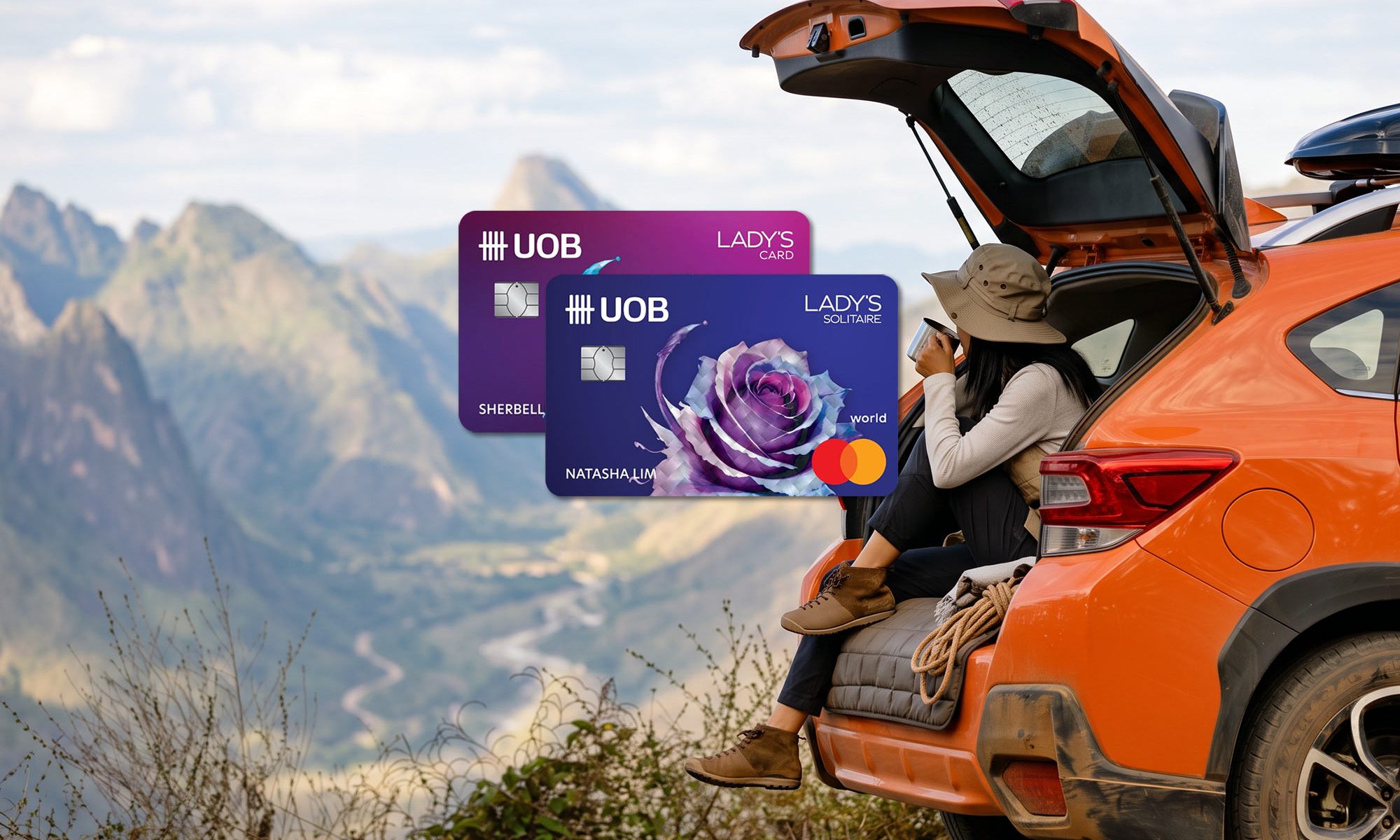

Here’s our review of the UOB Lady’s credit cards issued in Singapore. It forms part of our series of credit card reviews, which are all summarised on our dedicated Credit Cards page.
Dollar amounts refer to SGD, and ‘miles’ refer to KrisFlyer miles, except where stated. This review was updated on 26th October 2026.
| UOB Lady's Cards | |||
 |
First year free |
4 mpd your choice |
Up to 10 mpd with savings |
| APPLY HERE | |||
| UOB Lady's Cards | ||
|
||
|
First year free |
4 mpd your choice |
Up to 10 mpd with savings |
| APPLY HERE | ||
Mainly Miles Says
The UOB Lady’s Cards let you decide where you earn 4 mpd, picking from seven categories that run from restaurants and supermarkets to fuel, flights and hotels, and you can swap every quarter. Pair one with a UOB Lady’s Savings Account, and that rate can climb as high as 10 mpd, but the cards are not without their drawbacks.
Spend outside your chosen category earns just 0.4 mpd, categories are policed strictly by merchant code, and UNI$ expire after two years with only two useful transfer partners to speak of.
The Solitaire’s split S$750 caps also mean the cheaper entry-level card is now the better choice for many readers.
| Pros | Cons |
|
|
Three cards, one name
Despite the branding, the Lady’s Cards have been open to men for over three years – since July 2023. There are three credit cards in the range:
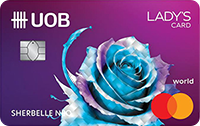
- UOB Lady’s Card, the entry-level version. It’s issued as a World Mastercard to new applicants, though some older cardholders hold a Classic or Platinum version, which works the same way.
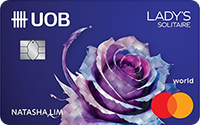
- UOB Lady’s Solitaire Card, the higher-income version, with two bonus categories.
- UOB Lady’s Solitaire Metal Card, which is invitation-only.
| UOB Lady’s Cards Which version? |
|||
| Lady’s |
 Lady’s Solitaire |
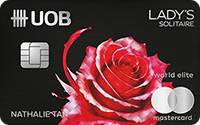 Lady’s Solitaire Metal |
|
| Min. income | S$30,000 | S$120,000 | Invitation only |
| Annual fee | S$196.20 (first year free) |
S$414.20 (first year free) |
S$598.99 |
| Free supp. cards | 1 | 2 | 2 |
| Bonus categories | 1 | 2 | 2 |
| Monthly 4 mpd cap | S$1,000 | S$1,500 (S$750 per category) |
S$2,000 |
| Max. miles per month (card only) |
4,000 | 6,000 | 8,000 |
| Max. miles per month (S$100k savings) |
10,000 | 15,000 | 20,000 |
| Travel insurance | None | Yes (registration needed) |
Yes |
This review focuses on the Lady’s and Lady’s Solitaire, which you can apply for directly.
The Metal card needs an invitation, and you’ll typically only get one after spending around S$45,000 on a Solitaire in a three-month period. That makes little sense on a card whose bonus stops at S$1,500 a month. Its extras include six lounge visits and one airport limo transfer a year, but the S$598.99 fee makes it a niche product.
There’s also a UOB Lady’s Debit Card, which has had no annual fee since 1st October 2026. It isn’t a miles card, so we don’t analyse that one.
Lady’s or Solitaire?
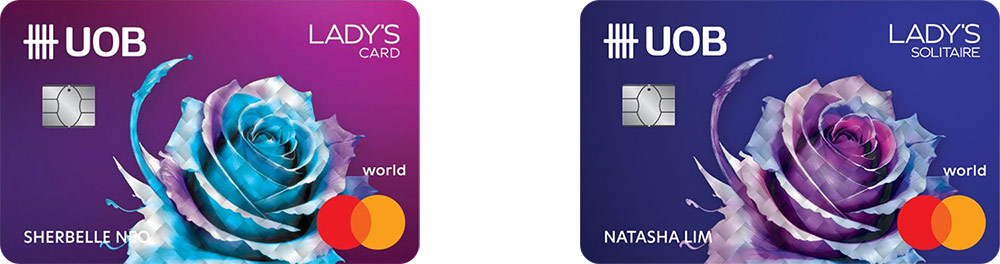
On paper the Solitaire looks like an upgrade, but UOB’s August 2025 changes turned that on its head somewhat!
The Solitaire’s S$1,500 cap is now split into two S$750 halves, one per category.
Nominating just one category doesn’t help either, as that single category is still limited to S$750 a month. The entry-level Lady’s Card gives you S$1,000 in a single category, so it’s the better card for anyone whose bonus spend is concentrated in one area, and with less than half the annual fee and a quarter of the income requirement.
The Solitaire only pulls ahead if you can reliably spend more than S$1,000 a month across two categories. At the full S$1,500, it earns 21,600 more miles a year than the Lady’s Card would on S$1,000. Fall short of S$750 in either category, though, and that advantage shrinks quickly.
Can you hold both?
No. Applying for a Solitaire automatically upgrades an existing Lady’s Card, and applying for a Lady’s Card downgrades a Solitaire. The old card is terminated within a month, and the T&Cs are clear that you’re only entitled to one card’s benefits at a time.
Your UNI$ move across when you switch, but their expiry dates don’t change. Recurring bill payments set up on the old card number won’t follow you either, so you’ll need to update those yourself.
Timing is also important – a category chosen on the new card is treated as a change, so it only takes effect from the following quarter.
If you’ve just switched, it’s worth checking your first month’s bonus carefully to make sure the new card’s cap has been applied.
Eligibility
- Minimum Age: 21
- Minimum Income, Lady’s (Singaporean / PR, aged 21-55): S$30,000/yr
- Minimum Income, Lady’s (Singaporean / PR, aged 56+): S$15,000/yr
- Minimum Income, Lady’s (foreigners): S$40,000/yr
- Minimum Income, Solitaire (all applicants): S$120,000/yr
If you fall below these thresholds, both cards can be issued against a fixed deposit instead – S$10,000 for the Lady’s Card and S$30,000 for the Solitaire. These secured applications are only handled at UOB branches.
Existing UOB cardholders applying for the Solitaire should check that UOB has their current income on file first, since the bank assesses against its own records.
Annual Fees
- Lady’s: S$196.20 (first year free), first supplementary card free, then S$98.10 each
- Solitaire: S$414.20 (first year free), first two supplementary cards free, then S$196.20 each
The first-year waiver doesn’t apply if you cancel and reapply for the same card, so cycling the card to avoid the fee won’t work.
From year two, fee waivers on request are widely reported for both cards, but UOB has a habit of collecting the fee before you get the chance to ask.
Watch out: UOB takes your points!
As with other UOB cards, when the fee falls due UOB first checks your pooled UNI$ balance. If it’s large enough, the bank quietly deducts UNI$ instead of billing you, on the first day of the month after the fee falls due.
| UOB Lady’s Cards Annual fee UNI$ deductions |
||||
| Card | Annual fee |
Full deduction |
Half deduction |
Implied cost per mile |
| Lady’s |
S$196.20 | UNI$6,500 (13,000 miles) |
UNI$3,250 + S$98.10 |
1.51¢ |
| Solitaire |
S$414.20 | UNI$10,000 (20,000 miles) |
UNI$5,000 + S$207.10 |
2.07¢ |
The full fee is only billed in cash if you don’t hold enough UNI$ for even the half deduction.
Once the deduction shows as posted, request a waiver in the UOB TMRW app, or call UOB if that’s declined. If the waiver is granted, the UNI$ are returned with a fresh two-year expiry.
If UOB won’t waive the fee, what you should do depends on which card you hold.
At a 1.8 cent valuation, the 13,000 miles taken from a Lady’s Card are worth around S$234, more than the S$196.20 fee itself. If you’re keeping the card anyway, it’s worth asking UOB to reverse the deduction and bill the fee in cash instead.
The Solitaire works the other way round. Its 20,000 miles are worth about S$360 against a S$414.20 fee, so letting UOB keep the UNI$ might be the better deal.
Either way, diarise your card anniversary, because a five-figure UNI$ deduction is an expensive thing to miss.
Sign-up bonus
There’s no miles sign-up bonus for the UOB Lady’s Cards at the time of writing.
UOB’s card offers, when they appear, have tended to be limited to the first few hundred applicants who meet the spend, and affiliate platforms sometimes attach cash rewards to new applications.
You’ll find current deals across all cards on our Sign-Up Bonuses page.
Regular earn rate
Outside your chosen category or categories, both cards earn just UNI$1 per S$5 (0.4 mpd), whether you spend in SGD or foreign currency.
That’s clearly terrible, so if a transaction isn’t in your category, use another card.
Bonus earn rate
Spend in your chosen category earns UNI$10 per S$5 (4 mpd), made up of the base UNI$1 plus UNI$9 in bonus UNI$, up to your monthly cap.
- Lady’s: one category, capped at S$1,000 per calendar month (48,000 miles a year)
- Solitaire: two categories, capped at S$750 each per calendar month (72,000 miles a year)
There’s no minimum spend, and the bonus applies equally to SGD and FCY transactions, in person or online, provided the merchant’s code falls inside your category. Supplementary card spend counts towards the principal cardholder’s cap.
Spend beyond the cap drops back to 0.4 mpd.
The cap runs by calendar month, based on the date each transaction posts to your account (more on that below).
The seven bonus categories
| UOB Lady’s Cards Bonus categories |
||
| Category | What’s included | Eligible MCCs |
| Beauty & Wellness | Pharmacies, cosmetics stores, hair and beauty salons, spas and massage | 5912, 5977, 7230, 7231, 7297, 7298 |
| Dining | Restaurants, fast food, caterers, food delivery and other food stores | 5811, 5812, 5814, 5499 |
| Entertainment | Bars and nightclubs, cinemas, theatre and event ticketing | 5813, 7832, 7922 |
| Family | Supermarkets and grocers, children’s clothing stores | 5411, 5641 |
| Fashion | Department stores, clothing, shoes, accessories, luggage and leather goods | 5311, 5611, 5621, 5631, 5651, 5655, 5661, 5691, 5699, 5948 |
| Transport | Public transport, taxis and ride-hailing, ferries, petrol stations | 4111, 4121, 4789, 5541, 5542 |
| Travel | Airlines and hotels (see below) |
Not published |
These definitions are strict. UOB awards the bonus based purely on the merchant category code (MCC) the merchant’s bank has assigned. That code doesn’t always match what the shop actually sells, and UOB says plainly in its T&Cs that it can’t guarantee a purchase will land in your category.
Beauty & Wellness is the most hit-and-miss, based on reader reports. Treatment packages from salons and spas are a common problem, since many are processed under codes that sit outside the category.
If you’re unsure about a merchant you’ll use regularly, put a small first transaction through and check that the bonus arrives before committing larger sums.
Which category should you choose?
The best category is generally the one where you’ll reliably spend close to the cap each month, and where your other cards struggle to earn 4 mpd.
- Travel suits high-value spend. One hotel booking or long-haul ticket can fill a S$1,000 cap in a single transaction, and in foreign currency it’s one of the cheapest ways to earn miles on a hotel booked direct.
- Dining and Family suit steady everyday spend. Supermarket shopping in person is a category many 4 mpd cards don’t reward at all.
- Transport earns 4 mpd at petrol stations including Shell and SPC (see below), which most UOB cards exclude entirely, along with Grab rides, taxis and bus and MRT fares.
- Fashion includes department stores (MCC 5311), and some voucher platforms code purchases this way – useful if you buy gift cards for spend you’d make anyway.
- Entertainment is probably the narrowest for most – bars, cinemas and ticketing agencies.
Because changes only apply from the following quarter, plan a quarter ahead. If you know you’ll be booking a big trip in March, for example, switch to Travel before 31st December, so your Q1 category is correct in time.
The Travel category – fine print vs. practice
Travel is the only category without a published MCC list.
UOB’s T&Cs define it narrowly, as transactions at major airlines and hotels whose main business is flights or hotels, including online and phone bookings. Read literally, that rules out online travel agencies, cruises and duty-free shopping.
UOB’s own marketing suggests otherwise.
The Lady’s Card page describes Travel as covering airlines, hotel and resort bookings and duty-free stores, and its list of example merchants includes Agoda, Expedia, Hotels.com, Klook, Chan Brothers Travel and Royal Caribbean.
In practice, UOB applies the wider reading. Bookings with online and offline travel agencies, cruise lines and duty-free shops generally earn the bonus, and so do almost all airlines and hotel groups.
There are a handful of exceptions among individual airline and hotel brand codes, so keep an eye on the first booking you make with a less familiar carrier or chain.
The T&Cs state that they prevail over UOB’s marketing material if the two conflict. So while OTA and cruise bookings earn the bonus today, UOB could stop that at any time without having to change its T&Cs. For the biggest bookings, paying the airline or hotel directly is the safest route.
Petrol – a rare UOB exception
The UOB Preferred Visa T&Cs name Shell and SPC as service stations that earn no UNI$ at all, and the same applies to the PRVI Miles Visa and Mastercard.
The Lady’s Cards T&Cs don’t have that exclusion. UOB even lists Shell, SPC, Caltex and Esso as example Transport merchants, and petrol stations (MCC 5541 and 5542) are part of the category definition.
That makes the Lady’s Card set to Transport one of very few ways to earn 4 mpd on petrol in Singapore. If you drive a lot, it’s well worth considering.
Public transport: bus and MRT rides paid via SimplyGo code as local commuter transport (MCC 4111), so these earn 4 mpd with Transport as your category too. Since the bonus is calculated on your monthly total, even short rides of a dollar or two still count towards the bonus.
Choosing and changing your categories
You nominate your category (or categories) through UOB’s enrolment page. There’s no default category, so skip this step and everything you put on the card earns the base 0.4 mpd.
- Your very first choice kicks in straight away
- Any later change only takes effect from the next calendar quarter (January, April, July or October)
- The cut-off for switching category is 11.59pm Singapore time on the night before a new quarter starts
- Make no change, and your existing choice stays in place, which is fine for most
UOB doesn’t make it easy to check which category you’ve chosen, so keep your own record of it.
The Solitaire’s S$750 sub-caps
The Solitaire’s split cap adds admin the Lady’s Card doesn’t have. With S$750 allowed in each of two categories, it’s up to you to keep count of each one, because nothing in the UOB TMRW app shows how much of either cap you’ve used.
That’s easy if one category is Travel and you make one or two large bookings a month. With two everyday categories like Dining and Family, it’s fiddly, and an overrun in either costs you 3.6 mpd on the excess with no way to move the unused headroom across.
If one category accounts for most of your bonus spend, we’d seriously consider downgrading to the Lady’s Card.
Points rounding – a welcome exception
S$5 earning blocks are a weakness on most UOB cards, but the Lady’s Cards largely sidestep the issue.
- Base UNI$ are awarded per transaction, per complete S$5, rounded down, as usual.
- Bonus UNI$ are worked out on the month’s combined eligible spend, with the S$5 rounding applied to that final total rather than to each individual purchase.
A S$3.50 coffee misses out on base UNI$ entirely, for example, but every cent of it still feeds into the month’s bonus, meaning small purchases earn close to the full 4 mpd. The most you can lose to rounding on the bonus is S$4.99 a month, worth at most 18 miles.
| Miles earned on 4 mpd transactions | ||
| Charge | UOB Lady’s (bonus on monthly total) |
If bonus were per transaction |
| S$3.50 | ~13 (3.6 mpd) |
0 (0 mpd) |
| S$8.80 | ~34 (3.83 mpd) |
20 (2.27 mpd) |
| S$12.40 | ~49 (3.92 mpd) |
40 (3.23 mpd) |
| S$27.90 | ~110 (3.96 mpd) |
100 (3.58 mpd) |
| S$49.99 | ~198 (3.96 mpd) |
180 (3.60 mpd) |
| S$50.00 | 200 (4.0 mpd) |
200 (4.0 mpd) |
Lady’s figures are approximate, since the bonus is rounded once on the monthly total rather than per transaction.
The right-hand column shows how the same purchases would fare on a card like the UOB Preferred Visa, where the whole 4 mpd is calculated per transaction in S$5 blocks.
This makes the Lady’s Card a far better home for small everyday purchases like coffee, convenience stores and short Grab rides than most other UOB cards.
↥ Minimum spend to earn points
On spend in your chosen category, there’s effectively no minimum. Even a S$2 purchase adds to the monthly total that bonus UNI$ are calculated on, though it won’t earn any base UNI$ on its own.
Outside your category, the usual UOB rule applies, and S$5.00 is the smallest transaction that earns anything, since base UNI$ are awarded per complete S$5 block. Foreign currency purchases are converted to SGD first, so a charge that converts to S$4.99 earns nothing.
At 0.4 mpd that’s rarely worth worrying about, since you shouldn’t be using this card outside your category anyway.
When do UNI$ credit?
Base UNI$ appear as each transaction posts.
Bonus UNI$ arrive as a single lump sum per month. UOB only commits to crediting them by the end of the following month, but in practice they usually land at the start of it.
Savings account bonus UNI$ (see below) follow the same timeline.
What about UOB$ merchants?
UOB$ merchants (formerly SMART$) are outlets where UOB cardholders earn instant cashback on in-store spend. On many UOB cards they used to be a trap, earning cashback instead of UNI$.
The Lady’s Cards always fared better here. Even before the rules changed, in-category spend at a UOB$ merchant still earned the full bonus UNI$, and only the base UNI$1 per S$5 was swapped for cashback.
Since November 2024, base UNI$ are awarded at UOB$ merchants too, so in-category spend there now earns the full 4 mpd, with a little UOB$ cashback on top, so there are no concerns.
What doesn’t earn UNI$ at all?
So far we’ve covered spend earning either 4 mpd or the base 0.4 mpd, but there’s a third tier: transactions that earn nothing whatsoever, not even the base rate. UOB’s exclusion list for the Lady’s Cards is long but mostly standard. The main categories are:
- Bills, top-ups and wallets: bill payments, AXS, SingPost SAM, ipaymy, RazerPay, EZ-Link and FlashPay top-ups, YouTrip, and payments to prepaid accounts
- PayPal: any transaction with a “PAYPAL*” descriptor, which is worth remembering for online fashion purchases
- Insurance and utilities: insurance premiums and electricity, gas and water bills
- Healthcare and education: hospitals, schools, colleges and universities
- Government: tax payments, fines, court costs and other government services
- Property and parking: rent paid through real estate agents, property management and car parks
- Financial: wire transfers, brokerages, forex and crypto platforms, and other quasi-cash transactions
- Organisations: charities, religious, political and membership organisations, and professional services
- Other: gambling, cigar shops and Amaze transactions
The usual exclusions apply too, including NETS, 0% instalment plans, SmartPay, cash advances, balance transfers, fees and interest.
The full list is in clauses 32-35 of the card’s T&Cs.
Posting date, not transaction date
Whenever you make a transaction on your UOB Lady’s Card, it typically takes one to three days to post to your account. UOB uses that posting date, not the transaction date, for everything that matters on this card:
- Monthly bonus cap: a purchase made on 30th November that posts on 2nd December counts towards December’s cap
- Lady’s Savings Account bonus: spend is matched against your balance for the month it posts in
- Quarterly categories: a purchase made on 31st March that posts on 2nd April is assessed against your April to June category
If you’re switching categories at the end of a quarter, avoid large purchases in the old category during its final few days, since they may post after the switch and then earn just 0.4 mpd.
Equally, leave a few days’ margin when you’re close to your monthly cap at the end of a month.
The 6 mpd years
Longer-term readers will remember a time when the Lady’s Cards were the highest-earning miles cards in Singapore.
March 2023 to March 2024: To mark International Women’s Day, UOB lifted the bonus rate from 4 mpd to 6 mpd (UNI$15 per S$5) from 8th March 2023. It applied automatically to cardholders’ chosen categories, on up to S$1,000 a month for the Lady’s Card and S$3,000 for the Solitaire and Metal.
A maxed-out Solitaire could earn 18,000 miles a month, three times today’s limit. The offer was due to finish in February 2024, but was extended by a month before UOB ended it on 31st March 2024, cutting the Solitaire’s cap to S$2,000 at the same time.
Together with the cards opening to men in July 2023, that year did more than anything to put the Lady’s Cards in wallets across Singapore.
6 mpd hasn’t entirely gone, either. When the year-long promotion ended, UOB immediately replaced it with the Lady’s Savings Account pairing outlined below, so a S$10,000 deposit now gets you back to 6 mpd. The difference is that it now costs you whatever that money could have earned in interest elsewhere.
The Lady’s Savings Account (up to 10 mpd)
This is the feature that sets the Lady’s Cards apart from every other 4 mpd card in Singapore.
If you’re also the primary holder of a UOB Lady’s Savings Account, you can earn extra bonus UNI$ on your category spend, depending on the account’s monthly average balance (MAB):
| UOB Lady’s Savings Account bonus | ||
| Monthly average balance |
Extra UNI$ per S$5 |
Total earn rate (your category) |
| Below S$10,000 | None | 4 mpd |
| S$10,000 to S$49,999 | 5X (2 mpd) | 6 mpd |
| S$50,000 to S$99,999 | 10X (4 mpd) | 8 mpd |
| S$100,000+ | 15X (6 mpd) | 10 mpd |
A few things to know:
- The extra UNI$ only apply to your chosen category, and only up to the same monthly cap as the card’s bonus (S$1,000 on the Lady’s, S$750 per category on the Solitaire)
- MAB is the average of each day-end balance across the calendar month, so it’s that average that needs to clear each threshold, not your balance at month-end
- In the month you open the account, MAB is averaged from the opening date only, so you don’t need to wait for a full month to qualify
- You must be both the principal cardholder and the primary account holder
- If you hold more than one Lady’s Savings Account, UOB uses the one with the highest MAB
UOB launched this pairing in April 2024 as a one-year promotion and now describes it as “here to stay”.
Is it worth it?
The account itself pays just 0.05% p.a. interest, so the question is really whether the extra miles beat what that money could earn elsewhere.
Here’s what each tier is worth if you max out your cap every month, valuing miles at 1.8 cents each:
| What the savings bonus is worth per year | ||||
| Balance (MAB) |
Lady’s extra miles |
Lady’s equiv. yield |
Solitaire extra miles |
Solitaire equiv. yield |
| S$10,000 | 24,000 (S$432) |
4.32% | 36,000 (S$648) |
6.48% |
| S$50,000 | 48,000 (S$864) |
1.73% | 72,000 (S$1,296) |
2.59% |
| S$100,000 | 72,000 (S$1,296) |
1.30% | 108,000 (S$1,944) |
1.94% |
Assumes the full monthly cap is reached every month, with miles valued at 1.8 cents each.
The first S$10,000 is where the real value lies. If you max out your card each month, it earns the equivalent of 4.32% a year on the Lady’s and 6.48% on the Solitaire, well ahead of what most savings accounts pay in cash.
Beyond that, the numbers fade fast. Look at the marginal return on each extra dollar:
- S$10,000 → S$50,000: the extra S$40,000 earns the equivalent of 1.08% (Lady’s) or 1.62% (Solitaire)
- S$50,000 → S$100,000: the extra S$50,000 earns the equivalent of just 0.86% (Lady’s) or 1.30% (Solitaire)
Those higher tiers are hard to justify when the same money could be earning interest elsewhere, and paid in cash, not miles that expire. Remember too that S$100,000 uses up your entire SDIC deposit insurance cover with UOB.
If you only spend half your cap in a typical month, halve all of these figures, which brings even the S$10,000 tier much closer to what you could earn in interest elsewhere.
The account has a S$1,000 minimum opening deposit, and a S$30 fee applies if you close it within six months.
FCY fee / cpm overseas
UOB charges a 3.25% foreign currency fee, in line with most banks.
Within your category, that makes the Lady’s Cards a cheap way to earn miles overseas, and the savings account boost pushes the cost lower still. Outside your category, it’s one of the most expensive.
| UOB Lady’s Cards: cost per mile overseas | |||
| Spend | Fee | Mpd | Cost per mile |
| Outside your category | 3.25% | 0.4 | 8.57¢ |
| Your category | 3.25% | 4.0 | 0.86¢ |
| Your category + S$10,000 savings |
3.25% | 6.0 | 0.57¢ |
| Your category + S$50,000 savings |
3.25% | 8.0 | 0.43¢ |
| Your category + S$100,000 savings |
3.25% | 10.0 | 0.34¢ |
Cost per mile accounts for an additional 0.30% ‘spread’ over money changer currency rates, and reflects miles earned on the billed amount inclusive of the fee. This doesn’t apply to all banks and all foreign currencies, so it’s a worst-case scenario.
At 0.86 cents per mile, the card alone is level with other 4 mpd cards overseas. Overseas restaurants on Dining, or hotels booked direct in foreign currency on Travel, are where it really earns its keep.
As with other UOB Mastercards, SGD transactions processed overseas incur a 1% fee, and earn no extra miles for it. Always choose to pay in the local currency.
Do UNI$ expire?
Yes. UNI$ expire two years after the end of the calendar quarter in which you earn them, so UNI$ earned in November 2026 will expire on 31st December 2028.
That’s a weakness across all UOB cards, when points from some other banks last longer or don’t expire at all.
Once transferred, KrisFlyer miles are valid for three years, while Asia Miles won’t expire as long as your account has qualifying activity at least once every 18 months.
UNI$ pool between cards
UNI$ from all your UOB cards are combined into a single balance, so if you hold the Lady’s Card alongside another UNI$-earning card like the UOB Preferred Visa, you can transfer them together and pay one conversion fee.
You can also cancel a UOB card without losing your UNI$, provided you still hold at least one other UOB card that earns them. If the Lady’s Card is your last one, transfer or use your UNI$ before cancelling, because they’re forfeited when the account closes.
Which loyalty schemes can I transfer into?
UNI$ transfer to three frequent flyer programmes, though in practice only two are worth considering.
| Frequent Flyer Programme |
Transfer Blocks (UNI$ Miles) |
|
 |
Singapore Airlines KrisFlyer |
5,000 10,000 |
 |
Cathay Pacific Asia Miles |
5,000 10,000 |
 |
AirAsia Rewards |
2,500 4,500 |
AirAsia points transfer at a poorer ratio but, most critically, are worth only a fraction of a KrisFlyer mile or Asia Mile, so we’d ignore that option entirely.
Two useful partners is thin by Singapore standards. Citi Rewards cardholders can choose from ten frequent flyer programmes plus IHG, for example. That said, KrisFlyer and Asia Miles between them open up Star Alliance and oneworld, which is enough for many readers.

What is the transfer cost to miles?
Each transfer costs S$27, up from S$25 when UOB raised the fee in December 2025.
However, transfers are free on all your pooled UNI$ if you also hold a UOB Visa Infinite, Visa Infinite Metal, Privilege Banking or Reserve card.
UOB’s KrisFlyer auto-conversion programme, which moved UNI$ across monthly for S$50 a year, was discontinued on 20th May 2026. It was rarely worth it anyway, since it locked you out of Asia Miles and required a UNI$15,000 balance to be left untouched.
↥ Is there a minimum transfer amount?
Transfers to KrisFlyer and Asia Miles start at UNI$5,000 (10,000 miles), and must be made in blocks of that size.
How long do transfers take?
UOB quotes up to five working days for KrisFlyer and up to 14 working days for Asia Miles.
In our experience, KrisFlyer transfers usually complete within one to two days. Asia Miles transfers really do take most of UOB’s quoted window though, and there are occasional reports of them taking even longer, so they’re not one to leave until the last minute.
Instant free transfers to KrisFlyer via Kris+
If you need KrisFlyer miles immediately, you can link UOB Rewards to the Kris+ app, convert as little as UNI$1,000 into KrisPay miles at a ratio of 1:1.7, then move those 1:1 into KrisFlyer straight away.
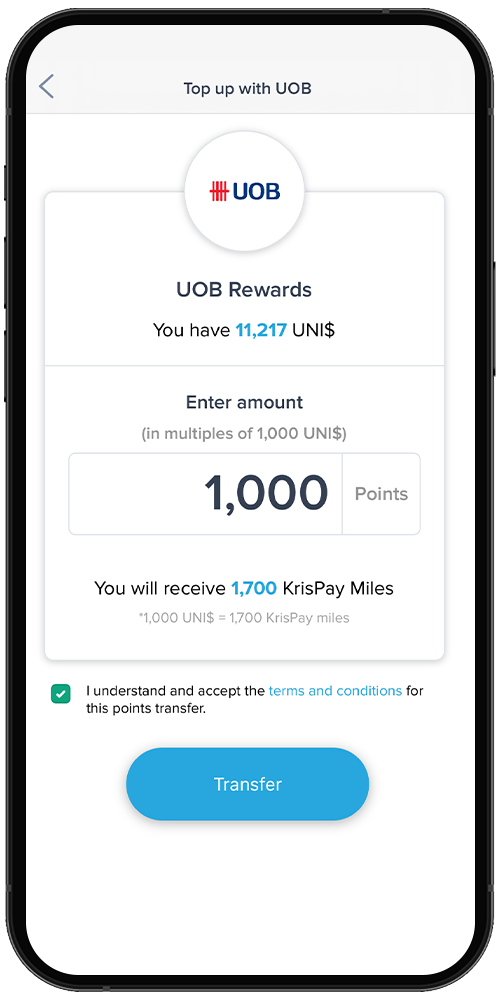
The catch is a 15% haircut compared with a normal transfer, which effectively cuts the card’s 4 mpd bonus rate to 3.4 mpd.
Two rules to remember:
- Move the KrisPay miles into KrisFlyer within 21 days
- Don’t spend any of them in Kris+ first, or the whole batch gets stuck there and then expires six months later if unused
It’s best kept for topping up a balance for a specific redemption, or clearing out a small leftover balance you won’t add to.
What else can UNI$ be used for?
UNI$ can also be redeemed for cash rebates and vouchers through Rewards+ in the UOB TMRW app, but these typically value each UNI$ at around 1 cent.
Transferred to KrisFlyer or Asia Miles, the same UNI$ is worth two miles, or around 3.6 cents at typical valuations, so miles are the better choice by a wide margin.
You can also use UNI$ to pay on the spot at participating merchants, though at similarly poor value.
Pairing with other UOB cards
Because UNI$ pool across all your UOB cards, the Lady’s Card fits neatly alongside the UOB Preferred Visa. The Preferred Visa covers mobile contactless and selected online spend at 4 mpd, while the Lady’s covers your chosen category. All the UNI$ go into one pot.
That helps you reach UOB’s UNI$5,000 transfer blocks sooner, and you only pay the S$27 conversion fee once.
Terms and conditions
Here are links to the full terms and conditions applicable to the UOB Lady’s Cards, the Lady’s Savings Account bonus and the UOB Rewards Programme.
- UOB Lady’s Cards T&Cs
- UOB Lady’s Savings Account Rewards Program T&Cs
- UOB Rewards Programme T&Cs
- Lady’s Solitaire Travel Insurance T&Cs
Our Summary
The UOB Lady’s Cards are the only 4 mpd cards in Singapore that let you choose where your bonus applies. They also cover spend that’s notoriously hard to earn 4 mpd on elsewhere, including supermarkets, petrol and airline or hotel bookings made direct, with the freedom to switch each quarter as your spending changes.
They’re also unusually forgiving for a UOB card. Calculating the bonus on your monthly total means small purchases barely suffer from UOB’s S$5 blocks, and a S$10,000 balance in a Lady’s Savings Account lifts the rate to 6 mpd, a very worthwhile return if you max out the cap.
Be careful not to get carried away with the savings tiers, though. Beyond that first S$10,000, the extra miles are a poor substitute for interest you could earn elsewhere.
The card is less forgiving in other ways. Anything outside your category earns a meagre 0.4 mpd, the categories are policed strictly by merchant code, UNI$ still expire after two years with only two useful transfer partners, and UOB will help itself to your points at renewal unless you intervene.
For most readers, the entry-level Lady’s Card is the one to get. Since August 2025, its S$1,000 single-category cap beats the Solitaire’s S$750 for anyone with one dominant spend category. The Solitaire only makes sense if you’ll fill two categories every month.
Pick the category where you’ll reliably spend S$1,000 a month, plan your switches a quarter ahead, and this card will earn its place in your wallet.
| Our Rating | ||||||||||||||||||||
| 3.5 / 5 among 4 mpd bonus cards |
||||||||||||||||||||
|
UOB Lady’s Cards |
||||||||||||||||||||
How we rate credit cards
|
||||||||||||||||||||