
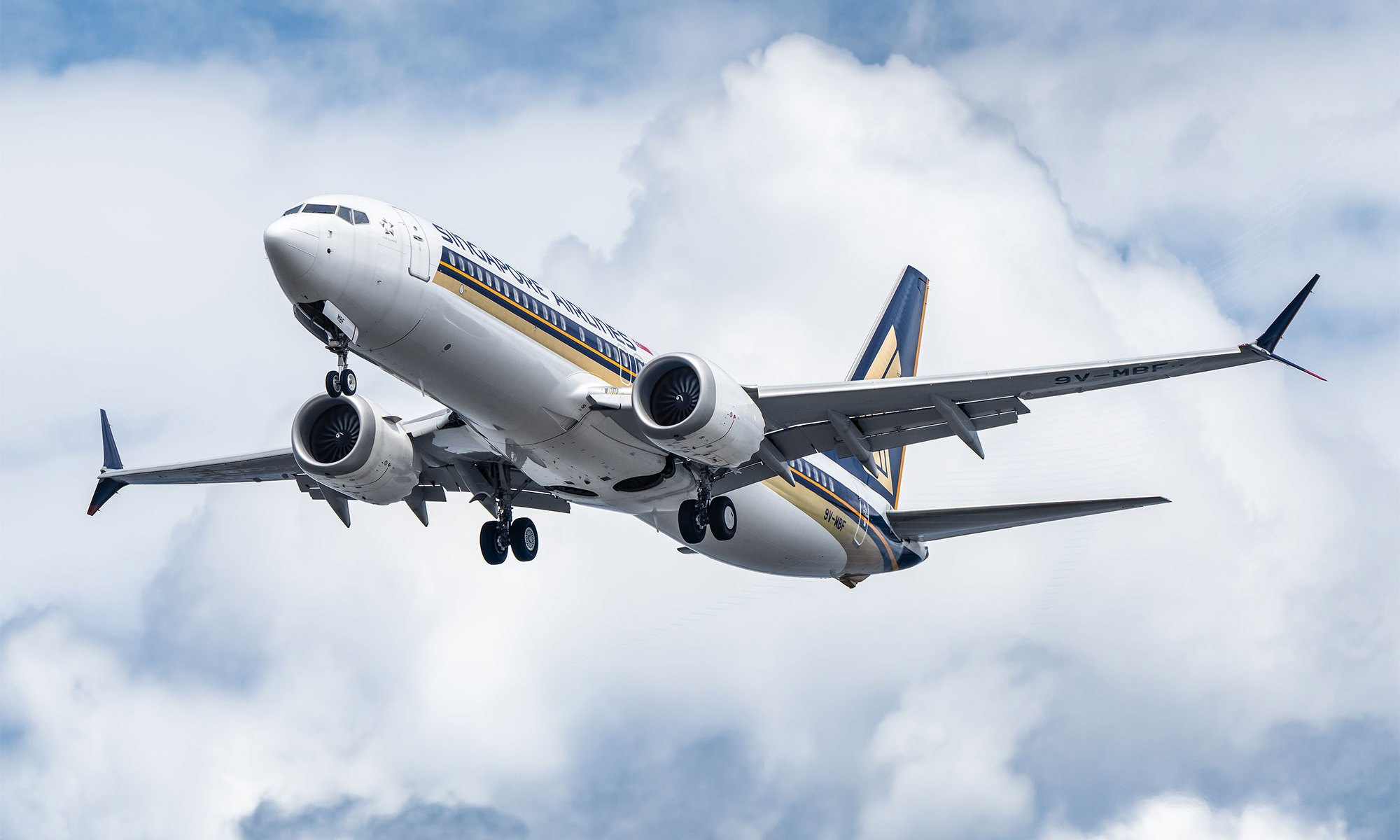

Singapore Airlines will operate three of its six daily Singapore – Bali flights with the narrow-body Boeing 737-8 MAX from late October 2026, and will even drop back to five daily services for more than half of the northern winter season.
Combined, it makes for the biggest capacity reduction the route has seen in years, and hands the airline’s least popular cabin products to half the timings on one of its busiest leisure city pairs.
Right now, throughout the northern summer 2026 season, all six of SIA’s daily Bali flights operate with the 337-seat Boeing 787-10, the carrier’s highest capacity aircraft after the Airbus A380. From 25th October 2026, that becomes three 787-10s and three 154-seat Boeing 737-8 MAXs, with some gaps in the schedule on top.
It’s worth remembering that six daily Bali flights is itself a relatively recent hike for the airline – the sixth rotation only joined the schedule in July 2023.
What’s changing
Three Bali rotations move to the MAX for the full northern winter 2026/27 season, running from 25th October 2026 to 27th March 2027:
- SQ934/935: Boeing 787-10 to Boeing 737-8 MAX
- SQ946/947: Boeing 787-10 to Boeing 737-8 MAX
- SQ948/949: Boeing 787-10 to Boeing 737-8 MAX
The SQ948/949 rotation is the one that was added as the route’s sixth daily service in July 2023, and it launched on the Boeing 737-8 MAX, so it’s simply going back to the aircraft it started with.
The route’s remaining three rotations – SQ936/937, SQ938/939 and SQ944/945 – stay on the Boeing 787-10, but each drops out of the schedule entirely for a three-week block during the season.
The schedule
Here’s how the schedule looks on SIA’s Bali route this winter, including aircraft types used.

| Singapore Bali 25th October 2026 – 27th March 2027 |
||||
| Flight | Depart SIN |
Arrive DPS |
Aircraft | Dates |
 SQ934 SQ934 |
06:45 | 09:30 | 737-8 MAX | All |
| SQ936 |
08:20 | 11:05 | 787-10 | All except 25 Oct – 14 Nov |
| SQ938 |
09:15 | 12:05 | 787-10 | All except 15 Nov – 5 Dec |
| SQ944 |
15:50 | 18:45 | 787-10 | All except 18 Jan – 6 Feb |
| SQ946 |
17:40 | 20:40 | 737-8 MAX | All except 21 Feb – 13 Mar |
| SQ948 |
21:30 | 00:25* | 737-8 MAX | All |
* Next day
| Bali Singapore 25th October 2026 – 27th March 2027 |
||||
| Flight | Depart DPS |
Arrive SIN |
Aircraft | Dates |
| SQ949^ |
07:20 | 10:10 | 737-8 MAX | All |
| SQ935 |
10:30 | 13:10 | 737-8 MAX | All |
| SQ937 |
12:15 | 15:20 | 787-10 | All except 25 Oct – 14 Nov |
| SQ939 |
13:20 | 16:05 | 787-10 | All except 15 Nov – 5 Dec |
| SQ945 |
19:55 | 22:40 | 787-10 | All except 18 Jan – 6 Feb |
| SQ947 |
21:30 | 00:20* | 737-8 MAX | All except 21 Feb – 13 Mar |
^ SQ949: 26th October 2026 – 28th March 2027
* Next day
On the timing side, the MAX takes both evening departures from Singapore, the 17:40 SQ946 and the 21:30 SQ948. That means from 25th October there’s no wide-body option after 15:50 for those looking to maximise a trip while also minimising annual leave by flying at the end of a work day.
In the other direction the last flight home, SQ947 at 21:30, is also a MAX, as are the two morning departures from Bali.
That’s awkward for the classic Singapore weekend in Bali – out on Friday evening, back late on Sunday – you’ll be on the narrow-body in both directions.

(Photo: Shutterstock)
Five daily for more than half the season
Shifting several flights to the Boeing 737-8 MAX is only half the story for SIA’s Bali route this winter. On top of the downgauge, the route drops from six to five daily flights across three separate blocks:
- 25th October – 5th December 2026 (42 days)
- 18th January – 6th February 2027 (20 days)
- 21st February – 13th March 2027 (21 days)
That’s 83 days of the 154-day season running at five daily rather than six, or 54% of the winter. Put another way, the full six-times-daily schedule the route is advertised as having only actually operates on 71 days between late October and late March.
Across the season, SIA will operate 841 flights each way, down from 924 last winter – 83 fewer departures.
Capacity down more than 20%
Adding it all up, Singapore Airlines will offer 202,714 seats in each direction on the Bali route across the northern winter 2026/27 season, against 258,193 seats across the equivalent 154-day winter season a year earlier.
| Singapore – Bali Winter Season Capacity (each way) |
|||
| NW25/26 | NW26/27 | Change | |
| Flights | 924 | 841 | 9% |
| Total seats | 258,193 | 202,714 | 21% |
| Business Class seats | 28,638 | 18,810 | 34% |
| Economy Class seats | 229,555 | 183,904 | 20% |
| Average seats per flight | 279 | 241 | 14% |
| 737-8 MAX flights | 25% | 52% | – |
Business Class takes the hardest hit.
The 737 MAX carries just 10 seats up front, against 36 on the Boeing 787-10, so tripling MAX operation on the route strips out a third of the winter’s premium cabin capacity – nearly 10,000 fewer Business Class seats each way across the season.
The comparison against what’s flying today is starker still.
Through the current summer schedule the route offers 2,022 seats and 216 Business Class seats each way every day. Across the coming winter, it averages out at roughly 1,316 seats and 122 Business Class seats a day – a 35% reduction overall, and a 43% reduction in Business Class.
More than half of all Bali departures – 441 of the 841 flights – will be operated by the narrow-body, up from a quarter of departures last winter.
The six-daily era has been a short one
When we reported the arrival of the sixth daily Bali flight in March 2023, it was the airline’s highest ever capacity to the island – 11,592 seats a week in each direction from July that year, an 18% increase on the 9,800 weekly seats Singapore Airlines and SilkAir offered between them in January 2020, before COVID.
That new sixth service was SQ948/949, and it was launched with the Boeing 737-8 MAX and deliberately awkward timings – a 9.20pm departure from Singapore for a midnight arrival in Bali, returning at 7.20am – designed to pick up long-haul connections rather than short-trip travellers from Singapore.
Capacity kept climbing from there, and today’s all-787-10 summer schedule represents the route’s highest ever capacity at 14,154 weekly seats each way.
The coming winter takes a sizeable step back from that.
| Singapore – Bali SIA Weekly Seats (each way) |
|
| Period | Seats per week |
| January 2020 Pre-COVID, SQ + SilkAir |
9,800 |
| July 2023 Sixth daily flight added |
11,592 |
| Now (NS26) 6x daily 787-10 |
14,154 |
| NW26/27 Season average |
~9,214 |
Averaged across the winter, SIA will be offering around 9,200 seats a week each way – roughly 20% below the level it hit when the sixth daily flight was introduced three years ago, and around 6% below what Singapore Airlines and SilkAir were between them flying to Bali in January 2020.
A poorer passenger experience
For our readers, the cabin product is the biggest impact of this change.
Passengers on SQ934/935, SQ946/947 and SQ948/949 currently enjoy the far more spacious Boeing 787-10, with direct aisle access from every Business Class seat and better legroom in Economy.


From late October, all three rotations shift to a narrow-body cabin that falls short in almost every category. Here’s a summary of the key differences to be aware of.
| SIA’s 787-10 vs. 737-8 MAX | ||
| Feature | Boeing 787-10 | Boeing 737-8 MAX |
| Business Seats |
36 seats 1-2-1 layout all aisle access 20″ – 26″ width |
10 seats 2-2, 1-1, 2-2 layout No direct aisle access for 67% of window seats 19″ – 22″ width |
| Business IFE |
18″ HD screens Free Wi-Fi Live TV |
16″ HD screens Free Wi-Fi Live TV |
| Economy Seats |
301 seats 32″ pitch 17.5″ width 5″ recline |
144 seats 30″ pitch 17.7″ width 5″ recline |
| Economy IFE |
11.6″ HD screens Free Wi-Fi Live TV |
10″ HD screens Free Wi-Fi Live TV |
| Economy Charging |
1 x USB-A socket Shared UNI AC socket |
1 x USB-A socket |
The key advantage of the Boeing 787-10 is that all Business Class passengers have direct aisle access – unlike the MAX’s awkward 2-2, 1-1, 2-2 configuration, where two-thirds of window passengers (those in 11A/K or 14A/K) must disturb their neighbours to reach the aisle.

(Image: aeroLOPA)
The two solo seats (12B and 12J) are the clear exceptions, offering excellent space and privacy – but with only two available per flight, and advance selection reserved for PPS Club members until 96 hours before departure, good luck securing one.

(Photo: MainlyMiles)
Couples can probably worry less, provided they can secure either a ‘throne’ seat each (12B and 12J), or one of the pair arrangements.
Additionally, the MAX offers smaller entertainment screens in both cabins, and provides less legroom and more limited device charging options in Economy.
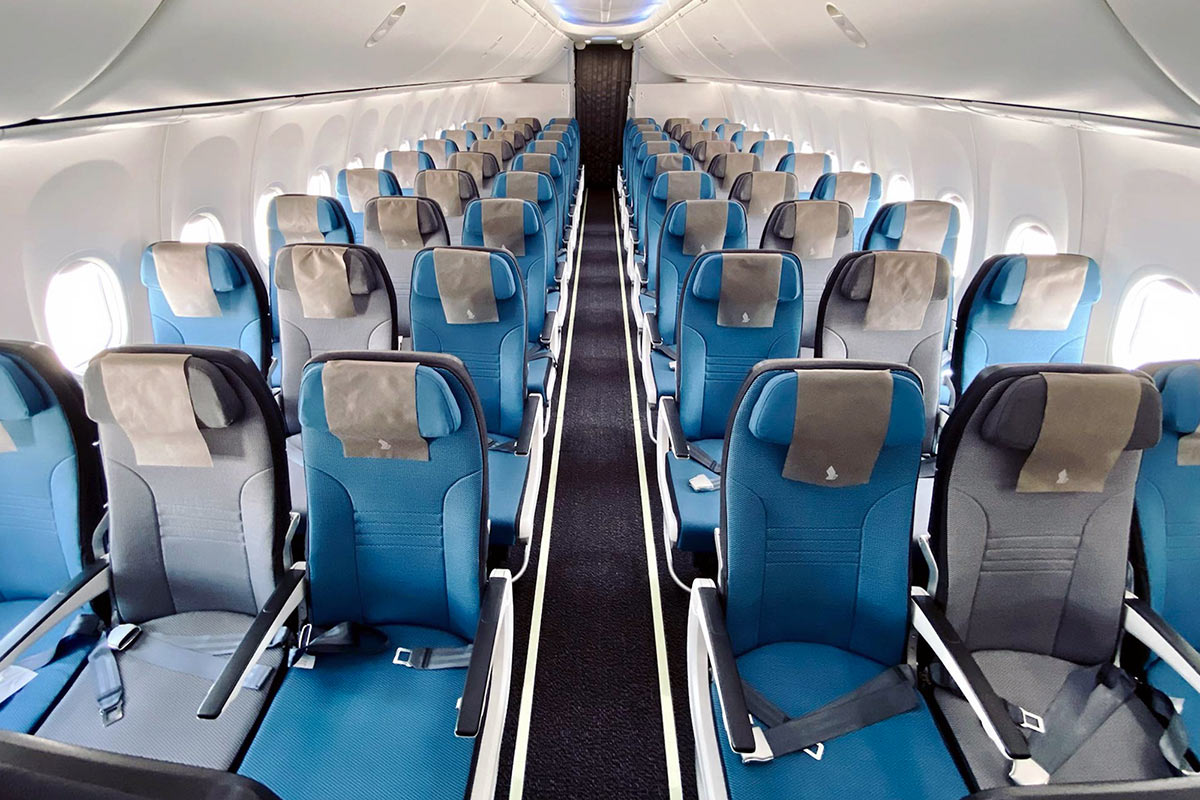
(Photo: MainlyMiles)
Seats do at least convert into fully flat beds, now guaranteed in Business Class on all SIA flights network-wide.
Here are our dedicated articles covering SIA’s Boeing 737 MAX cabins, to help you know what to expect on board these less popular aircraft.


You can always check which aircraft type and Business Class seat model Singapore Airlines plans to operate network-wide in our continually-updated Business seats by route guide.
Why the downgauge?
The short answer is probably that Singapore Airlines now simply has more MAXs and no more wide-bodies.
As we reported in May, the carrier’s long-haul fleet is shrinking for the first time in six years, with the Boeing 737-8 MAX its sole new aircraft type arriving this financial year. Five deliveries will take the narrow-body fleet from 21 to 26 aircraft, a 24% increase in a single year, as SIA finally begins the last push towards its 29-strong order after years of Boeing production delays.
Those aircraft have to fly somewhere, and the natural home for them is the regional network of one to six hour sectors. Bali, at around 2 hours 45 minutes, sits comfortably in the middle of that band.
It’s a pattern repeating across the map. In June we reported that the MAX would serve Manila for the first time from August 2026, while Cairns goes daily from December 2026 downgauging from the Airbus A350 MH to the narrow-body in the process.
KrisFlyer awards
Bali has historically been one of the more redeemable routes in the KrisFlyer programme, helped by six daily wide-body flights and regular appearances on the monthly Spontaneous Escapes list.
With a third of the winter’s Business Class seats removed, and three of the six timings offering just 10 seats up front, Saver space in the front cabin will be considerably harder to find between late October and late March.
Most of those 10 seats are also likely to be taken by long-haul connecting passengers arriving from Europe, the USA and Australia, potentially leaving very little to release as award inventory.

| KrisFlyer Redemption Rates One-Way Singapore ⇄ Bali |
||||
| Airline / Cabin | Saver | Advantage | Access | |
 |
Economy | 8,000 |
16,500 |
23,500 |
|
Business | 22,000 |
40,500 |
52,500 to 83,500 |
 |
Economy | 4,500 |
9,000 |
n/a |
Taxes and fees on this route come in at around S$65 in the Singapore – Bali direction and S$17 in the Bali – Singapore direction, though do note that you’ll also be hit with Singapore’s new SAF Tax for bookings made from 1st October 2026 for travel on or after 1st January 2027.
Bali does occasionally appear on SIA’s monthly Spontaneous Escapes list, with 30% off Saver awards.
This brings one-way redemption rates down to 15,400 miles in Business Class and 5,600 miles in Economy Class.
If you’re set on redeeming in Business Class, the three continuing Boeing 787-10 rotations – SQ936/937, SQ938/939 and SQ944/945 – are where you’ll want to look first, bearing in mind each of those has a three-week gap in the season.
PPS Club members retain slightly better access thanks to additional award inventory, and remain the only passengers able to lock in those solo ‘throne’ seats on the 737 MAX in advance.
If you already hold or intend to book a firm ticket in an eligible Economy booking class, here’s how many miles it will then cost you to upgrade to Business Class on this route, assuming Saver upgrade award availability.
| Upgrade using KrisFlyer miles Singapore ⇄ Bali |
|
| Upgrading to → |  Business Saver |
| Existing booking ↓ | |
| Economy Standard (Class: M, H, W) |
18,000 |
| Economy Flexi (Class: Y, B, E) |
16,500 |
As usual, upgrading with miles is not a great deal, unless perhaps your company is paying for an Economy fare on your behalf!
Wide-bodies return for summer 2027
Thankfully there is good news if you’re planning a Bali trip further ahead, with currently published schedules showing SIA’s Singapore – Bali schedule returning to six daily Boeing 787-10 flights from 28th March 2027, restoring the route to full wide-body operation and the same capacity it offers today.
That fits the pattern we saw last year, with SIA deploying its largest regional aircraft during Bali’s peak northern summer season, when European and North American visitors arrive in the dry season and premium demand is at its highest, then dials capacity back over the quieter winter months.
As always though, summer season aircraft allocations remain provisional at this stage. SIA typically finalises them in December or January, and what’s loaded today isn’t always what actually flies when the schedule is so far into the future.
Summary
Singapore Airlines is shifting half its Bali flights to the Boeing 737-8 MAX from late October 2026 – SQ934/935, SQ946/947 and SQ948/949 – while also trimming the route to five daily flights for 83 days of the 154-day winter season.
Total seat capacity falls by 21% compared with last winter, and by around 35% against what’s flying today, with Business Class capacity down by a third across the season. Averaged over the winter, the airline will be offering slightly fewer weekly seats to Bali than it and SilkAir managed between them before COVID – on a route that only reached six daily flights in July 2023.
For Economy passengers on a short three-hour hop, the MAX is perfectly ok, if a little tighter. For anyone hoping for a flat bed with direct aisle access – or a Saver award in Business Class – the three continuing Boeing 787-10 rotations are the ones to aim for, and they’ll no doubt be in higher demand than ever.
Wide-body service returns across the board from late March 2027, provisionally at least.
(Cover Photo: Plane’s Portrait Aviation Media / Malcolm Lu)